
 princeevee:
is this correct?
 princeevee:
@Vocaloid
 Vocaloid:
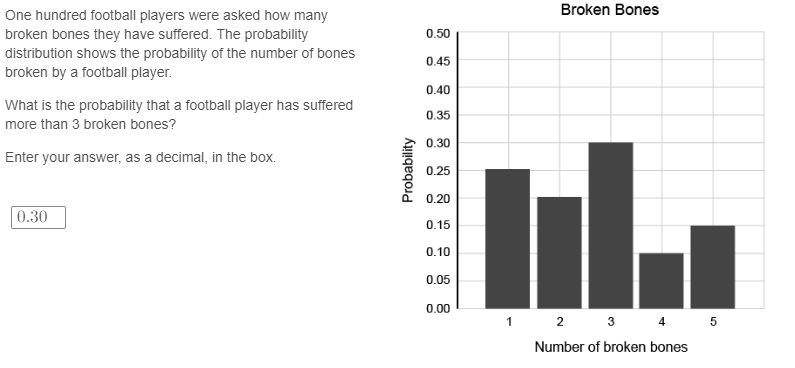
not quite "more than 3" means 4 bones and 5 bones only
princeevee:
4.5?
Vocaloid:
nope
Vocaloid:
look at the graph
Vocaloid:
how many people broke 4 bones? how many people broke 5 bones?
princeevee:
0.10 and 0.15
Vocaloid:
good now add them together
princeevee:
0.25
Vocaloid:
good that's your answer
 princeevee:
@Vocaloid
Vocaloid:
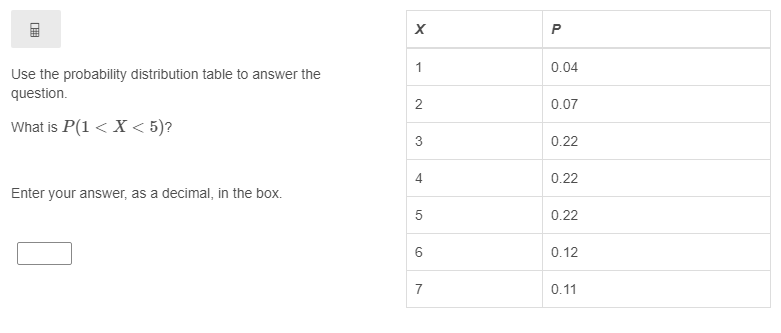
1 < X < 5 in this case means X = 2,3,4 so add up the probabilities for 2, 3, and 4
Vocaloid:
still there?
princeevee:
yeah
Vocaloid:
what did you get?
princeevee:
0.51
Vocaloid:
good that's your answer
 princeevee:
@Vocaloid
Vocaloid:
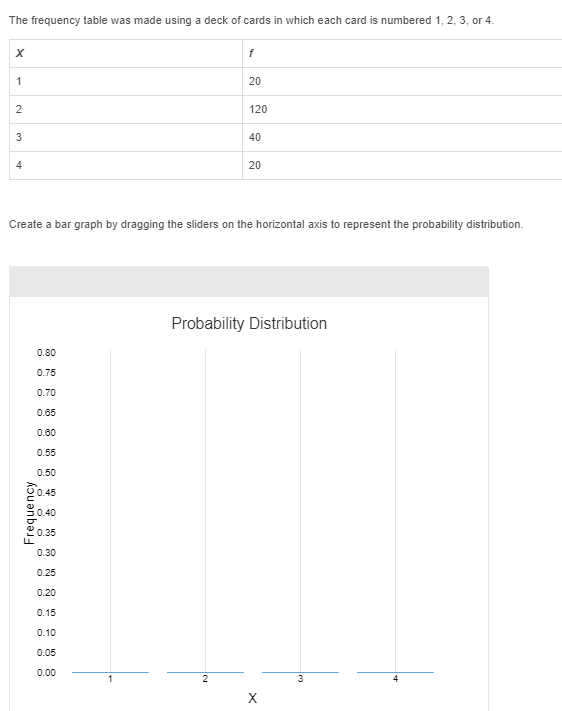
first step: add all the frequencies together 20 + 120 + 40 +20 = ?
princeevee:
128
Vocaloid:
check your math again, your answer should be a multiple of 10
Vocaloid:
20 + 120 = ?
princeevee:
140
Vocaloid:
good and 140 + 40 + 20 =?
princeevee:
200
Vocaloid:
good now you want to calculate the probability distribution for x = 1,2,3,4 as decimals
Vocaloid:
20/200 = ? 120/200 =? 40/200 =? 20/200 =?
princeevee:
0.1, 0.6 ,0.2, 0.1
Vocaloid:
good, those are the numbers you want to put as the heights of the bars so the first bar should be 0.1, second should be 0.6, etc. and that's your answer
princeevee:
they only go by fifth's like 0,5 to 0,10
Vocaloid:
0.1 = 0.10 0.6 = 0.60 0.2 = 0.20 0.1 = 0.10 those marks should be on the bars
princeevee:
ok then
 Vocaloid:
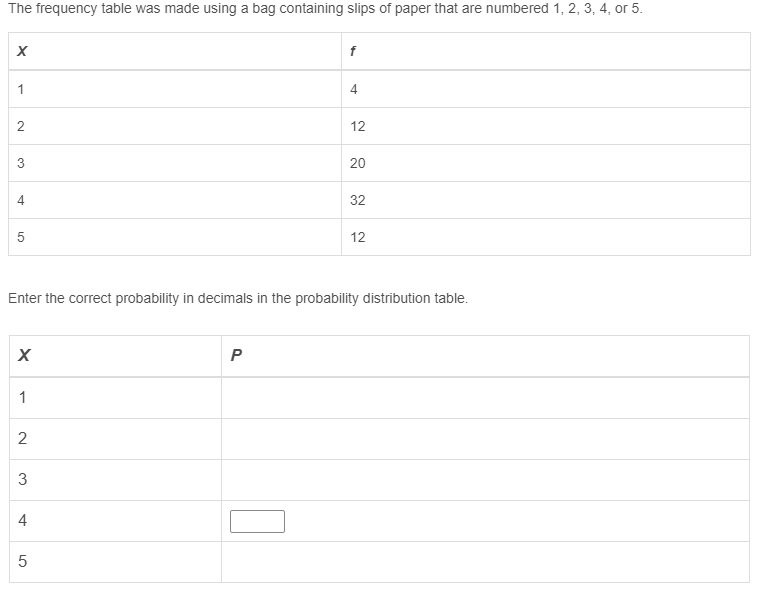
same thing as before, add up the frequencies 4 + 12 + 20 + 32 + 12 = ?
princeevee:
80
Vocaloid:
good now we calculate the probabilities 4/80 =? 12/80=? 20/80=? 32/80=? 12/80=?
princeevee:
0.4 for the fourth one, thats the only one i need
Vocaloid:
oh ok, then yes, 0.4 is it
 Vocaloid:
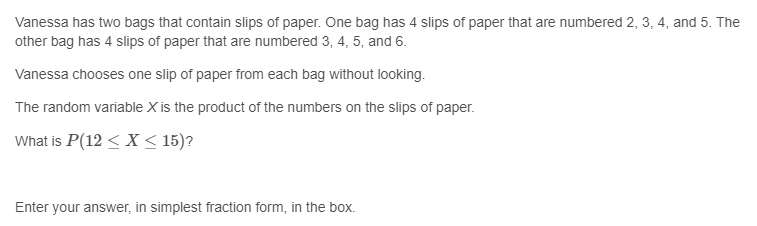
hm I forgot the shortcut method for this so I would just multiply the numbers and find the 16 possible products (sorry ;_:)
Vocaloid:
2*3 = ? 2*4 = ? 2*5 = ? 2*6 = ?
princeevee:
6,8,10,12
Vocaloid:
good 3*3 = ? 3*4 = ? 3*5 = ? 3*6 = ?
princeevee:
9,12,15,18
Vocaloid:
good 4*3 = ? 4*4 = ? 4*5 = ? 4*6 = ?
Vocaloid:
still there?
princeevee:
yeah, hang on
princeevee:
12,16,20,24
Vocaloid:
good, one more set of problems 5*3 = ? 5*4 = ? 5*5 = ? 5*6 = ?
Vocaloid:
good, now let's look over all the numbers we wrote 6,8,10,12 9,12,15,18 12,16,20,24 15,20,25,30 we have 5 numbers that are between 12 and 15 so I believe 5/16 would be our answer
princeevee:
A veterinarian is using a new vaccine for cats. The vaccine has a 10% probability of causing side effects. In which distributions does the variable X have a binomial distribution? Select each correct answer. When the vaccine is given to three cats, X is the number of cats that have side effects. When the vaccine is given to six cats, X is the number of cats that do not have any side effects. When the vaccine is given to multiple cats, X is the total number of cats that receive the vaccine. When the vaccine is given to multiple cats, X is the number of cats that receive the vaccine until one of them has side effects.
princeevee:
woah, that shouldnt be big...
Vocaloid:
since there are two outcomes for each cat (side effects vs. no) I believe it would just be the first two choices
 Vocaloid:
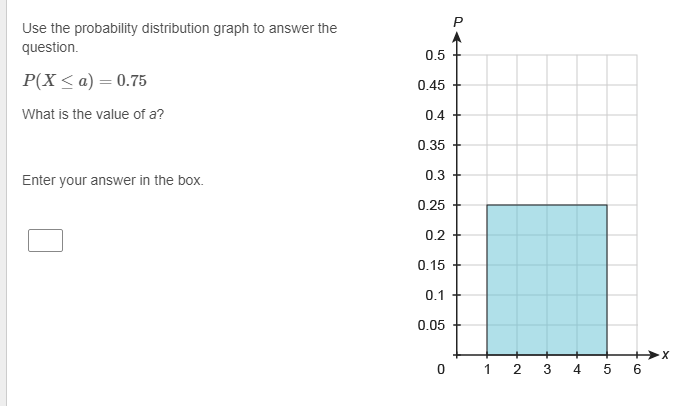
hint: 75% of the data is below what value on the x-axis?
princeevee:
5?
Vocaloid:
not quite. 100% of the data is below 5 since the entire blue bar is below 5 what about 75% of the data? if you cut vertically through the boundary between the bottom 75% of the data and the top 25% what number do you hit on the x-axis?
Vocaloid:
like this:
Vocaloid:
|dw:1503950638522:dw|
princeevee:
4
Vocaloid:
good so your answer is 4
 Vocaloid:
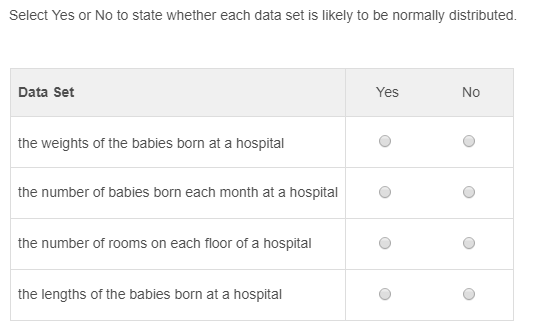
I'm not 100% sure but things that occur in nature tend to be normally distributed so heights and weights definitely yes, and number of rooms definitely not. I'm not sure about number of babies born but I would say yes.
princeevee:
The heights of the peach trees in an orchard are normally distributed with a mean of 12.5 feet and a standard deviation of 1.8 feet. What is the height of a peach tree with a z-score of −0.5−0.5 ? Enter your answer, rounded to the nearest tenth, in the box.
Vocaloid:
-0.5 = (height-mean)/standard deviation solve for height
princeevee:
hmm...
princeevee:
this is tricky
Vocaloid:
take the numbers from the problem and plug them into the equation
Vocaloid:
-0.5 = (height-mean)/standard deviation -0.5 = (height-12.5)/1.8 height = ?
princeevee:
i still dont get it...
princeevee:
yeah, im still stumped
Vocaloid:
multiply both sides by 1.8
Vocaloid:
-0.5*1.8 = height-12.5 height = ?
princeevee:
-0.9?
Vocaloid:
getting there
Vocaloid:
-0.9 = height - 12.5 height = ?
princeevee:
2.6?
Vocaloid:
-0.9 + 12.5 = ?
princeevee:
11.6
Vocaloid:
good that's it
Vocaloid:
wait
Vocaloid:
is it actually written as "−0.5−0.5 ?" as the z-score?
Vocaloid:
in that case you would re-do the calculation with the z-score as -1
Vocaloid:
-1 = (height - 12.5)/1.8 height = ?
princeevee:
11.6?
Vocaloid:
no, I said to re-do the calculation with z-score = -1 not -0.5 again, multiply both sides by 1.8
Vocaloid:
-1 = (height - 12.5)/1.8 -1.8 = height - 12.5 height = ?
Vocaloid:
@princeevee are you still there?
princeevee:
yeah
Vocaloid:
-1.8 = height - 12.5 height = ?
Vocaloid:
you are just solving for an unknown variable
princeevee:
11.3?
Vocaloid:
how do we get "height" by itself if we have "height - 12.5" on the right side?
princeevee:
we add the left then minus the ammount
Vocaloid:
???
Vocaloid:
what is the "opposite" of subtraction?
princeevee:
we add -1.8 to 12.5 then minus it
Vocaloid:
Forget -1.8 for a minute
Vocaloid:
if we have height - 12.5 how do we get "height" by itself?
Vocaloid:
what is the "opposite" of subtracting 12.5?
princeevee:
adding.
Vocaloid:
good, so if we have "height - 12.5" we can do the opposite of - 12.5 and add 12.5 to get height - 12.5 + 12.5 = height make sense?
princeevee:
25.0
Vocaloid:
no
Vocaloid:
height - 12.5 + 12.5 = height make sense?
princeevee:
yeah
Vocaloid:
so if we add 12.5 on one side we must add 12.5 on the other side
princeevee:
ok
Vocaloid:
-1.8 + 12.5 = height = ?
princeevee:
10.7 is what i got
Vocaloid:
good, that should be your answer
princeevee:
Use technology or a z-distribution table to find the indicated area. The masses of the eggs collected on a farm are normally distributed with a mean of 55 grams and a standard deviation of 4.2 grams. Approximately 80% of the eggs on the farm have a mass greater than which mass? 51.5 g 54.1 g 55.8 g 58.5 g
Vocaloid:
I used my calculator to find the z-square value corresponding to 80% which is 0.842 (InvNorm) so let's solve: 0.842 = (x-mean)/standard deviation let me know if you are having trouble
princeevee:
lets see....
princeevee:
i tried doing it and i got C, is that right?
Vocaloid:
0.842 = (x-mean)/standard deviation 0.842 = (x - 55)/4.2 x = ?
princeevee:
hmm...
Vocaloid:
multiply both sides by 4.2
Vocaloid:
0.842*4.2 = (x - 55)
Vocaloid:
x = ?
princeevee:
3.5364
Vocaloid:
if we have x - 55 how can we get "x" by itself?
princeevee:
...
Vocaloid:
what's the opposite of subtracting 55?
princeevee:
adding
Vocaloid:
adding what number?
princeevee:
...
Vocaloid:
if we have a hole that is 55 feet deep, then how much dirt do we have to add to fill up the hole?
princeevee:
do you take me as an idiot?
Vocaloid:
no
princeevee:
kinda sounds like you do
Vocaloid:
I'm sorry I was just losing my temper
princeevee:
i can just do these myself
Join our real-time social learning platform and learn together with your friends!
 DoltonCarlee:
what are y'all's options on S A T essays because honestly their not that bad
DoltonCarlee:
what are y'all's options on S A T essays because honestly their not that bad

 thereneelg:
Can someone give me a summary of article 231, The war guilt clause?? I need to explain what it is, but I can't find any shortened version of what it is and
thereneelg:
Can someone give me a summary of article 231, The war guilt clause?? I need to explain what it is, but I can't find any shortened version of what it is and
 luisaam2:
What should you do when the person you want to talk to the most is the one making
luisaam2:
What should you do when the person you want to talk to the most is the one making
 Breathless:
https://medal.tv/games/roblox/clips/nAYivIl6oXB6q9QAI?invite=cr-MSxCSk4sMTY4OTA4N
Breathless:
https://medal.tv/games/roblox/clips/nAYivIl6oXB6q9QAI?invite=cr-MSxCSk4sMTY4OTA4N
 Twaylor:
I'm not that good at law can someone fact check this without bias? June 29, 2026, the Supreme Court decided Chatrie v.
Twaylor:
I'm not that good at law can someone fact check this without bias? June 29, 2026, the Supreme Court decided Chatrie v.
 Demon25:
For a hoco proposal with a cheerleader and football player, what else should be a
Demon25:
For a hoco proposal with a cheerleader and football player, what else should be a
