
 zarkam21:
Help
 Vocaloid:
|dw:1519771630989:dw|
Vocaloid:
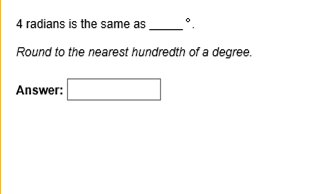
so to go from radians to degrees simply multiply by (180/pi)
zarkam21:
57.3
Vocaloid:
4 * 180/pi = ?
zarkam21:
229.18
Vocaloid:
good, that's it
 Vocaloid:
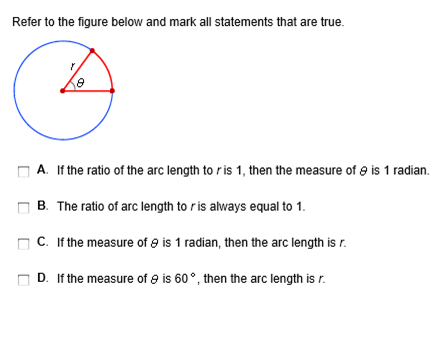
(important definition to remember: one radian is defined as the angle that makes the arc equal to the radius) with that being said, which two choices do you think might apply?
zarkam21:
A
Vocaloid:
good, anything else?
zarkam21:
b
Vocaloid:
Hm, that's not quite right, arc length/r is only equal to 1 in a very specific circumstance (angle = 1 radian)
zarkam21:
so c
Vocaloid:
good, A+C
 Vocaloid:
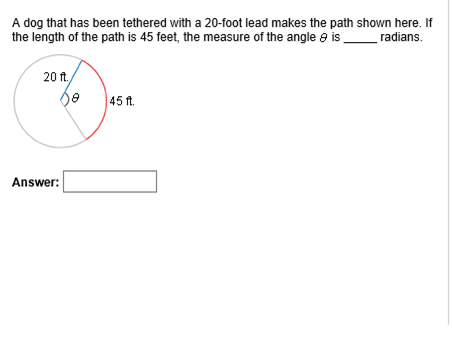
arc = radius * theta **** important: this only works if the angle is in radians, which it is here
zarkam21:
2.25
Vocaloid:
perfect
 Vocaloid:
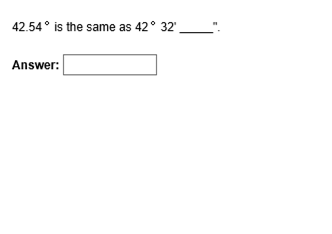
ok, so to convert from degrees to DMS (degrees/minutes/seconds) we leave the whole number part alone (42 degrees) then work on the 0.54 part we can multiply 0.54 by 60 to get 32.4, then we take the whole number part as 32 ' (32 minutes) and then multiply that decimal part again by 60 (so .4 * 60 ---> 24 seconds) so 24 seconds would recommend jotting these steps down
zarkam21:
so 24
Vocaloid:
yes
zarkam21:
should I label it like 24 seconds or only 24
Vocaloid:
the '' marks (seconds) are already given in the problem, so just 24
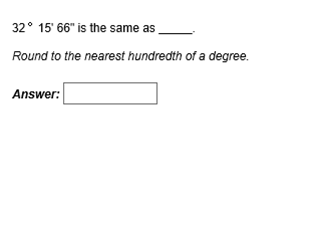 Vocaloid:
converting from DMS to degrees degrees + (1/60)*minutes + (1/3600)*seconds take your degrees, minutes, and seconds values from the original (32deg 15 min 66 seconds)
zarkam21:
(1/60)*15 + (1/3600)*66= 0.27
Vocaloid:
don't forget to add the original 32 degrees
zarkam21:
59
Vocaloid:
32 + 0.27 = ?
zarkam21:
32.27
Vocaloid:
good, that's your ans
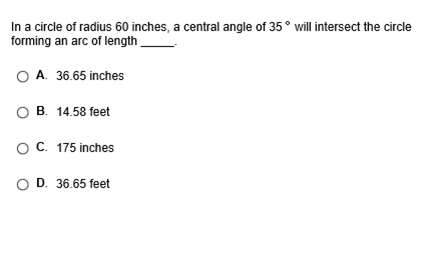 zarkam21:
A?
Vocaloid:
arc = radius * theta since the angle is in degrees first you need to convert theta to radians first
Vocaloid:
oh yeah I got A too gj
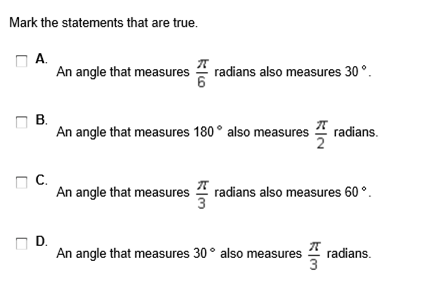 zarkam21:
B and D
Vocaloid:
you kinda just have to do the conversions and see which ones are correct
Vocaloid:
I think you're missing at least one
Vocaloid:
also, for B, 180 degrees is pi radians not pi/2 so not B
zarkam21:
C and D
Vocaloid:
30 degrees is pi/6 radians so not D
Vocaloid:
whicheliminateseverything except A + C = your answer
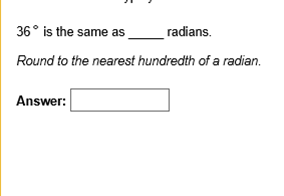 zarkam21:
0.628 radians
Vocaloid:
hundredth, so only 2 decimal places --> 0.63 = your ans
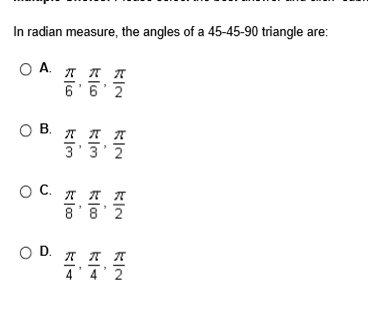 zarkam21:
C
Vocaloid:
try re-doing the 45 deg to radians conversion
zarkam21:
D
Vocaloid:
good
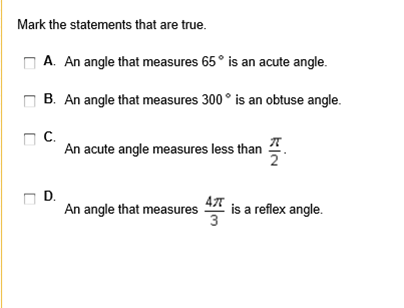 zarkam21:
c and b
Vocaloid:
some definitions to go over: acute angle = less than 90 degrees obtuse angle = between 90 and 180 reflex angle = 180-360 with this in mind try re-doing some of your calculations
zarkam21:
A and C
Vocaloid:
D still works (it's equal to 240) so ACD = your answer
Join our real-time social learning platform and learn together with your friends!
 KBaby:
Verse 1 We left our names in the dust of the driveway Watched the old town shrink
KBaby:
Lyrics Generator Use AI to write the lyrics for a song. Suggested Genres: Pop Hip
KBaby:
Verse 1 We left our names in the dust of the driveway Watched the old town shrink
KBaby:
Lyrics Generator Use AI to write the lyrics for a song. Suggested Genres: Pop Hip

 aitexturegenerator:
How are you all handling AI-generated textures for 3D models and game assets without losing the hand-made feel? I've been doing a small stylized environment
aitexturegenerator:
How are you all handling AI-generated textures for 3D models and game assets without losing the hand-made feel? I've been doing a small stylized environment

 Demon25:
Woke up feeling like that girl and that dude well he still aint crap pluse the du
Demon25:
Woke up feeling like that girl and that dude well he still aint crap pluse the du
 playtsec:
how do I get rid of stress from teachers... I just feel like running out the classroom and leaving on my own.
playtsec:
how do I get rid of stress from teachers... I just feel like running out the classroom and leaving on my own.
 JohnnyLFowler0812:
What type of gamer would play something and then get off for a while. Why not sta
JohnnyLFowler0812:
Which is better? Metallica Rap Country R&B hiphop Medal Gospel Chill Which 3 opti
JohnnyLFowler0812:
What type of gamer would play something and then get off for a while. Why not sta
JohnnyLFowler0812:
Which is better? Metallica Rap Country R&B hiphop Medal Gospel Chill Which 3 opti