
 lolokrat:
Help with Interpreting Quadratic Function Graphs?
 lolokrat:
@SmokeyBrown
 SmokeyBrown:
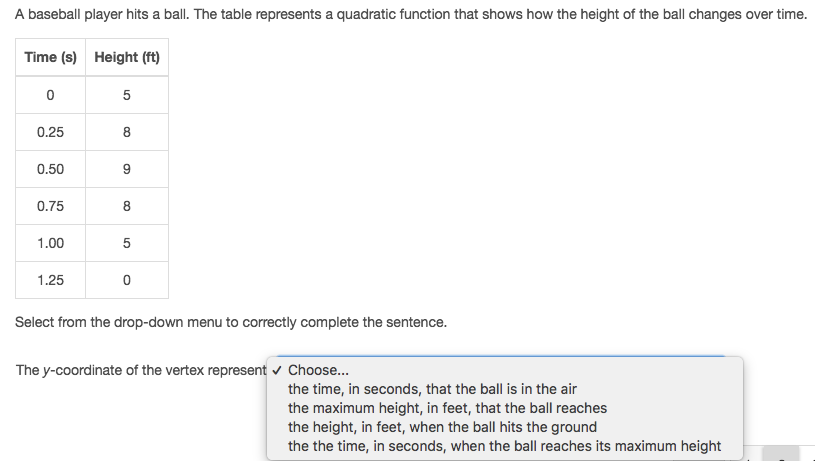
So the vertex of a quadratic function is the highest or lowest point of the curve, specifically where the curve changes direction. I'm assuming you'd be graphing this particular curve as time-by-height, with time in seconds on the x-axis and height in feet on the y-axis.
lolokrat:
so its C?
 Nnesha:
No need to graph to answer the the question. However, it will be a good practice.
lolokrat:
?
Nnesha:
(x-coordinate , y-coordinate ) first column in a table represents the x-coordinate (the values that go on x-axis), and the 2nd column represents the y-coordinate(values on y-axis)
lolokrat:
ok .
SmokeyBrown:
So the third choice, the height of the ball when it hits the ground, would be 0 ft, right? But if we look at the table, we'll see that the point that goes with this answer, (1.25, 0), doesn't fit the definition of a vertex. It is the lowest point on the graph, true, but the graph doesn't change direction (from increasing to decreasing or vice-versa) at this point. In fact, if we took the graph not literally and extended the equation past this point, we'd see that it continues to decrease even past 1.25 seconds. There's another point that is the actual vertex of the curve.
lolokrat:
im not understanding why you are bringing up the graphing if i thought it's just figuring out what x and y correlate to the answer choices?
SmokeyBrown:
So, you don't need a graph to find the answer, necessarily, but it does help visualizing the answer. Actually, you don't even need the exact values in the table to find the answer. Just know that the ball starts out increasing in height, then at some point, starts decreasing in height. Keeping in mind that the vertex is the point at which the graph, if we were to draw it, would start changing directions, this means the vertex is the point where the ball shifts from increasing to decreasing. And the y-coordinate to go along with this point represents... what? Well, we know y must represent a height, for starters.
lolokrat:
so if it represents height, is it B?
SmokeyBrown:
Yup, there you go.
lolokrat:
Thanks! can you help with 3 more?
SmokeyBrown:
Sure thing, I'll do my best.
 SmokeyBrown:
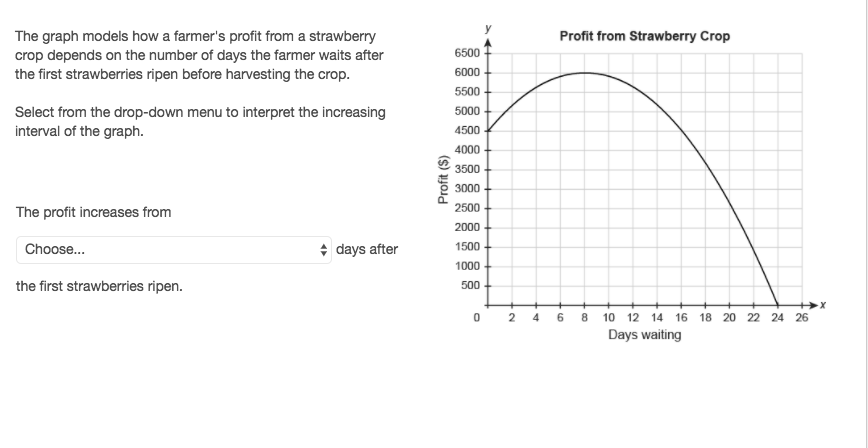
Ok, so I'm getting from the question that the strawberries bring in the most profit right after they ripen. So looking at the graph, we can find the point where profit (on the y-axis) is highest, and connect that to the right day (on the x-axis).
SmokeyBrown:
Ok, not quite. The strawberries are already ripe, and the graph shows how long the farmer should wait after the strawberries are ripe.
lolokrat:
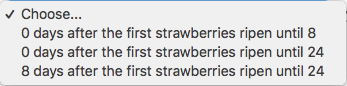
A? i see its increasing from 0-8 days then starts decreasing 8-24
SmokeyBrown:
Yup, exactly.
 SmokeyBrown:
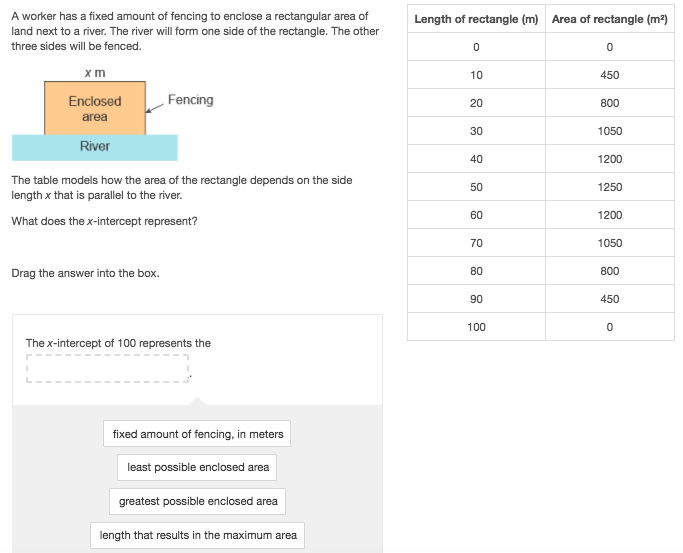
So this one is a little tricky, but we can use process of elimination to arrive at the right answer. From the diagram and table, we know that x represents the length of one side of the rectangle, so from that we can eliminate the two answers involving area. Now, between the remaining two answers, would you say the x-intercept of 100 represents the "fixed amount of fencing available" or the "length that results in the greatest area covered"?
lolokrat:
the "length that results in the greatest area covered"?
SmokeyBrown:
Not quite. If we look at the table, we'll see that a length of x=100 actually gives us an area of 0.
SmokeyBrown:
One way you could think of this is the following: When you use none of the fencing on a single length, of course the area is going to be 0. But if you use *all* of the fencing on a single length, the area is also 0.
lolokrat:
ohhhh, so its fixed amount of fencing available
SmokeyBrown:
Yup, that's right!
 SmokeyBrown:
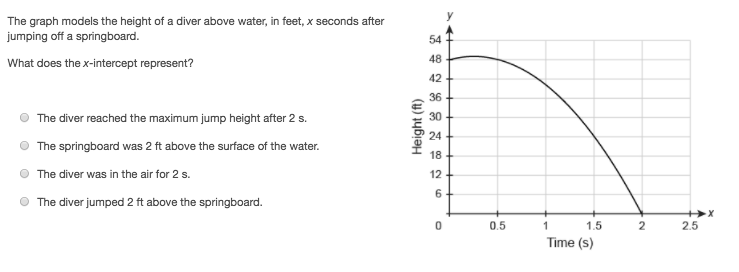
In this question, we're looking a the x-intercept. On the x-axis, we have time in seconds and on the y-axis we have height in feet. Since the question is about a diver, we can imagine that the curve represents the height of the diver, increasing slightly as she first jumps, before decreasing until two seconds. At this point, the diver presumably lands in the water and stops moving.
SmokeyBrown:
So, from this interpretation, would would the x-intercept, x=2, represent?
lolokrat:
2 seconds?
SmokeyBrown:
Yup, now, there are two answer options that involve 2 seconds. "The diver reached the maximum height at 2 seconds" and "The diver was in the air for 2 seconds"
lolokrat:
The diver was in the air for 2 seconds"?
SmokeyBrown:
Yup, I'd agree.
 SmokeyBrown:
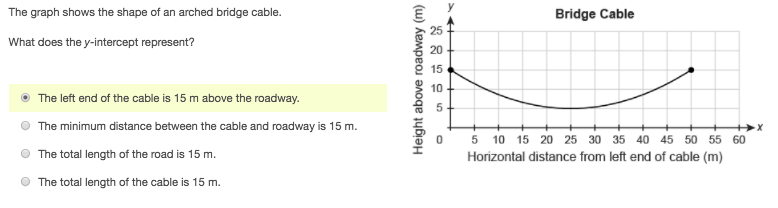
Yup, I don't see anything wrong with the answer you've chosen there.
lolokrat:
got them all right, thank you!
SmokeyBrown:
No problem. Congratulations!
lolokrat:
haha thank you
Join our real-time social learning platform and learn together with your friends!
 KBaby:
Verse 1 We left our names in the dust of the driveway Watched the old town shrink
KBaby:
Lyrics Generator Use AI to write the lyrics for a song. Suggested Genres: Pop Hip
KBaby:
Verse 1 We left our names in the dust of the driveway Watched the old town shrink
KBaby:
Lyrics Generator Use AI to write the lyrics for a song. Suggested Genres: Pop Hip

 aitexturegenerator:
How are you all handling AI-generated textures for 3D models and game assets without losing the hand-made feel? I've been doing a small stylized environment
aitexturegenerator:
How are you all handling AI-generated textures for 3D models and game assets without losing the hand-made feel? I've been doing a small stylized environment

 Demon25:
Woke up feeling like that girl and that dude well he still aint crap pluse the du
Demon25:
Woke up feeling like that girl and that dude well he still aint crap pluse the du
 playtsec:
how do I get rid of stress from teachers... I just feel like running out the classroom and leaving on my own.
playtsec:
how do I get rid of stress from teachers... I just feel like running out the classroom and leaving on my own.
 JohnnyLFowler0812:
What type of gamer would play something and then get off for a while. Why not sta
JohnnyLFowler0812:
Which is better? Metallica Rap Country R&B hiphop Medal Gospel Chill Which 3 opti
JohnnyLFowler0812:
What type of gamer would play something and then get off for a while. Why not sta
JohnnyLFowler0812:
Which is better? Metallica Rap Country R&B hiphop Medal Gospel Chill Which 3 opti