
 Pixel:
Check this?
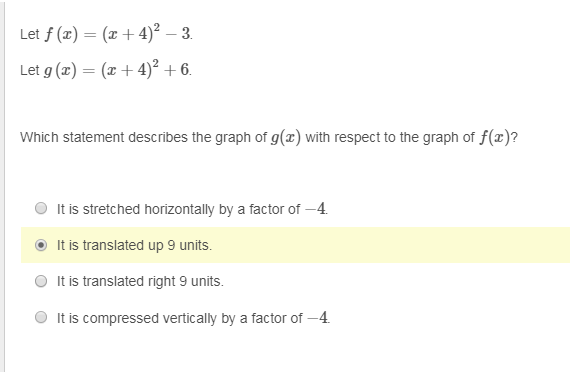 Pixel:
@Angle
 Angle:
perfect :)
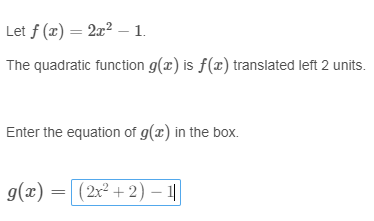 Pixel:
or is it -
Angle:
hmm I think the formula is set up more like this \(2(x - 0)^2 -1\) so the 2 in front of the x should not be in the parenthesis in your answer
Pixel:
-0?
Pixel:
oh
Pixel:
i see
Pixel:
x-0 = x
Angle:
yes, I was rewriting the original f(x) = ... equation
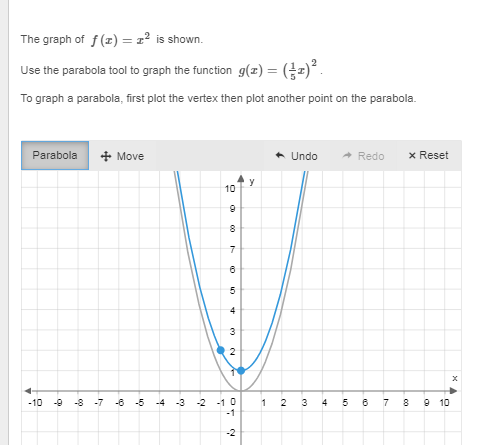 Angle:
I don't think the vertex should move because there are no + or - stuffs
Pixel:
Oh k
Pixel:
give me a sec
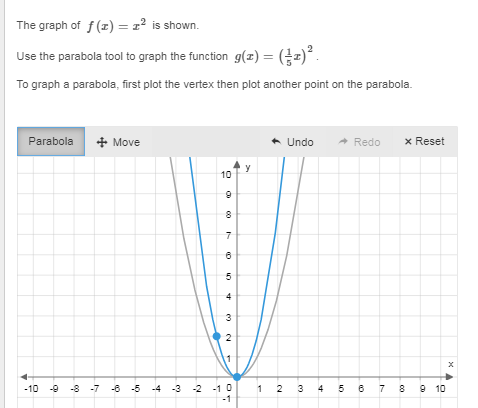 Angle:
hmmm why don't we try plugging in a random point for x and see what happens so if x = 5 then g(5) = ( (1/5) * 5 )^2 = 1^2 = 1 so the graph should go through the point (x,y) = (5, 1)
Pixel:
Oh i see, Thanks
 Angle:
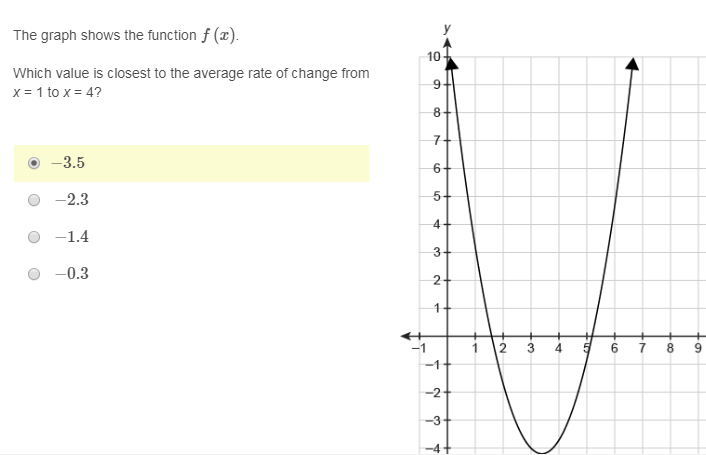
so the way to do this is to find the slope between the points (1, 3) and (4, -3)
Pixel:
is it adding or subtracting
Pixel:
-3, -6 if subtracting
Pixel:
-2
Pixel:
so -2.3
Angle:
\(slope = \large \frac{(-3) - (3)}{(4) - (1)}\)
Pixel:
-2 or -2.3
Angle:
still not right \(\color{#0cbb34}{\text{Originally Posted by}}\) @Angle \(slope = \large \frac{(-3) - (3)}{(4) - (1)}\) \(\color{#0cbb34}{\text{End of Quote}}\)
Pixel:
e.e
Pixel:
-6/3
Pixel:
-2 or -2.3 ._.
Angle:
WHOOPS MY BAD -2.3 was right x'D for some reason I was thinking 4-1=4 ;-;
Pixel:
LOL
 Angle:
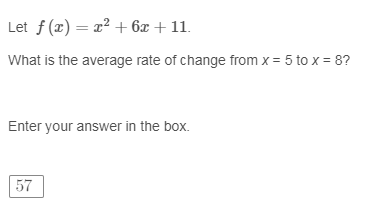
so close! 57 is a number that we can use to get our answer because there's a difference between "how much it changes" verses "average rate of change" so we should divide 57 by (8-5)
Pixel:
57 / 3 = 19
Angle:
exactly :)
Pixel:
:)
 Angle:
correct!
 Angle:
perfect ^_^
 Pixel:
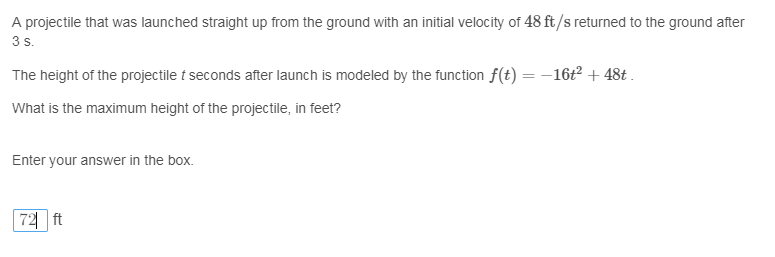
this was a guess
Angle:
hmm I would say, we should find the vertex of this graph
Pixel:
Its 1.5,36
Pixel:
so is it 36?
Angle:
yup!
 Angle:
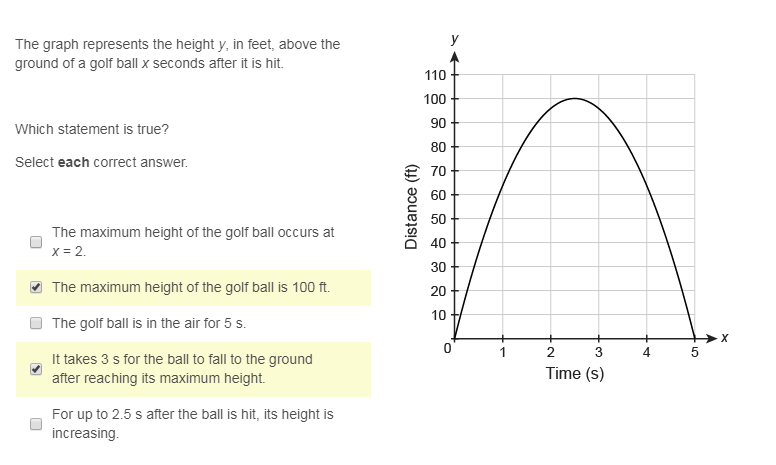
the second check box is correct
Pixel:
what about the 4th
Angle:
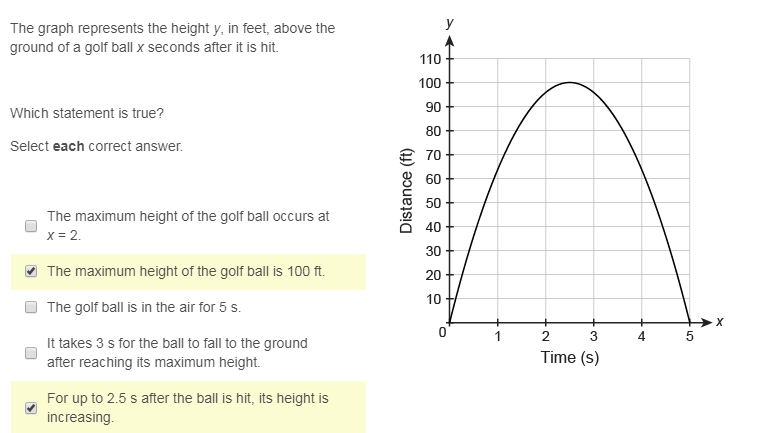
well the maximum height happens at time = 2.5 seconds
Pixel:
OH its this
 Pixel:
right
Angle:
good good, yup and there's one more
Pixel:
3rd one
Angle:
perfect
Pixel:
thank youu
 jhonyy9:
where is ?
Join our real-time social learning platform and learn together with your friends!
 KBaby:
Verse 1 We left our names in the dust of the driveway Watched the old town shrink
KBaby:
Lyrics Generator Use AI to write the lyrics for a song. Suggested Genres: Pop Hip
KBaby:
Verse 1 We left our names in the dust of the driveway Watched the old town shrink
KBaby:
Lyrics Generator Use AI to write the lyrics for a song. Suggested Genres: Pop Hip

 aitexturegenerator:
How are you all handling AI-generated textures for 3D models and game assets without losing the hand-made feel? I've been doing a small stylized environment
aitexturegenerator:
How are you all handling AI-generated textures for 3D models and game assets without losing the hand-made feel? I've been doing a small stylized environment

 Demon25:
Woke up feeling like that girl and that dude well he still aint crap pluse the du
Demon25:
Woke up feeling like that girl and that dude well he still aint crap pluse the du
 playtsec:
how do I get rid of stress from teachers... I just feel like running out the classroom and leaving on my own.
playtsec:
how do I get rid of stress from teachers... I just feel like running out the classroom and leaving on my own.
 JohnnyLFowler0812:
What type of gamer would play something and then get off for a while. Why not sta
JohnnyLFowler0812:
Which is better? Metallica Rap Country R&B hiphop Medal Gospel Chill Which 3 opti
JohnnyLFowler0812:
What type of gamer would play something and then get off for a while. Why not sta
JohnnyLFowler0812:
Which is better? Metallica Rap Country R&B hiphop Medal Gospel Chill Which 3 opti