
 zarkam21:
D?
 Vocaloid:
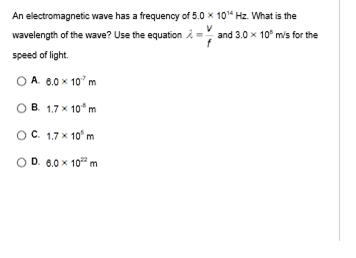
I got something a little different wavelength = v/f = (3*10^8)/(5*10^14) = ?
zarkam21:
A
Vocaloid:
perfect
 Vocaloid:
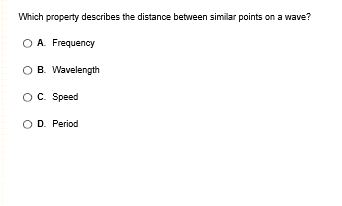
|dw:1526568066881:dw| kinda just have to know this ^_^
 zarkam21:
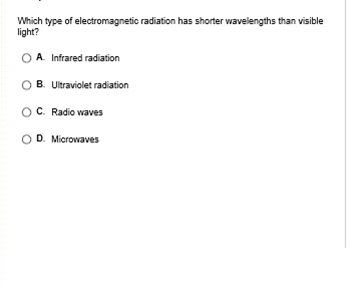
D
Vocaloid:
shorter wavelengths = higher energy microwaves are much lower energy than visible light so microwaves have longer wavelengths as a good memory device: infra means below in Latin and ultra means above, so ultraviolet means above violet, or above the visible light spectrum making UV the best answer
 Vocaloid:
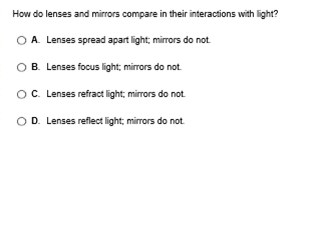
|dw:1526571444682:dw| lenses refract, mirrors reflect
zarkam21:
C?
Vocaloid:
good
 zarkam21:
here are the charts that have to do with this
 Vocaloid:
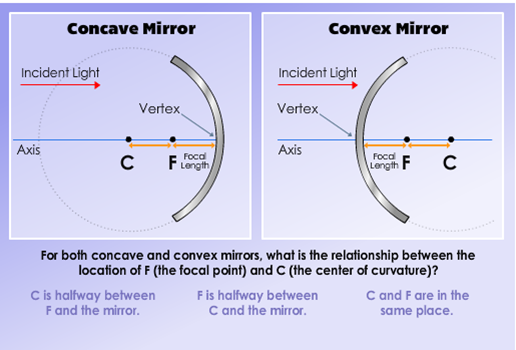
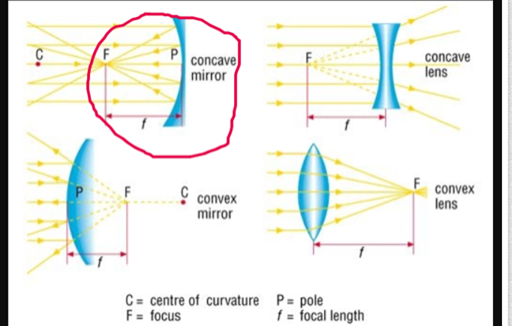
trying to teach myself this but since the mirror curves outward, is it convex or concave?
 Vocaloid:
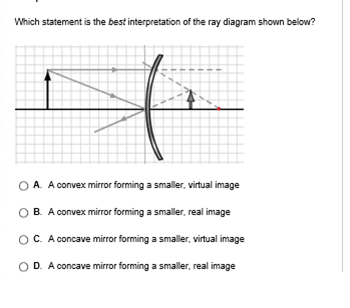
the mirror in your problem goes the other way so its convex to distinguish between real and virtual, do the rays of light converge?
zarkam21:
A convex lens, also known as a positive lens, is described as having thin edges and a thick middle surface. When rays of light pass through this lens the refracted rays of light, converge at one single point which is called a principal or focal point. Read more: Difference between Real Image and Virtual Image | Difference Between http://www.differencebetween.net/technology/difference-between-real-image-and-virtual-image/#ixzz5Fm63EP9w
zarkam21:
A real image is defined as one that is formed when rays of light are directed in a fixed point. Read more: Difference between Real Image and Virtual Image | Difference Between http://www.differencebetween.net/technology/difference-between-real-image-and-virtual-image/#ixzz5Fm68VOYd
Vocaloid:
ok, but take a look at your problem - the solid line represents where the rays of light actually are, do the solid lines converge?
zarkam21:
oh sorry i didnt know what you ere asking Yes they do
Vocaloid:
|dw:1526572442635:dw|
Vocaloid:
notice how the bottom ray bounces off the mirror and doesn't intersect the first ray so they don't converge, producing a virtual image so convex mirror + virtual image
 zarkam21:
|dw:1526572773751:dw|
zarkam21:
its either d or c
zarkam21:
D?
Vocaloid:
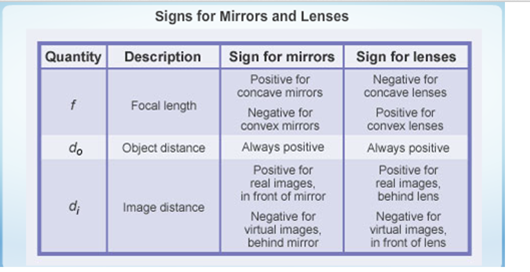
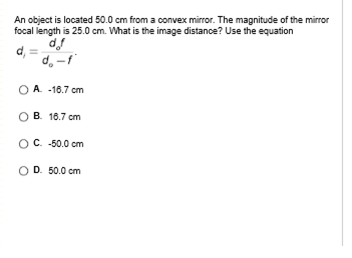
uh I really wouldn't know this one, if you plug in do = 50 and f = 25 you get D your chart says focal length is negative for a convex mirror though so plugging in do = 50 and f = -25 gives (50)(-25)/ (50+25)
zarkam21:
well that would give me 16.3
zarkam21:
should i just go with either c or d
Vocaloid:
my search says that focal length is negative and the image is behind the mirror so it has to be A
 zarkam21:
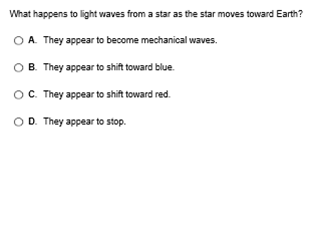
B
Vocaloid:
good
 zarkam21:
A
Vocaloid:
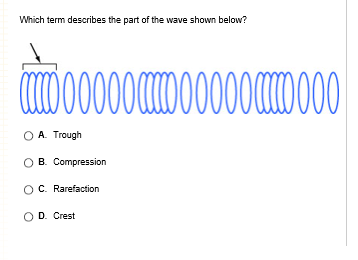
troughs and crests are for transverse waves when the waves are ~compressed~ is this a compression or a rarefaction?
zarkam21:
compression
Vocaloid:
good so compression = your sol'n
 zarkam21:
A
Vocaloid:
|dw:1526576054424:dw|
Vocaloid:
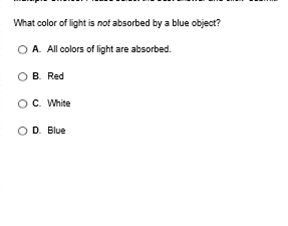
remember, if an object is [color] it has to absorb every color of light except [color]
zarkam21:
so blue
Vocaloid:
good
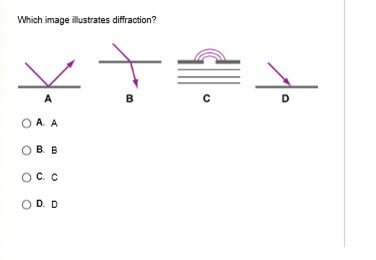 zarkam21:
C
Vocaloid:
good
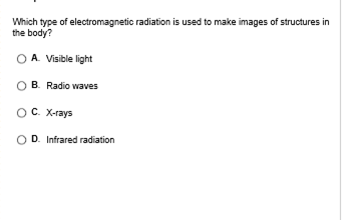 zarkam21:
x rays??
zarkam21:
or maybe visivle light
zarkam21:
unsure on thsi one
zarkam21:
unsure on thsi one
zarkam21:
unsure on thsi one
zarkam21:
unsure on thsi one
zarkam21:
unsure on thsi one
Vocaloid:
well done (x-rays not visible)
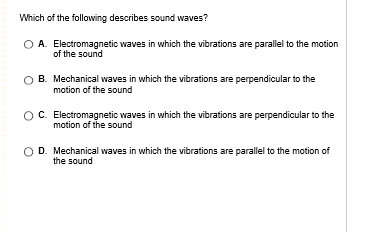 zarkam21:
A
Vocaloid:
|dw:1526576329370:dw|
Vocaloid:
sound waves are mechanical and longitudinal which leads us towards answer choice..?
zarkam21:
D
Vocaloid:
perfect
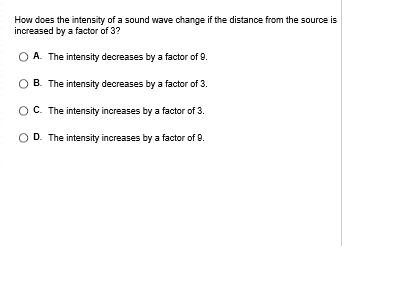 Vocaloid:
|dw:1526576467387:dw| sound is proportional to 1/r^2 making the factor..?
zarkam21:
1/9
Vocaloid:
good so which answer choice might this correspond to?
zarkam21:
A
Vocaloid:
good
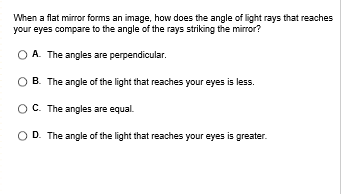 zarkam21:
A
Vocaloid:
|dw:1526576620292:dw| they're not perpendicular but there's another property that they share
zarkam21:
C
Vocaloid:
good
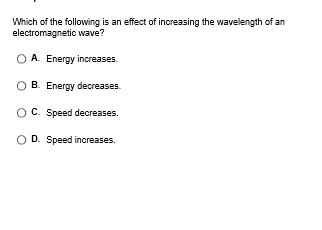 zarkam21:
C
Vocaloid:
not quite, changing the wavelength won't slow it down remember that energy + wavelength are inversely related
zarkam21:
so energy will increase
zarkam21:
D
Vocaloid:
*inversely* related means that if one goes up the other goes down wavelength goes up --> energy goes down (decreases)
Join our real-time social learning platform and learn together with your friends!
 Demon25:
For a hoco proposal with a cheerleader and football player, what else should be a
Demon25:
For a hoco proposal with a cheerleader and football player, what else should be a

 Breathless:
TOC: "MGF any confirmation on the commander? we require confirmation as soon as[radio static].
Breathless:
TOC: "MGF any confirmation on the commander? we require confirmation as soon as[radio static].
 EdwinJsHispanic:
I wrote something that I don't know if I want it as a poem or song, Please let me know on yours thoughts about it, I'm still doing this! "Broken promises an
EdwinJsHispanic:
I wrote something that I don't know if I want it as a poem or song, Please let me know on yours thoughts about it, I'm still doing this! "Broken promises an
 thehearken:
hi um I don't know if this is the right section for this, but can someone go over my poem and tell me if its good enough to give my English professor for a
thehearken:
hi um I don't know if this is the right section for this, but can someone go over my poem and tell me if its good enough to give my English professor for a
 heartlessprophet:
Aye what's 19z%u00f74p=9u03c0 my teacher thinking of impossible questions for us
heartlessprophet:
Aye what's 19z%u00f74p=9u03c0 my teacher thinking of impossible questions for us
 kippppp:
does anyone have any good tips for writing stories? i'm trying to write a dnd campaign but i'm not that great of a writer yet.
kippppp:
does anyone have any good tips for writing stories? i'm trying to write a dnd campaign but i'm not that great of a writer yet.
 GRIZZLEY19:
Y'all let me know what y'all think about this beat I made I took me like a hour maybe rate it 0/10 https://drive.
GRIZZLEY19:
Y'all let me know what y'all think about this beat I made I took me like a hour maybe rate it 0/10 https://drive.
 Ultrilliam:
Welcome to the 10th Anniversary Update! (Part 2) Sorry this one passed the date a
Ultrilliam:
Welcome to the 10th Anniversary Update! (Part 2) Sorry this one passed the date a
 Twaylor:
was walking downtown and my adhd brain wanted to make some (rock?) lyrics: There'
Twaylor:
was walking downtown and my adhd brain wanted to make some (rock?) lyrics: There'