
 zarkam21:
D?
 Vocaloid:
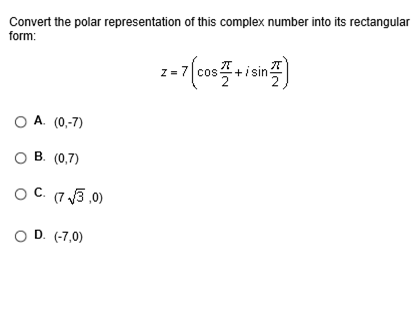
uh, not 100% sure but you would start by letting x = rcos(theta) where r = 7 and theta = pi/2
zarkam21:
0
Vocaloid:
good this question is kind of tripping me up because 7i * sin(pi/2) is 7i but that's not one of the choices
zarkam21:
maybe B?
Vocaloid:
yeah it's not the best choice but it's the closest to what's accurate
 Vocaloid:
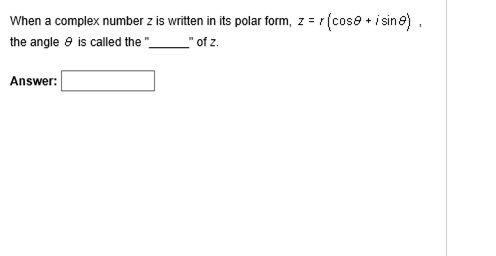
http://www.mathcentre.ac.uk/resources/sigma%20complex%20number%20leaflets/sigma-complex9-2009-1.pdf
Vocaloid:
2nd paragraph
zarkam21:
argument
Vocaloid:
A+
 zarkam21:
t
Vocaloid:
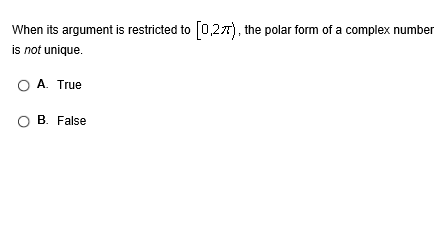
since we have restricted the domain from 0 to 2pi then every angle is unique, thus making the original statement false
 zarkam21:
C
Vocaloid:
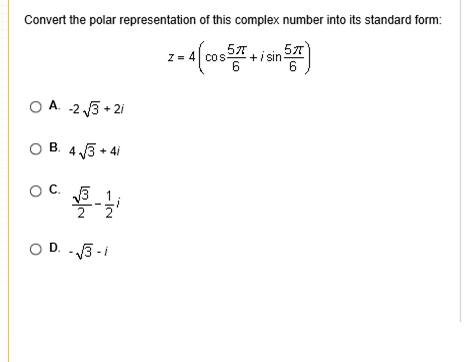
the number in front of the parentheses is r theta is the angle as usual so rcos(theta) = ?
zarkam21:
-2sqrt3
Vocaloid:
good and there's only one answer choice that has -2sqrt(3) as its first value
zarkam21:
A
Vocaloid:
good
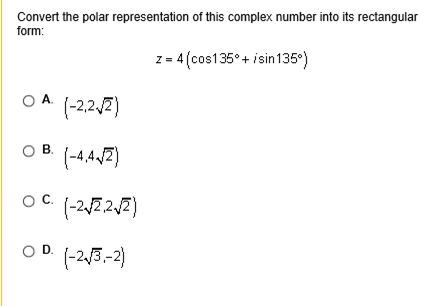 zarkam21:
A
Vocaloid:
4cos(135) = ?
Vocaloid:
still there? you just need to calculate what 4*cos(135) is, that will give you your x-coordinate
zarkam21:
-2sqrt2
Vocaloid:
good, and there's only one solution that has -2sqrt(2) as the x-coordinate
zarkam21:
c
Vocaloid:
perfect
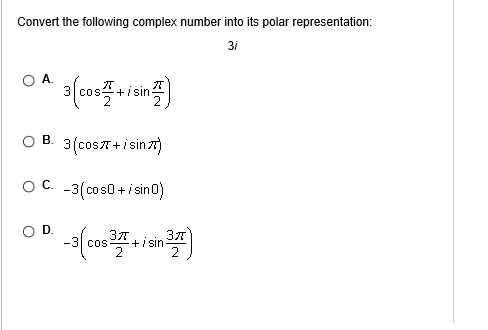 zarkam21:
D
Vocaloid:
hm. I suppose D is mathematically accurate but there may be a better way to represent it with the smallest angle possible
zarkam21:
um a?
Vocaloid:
good
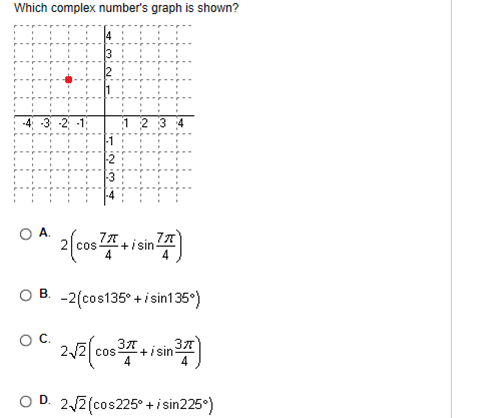 zarkam21:
b
zarkam21:
D
Vocaloid:
if you draw a line from the origin to the red dot how long is that line? as a hint you must use the pythagorean theorem
zarkam21:
-2,1
zarkam21:
so i would use the pyth for these ?
Vocaloid:
|dw:1527614555973:dw|
Vocaloid:
notice how you have a triangle with legs 2 units each so length of the hypotenuse = sqrt(2^2 + 2^2) = ?
zarkam21:
2sqrt 2 so c
Vocaloid:
good
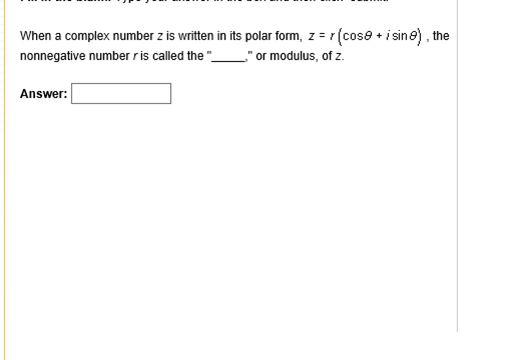 Vocaloid:
had to look this one up tbh if you remember from vectors we used a specific word, starting with an m, to describe the length of a vector, remember what that might be?
zarkam21:
magnitude:?
Vocaloid:
good, so magnitude is also our solution here
 zarkam21:
D
Vocaloid:
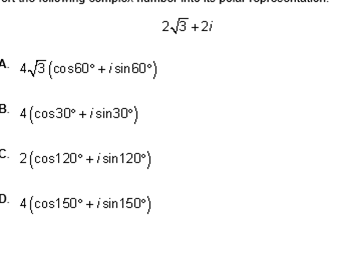
close but not quite arctan(y/x) = ?
zarkam21:
B
Vocaloid:
good
 zarkam21:
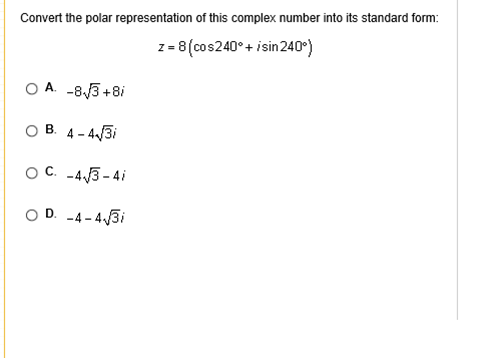
D
Vocaloid:
good
Join our real-time social learning platform and learn together with your friends!
 Demon25:
For a hoco proposal with a cheerleader and football player, what else should be a
Demon25:
For a hoco proposal with a cheerleader and football player, what else should be a

 Breathless:
TOC: "MGF any confirmation on the commander? we require confirmation as soon as[radio static].
Breathless:
TOC: "MGF any confirmation on the commander? we require confirmation as soon as[radio static].
 EdwinJsHispanic:
I wrote something that I don't know if I want it as a poem or song, Please let me know on yours thoughts about it, I'm still doing this! "Broken promises an
EdwinJsHispanic:
I wrote something that I don't know if I want it as a poem or song, Please let me know on yours thoughts about it, I'm still doing this! "Broken promises an
 thehearken:
hi um I don't know if this is the right section for this, but can someone go over my poem and tell me if its good enough to give my English professor for a
thehearken:
hi um I don't know if this is the right section for this, but can someone go over my poem and tell me if its good enough to give my English professor for a
 heartlessprophet:
Aye what's 19z%u00f74p=9u03c0 my teacher thinking of impossible questions for us
heartlessprophet:
Aye what's 19z%u00f74p=9u03c0 my teacher thinking of impossible questions for us
 kippppp:
does anyone have any good tips for writing stories? i'm trying to write a dnd campaign but i'm not that great of a writer yet.
kippppp:
does anyone have any good tips for writing stories? i'm trying to write a dnd campaign but i'm not that great of a writer yet.
 GRIZZLEY19:
Y'all let me know what y'all think about this beat I made I took me like a hour maybe rate it 0/10 https://drive.
GRIZZLEY19:
Y'all let me know what y'all think about this beat I made I took me like a hour maybe rate it 0/10 https://drive.
 Ultrilliam:
Welcome to the 10th Anniversary Update! (Part 2) Sorry this one passed the date a
Ultrilliam:
Welcome to the 10th Anniversary Update! (Part 2) Sorry this one passed the date a
 Twaylor:
was walking downtown and my adhd brain wanted to make some (rock?) lyrics: There'
Twaylor:
was walking downtown and my adhd brain wanted to make some (rock?) lyrics: There'