
 Nevey:
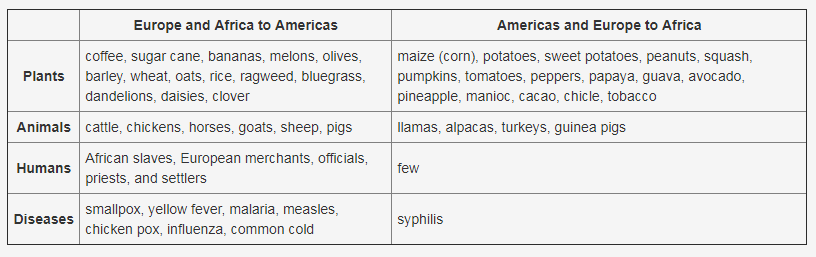
Use the following chart summarizing the Columbian Exchange to answer the question: Europe and Africa to Americas Americas and Europe to Africa Plants coffee, sugar cane, bananas, melons, olives, barley, wheat, oats, rice, ragweed, bluegrass, dandelions, daisies, clover maize (corn), potatoes, sweet potatoes, peanuts, squash, pumpkins, tomatoes, peppers, papaya, guava, avocado, pineapple, manioc, cacao, chicle, tobacco Animals cattle, chickens, horses, goats, sheep, pigs llamas, alpacas, turkeys, guinea pigs Humans African slaves, European merchants, officials, priests, and settlers few Diseases smallpox, yellow fever, malaria, measles, chicken pox, influenza, common cold syphilis What does the type of animals and plants brought to the New World demonstrate about the needs of Pre-Columbian civilizations? Pre-Columbian civilizations did not have access to egg-laying animals, so Europeans brought them. Pre-Columbian civilizations did not practice small-scale farming, so Europeans brought them. Pre-Columbian civilizations had an abundance of animals for food, but Europeans also wanted to continue using their traditional animals for food. Pre-Columbian civilizations had few animals suitable for raising and slaughtering to use for meat.
Nevey:
@JustSaiyan
 Nevey:
@ThisGirlPretty
Nevey:
@Elsa213
 JustSaiyan:
The most likely answer is D. If you look at what Europe sent to the US, and then what the US sent back in return, you'll notice none of them are farm animals that we are familiar with today.
Nevey:
ok ty
Join our real-time social learning platform and learn together with your friends!
 KBaby:
Verse 1 We left our names in the dust of the driveway Watched the old town shrink
KBaby:
Lyrics Generator Use AI to write the lyrics for a song. Suggested Genres: Pop Hip
KBaby:
Verse 1 We left our names in the dust of the driveway Watched the old town shrink
KBaby:
Lyrics Generator Use AI to write the lyrics for a song. Suggested Genres: Pop Hip

 aitexturegenerator:
How are you all handling AI-generated textures for 3D models and game assets without losing the hand-made feel? I've been doing a small stylized environment
aitexturegenerator:
How are you all handling AI-generated textures for 3D models and game assets without losing the hand-made feel? I've been doing a small stylized environment

 Demon25:
Woke up feeling like that girl and that dude well he still aint crap pluse the du
Demon25:
Woke up feeling like that girl and that dude well he still aint crap pluse the du
 playtsec:
how do I get rid of stress from teachers... I just feel like running out the classroom and leaving on my own.
playtsec:
how do I get rid of stress from teachers... I just feel like running out the classroom and leaving on my own.
 JohnnyLFowler0812:
What type of gamer would play something and then get off for a while. Why not sta
JohnnyLFowler0812:
Which is better? Metallica Rap Country R&B hiphop Medal Gospel Chill Which 3 opti
JohnnyLFowler0812:
What type of gamer would play something and then get off for a while. Why not sta
JohnnyLFowler0812:
Which is better? Metallica Rap Country R&B hiphop Medal Gospel Chill Which 3 opti