
 AnimeGhoul8863:
The shape of a roller coaster is modeled by a polynomial function, R(x). Describe how to find the x-intercepts of R(x) and how to construct a rough graph of R(x) so that the engineer can predict when there will be no change in the direction of the coaster. You may create a sample polynomial of degree 3 or higher to use in your explanations.
AnimeGhoul8863:
Polynomial Equation: R(x)=4x^3+2x^2-7 Degree: 3 We then Plug in 1.059 in as X so it would look like R(1.059)=4(1.059)^3+2(1.059)^2-7 This then Equals R=-0.00608544 ^what i have so far
AnimeGhoul8863:
@Mehek
 ShadowWolf:
You will need three roots for this, so we have Let x = -30, -10 and +20 So the factors will be (x+30)(x+10)(x-20) The divide it to 100, this will help bring the peak up and down So the polynomial function R(x) will become 1/100 * (x+30)(x+10)(x-20) R(x) = 1/100 * (x+30)(x+10)(x-20) Finding the X-intercept: Let R(x) = 0 and solve for x. 1/100 * (x+30)(x+10)(x-20) = 0 x = -30, -10, 20 are the x-intercepts.
AnimeGhoul8863:
-.- i dun want copy and pasted answers i need actual help
 Mehek:
You find x-intercepts by first factoring then solving for x
Mehek:
and if you can't factor you use the quadratic formula
AnimeGhoul8863:
Wait ok so whatt and how am i factoring
Mehek:
Factoring 4x^3 + 2x^2 - 7
AnimeGhoul8863:
ok hold on let me do it e.e
AnimeGhoul8863:
I dont think you can factor this
Mehek:
Right so then you use the quadratic formula
AnimeGhoul8863:
if i did it correctly it would be x=1.059 which i added as X
AnimeGhoul8863:
Polynomial Equation: R(x)=4x^3+2x^2-7 Degree: 3 I Tried to factor 4x^3+2x^2-7 but it didnt work so i used the quadratic formula which equaled x=1.059 which we Plug in 1.059 in as X and made y zero so it would look like R(1.059)=4(1.059)^3+2(1.059)^2-7
Mehek:
\(\bf{x=\dfrac{-b±\sqrt{b^2-4ac}}{2a}}\)
AnimeGhoul8863:
huh?
Mehek:
That's the quadratic formula
Mehek:
a is the coefficient of the first term, b is the second, c is the third
AnimeGhoul8863:
......
AnimeGhoul8863:
i thought i already solved it i said it was 1.059 am i wrong?
Mehek:
\(\bf4x^3+2x^2-7\) where a = 4 b = 2 c = -7
Mehek:
oop i didn't see the reply
AnimeGhoul8863:
so i am right ?
Mehek:
Yes
Mehek:
So that's where the graph intercept the x-axis
AnimeGhoul8863:
wait whats next? if the equation looks like this what do i do? R(1.059)=4(1.059)^3+2(1.059)^2-7
Mehek:
That gives you the point for the x-intercept (1.059, R(1.059))
Mehek:
Since you found what x is equal to you don't need to plug it in because that's all you do for the x-intercept
AnimeGhoul8863:
Polynomial Equation: R(x)=4x^3+2x^2-7 Degree: 3 I Tried to factor 4x^3+2x^2-7 but it didnt work so i used the quadratic formula which equaled x=1.059 This then gives use the point for the x-intercept (1.059, R(1.059)) ^is that all i have to do?
Mehek:
You can put (1.059, 0) cause it's the same thing
Mehek:
And yes that's all
Mehek:
For the first part
AnimeGhoul8863:
First part? what else do we have to do?
Mehek:
"Describe how to find the x-intercepts of R(x) and `how to construct a rough graph of R(x) so that the engineer can predict when there will be no change in the direction of the coaster`."
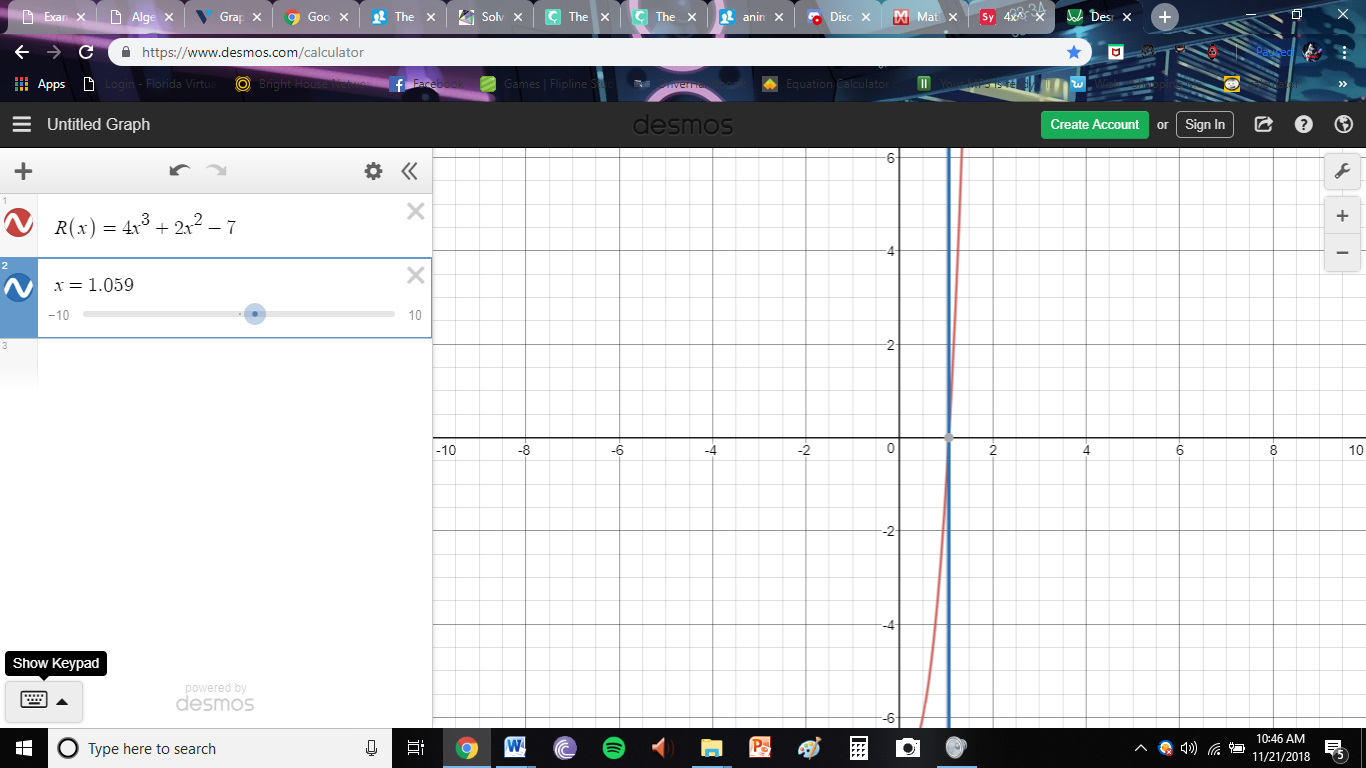 AnimeGhoul8863:
would it look like this?
Mehek:
Yeah but you have to say how you can construct it So first you'd plot the x-intercept Then you'd find the y-intercept which is plugging all the x with 0 and getting -7 so you'd plot (0,-7)
Mehek:
Have you learned how to find the minimum/maximum of a graph?
AnimeGhoul8863:
wait ok hold up so That way you can construct this graph is to first plot the x intercept which is 1.059 then you find the y intercept which is -7 because you plug everything in x with 0 which gives you -7 this would make your graph Decrease and go down.
AnimeGhoul8863:
Ummmm i probably did but forgot e.e
Mehek:
Correct
AnimeGhoul8863:
so would that be the answer for part 2
Mehek:
to find min/max \(\bf x= \dfrac{-b}{2a}\)
Mehek:
Yeah it would but it also mentions changes in direction so idk if you need the min/max
AnimeGhoul8863:
It changes direction as it decreases would that work
Mehek:
Yeah ig that works
AnimeGhoul8863:
Thank you would you possibly be able to help me with a few more e.e
AnimeGhoul8863:
ill make sure yew get lots of medals >.<
ShadowWolf:
Gee I still helped 😒😒
Join our real-time social learning platform and learn together with your friends!
 KBaby:
Verse 1 We left our names in the dust of the driveway Watched the old town shrink
KBaby:
Lyrics Generator Use AI to write the lyrics for a song. Suggested Genres: Pop Hip
KBaby:
Verse 1 We left our names in the dust of the driveway Watched the old town shrink
KBaby:
Lyrics Generator Use AI to write the lyrics for a song. Suggested Genres: Pop Hip

 aitexturegenerator:
How are you all handling AI-generated textures for 3D models and game assets without losing the hand-made feel? I've been doing a small stylized environment
aitexturegenerator:
How are you all handling AI-generated textures for 3D models and game assets without losing the hand-made feel? I've been doing a small stylized environment

 Demon25:
Woke up feeling like that girl and that dude well he still aint crap pluse the du
Demon25:
Woke up feeling like that girl and that dude well he still aint crap pluse the du
 playtsec:
how do I get rid of stress from teachers... I just feel like running out the classroom and leaving on my own.
playtsec:
how do I get rid of stress from teachers... I just feel like running out the classroom and leaving on my own.
 JohnnyLFowler0812:
What type of gamer would play something and then get off for a while. Why not sta
JohnnyLFowler0812:
Which is better? Metallica Rap Country R&B hiphop Medal Gospel Chill Which 3 opti
JohnnyLFowler0812:
What type of gamer would play something and then get off for a while. Why not sta
JohnnyLFowler0812:
Which is better? Metallica Rap Country R&B hiphop Medal Gospel Chill Which 3 opti