
 xXMarcelieXx:
i need help with i and j
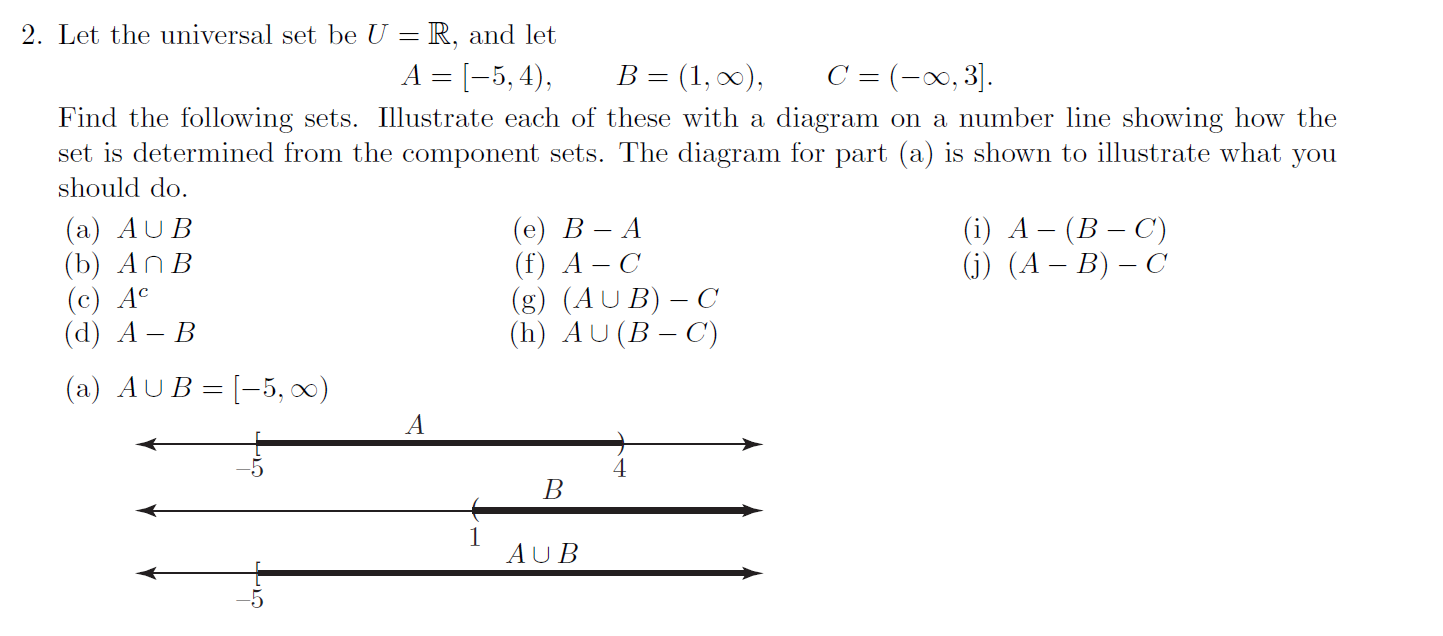
 Hero:
Hero:
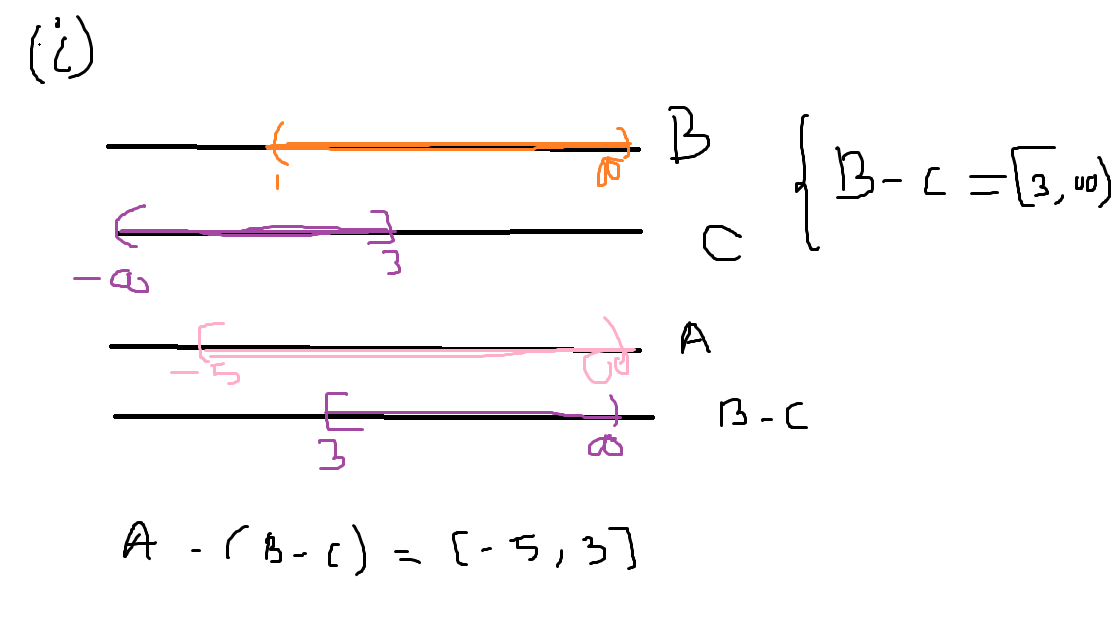
You mis-interpreted B - C which means the elements of B that are not in C
Hero:
Actually, I take that back. What you've done is almost correct. \(B - C = (3, \infty)\)
xXMarcelieXx:
oml.. then how would i start it lol
xXMarcelieXx:
oh wait how come its not bracket for 3?
Hero:
Because 3 is included in C. We want the elements of B that are NOT in C.
Hero:
So the next step would be to name the interval \((3, \infty)\) just to make it easier to do the next step.
Hero:
So let \(D = (3, \infty)\). Now find \(A - D\)
Hero:
After you find that interval, you'll be done with problem I
Hero:
BTW, the final result you have is almost correct as well.
xXMarcelieXx:
so then it would be ( 3 , infinity)?
Hero:
What did you get for your final final result? Do you remember?
Hero:
And actually I'm going to say [-5,-3] is correct because B - C does not include 3 but A does. So don't even change your final result.
Hero:
So funny thing, your intermediary step had a small error, but your final result is still correct.
Hero:
Looks like you don't need much help with this after all.
xXMarcelieXx:
i sometimes get confused when to write parenthesis and brackets
Hero:
Parentheses just means the endpoints of an interval are not included. Brackets mean include the endpoints. Something like that.
 Hero:
Hero:
What do you mean? We already went over i
Hero:
@xXMarcelieXx I don't understand what you just wrote. Did you mean, "so far I got this"?
 xXMarcelieXx:
sorry i was working on it lol
xXMarcelieXx:
for j *
Hero:
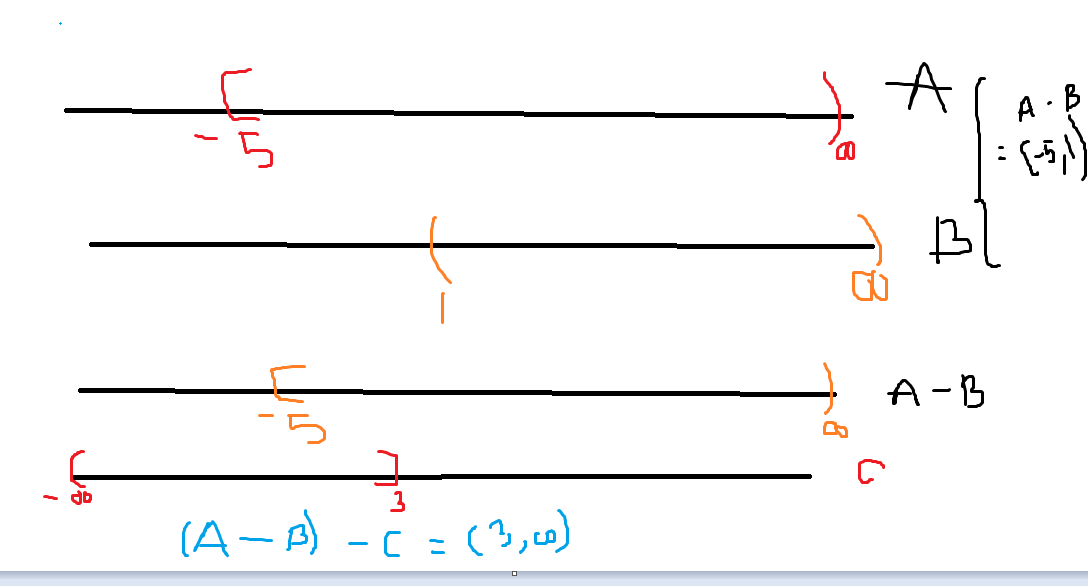
Okay double check your A - B. Remember, A - B means the elements of A excluding the elements of B.
xXMarcelieXx:
hmm i still dont get it lol
Hero:
If you can't do j, then explain how you did i
xXMarcelieXx:
i just did i by doing the number lines though and making sense of it lol
xXMarcelieXx:
isnt A-B umm ( -5 , 1) ?
Hero:
Actually, it's [-5,1] which you wrote correctly but when you made your number line, you did it wrong.
xXMarcelieXx:
when you said " A - B means the elements of A excluding the elements of B " do you mean that we only include the numbers from A that arent in B ?
Hero:
correct
Hero:
But do you see where you wrote A - B = [-5,1] which is different from the number line you created for A - B?
xXMarcelieXx:
oh truee
xXMarcelieXx:
so then the final answer will change?
Hero:
It will indeed
xXMarcelieXx:
hmm would we have union?
xXMarcelieXx:
oh wait nvm lol so then we would have ( 1 ,3)
Hero:
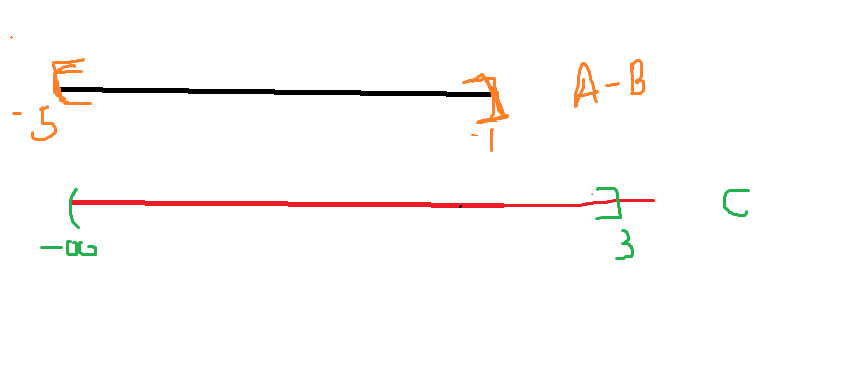
You should draw number lines for this one.
Hero:
You work a lot better by drawing the number lines and posting them here
 Hero:
Hero:
Okay, so how come you did not graph the number line for (A - B) - C?
xXMarcelieXx:
oh i graphed it into parts first
xXMarcelieXx:
but we would get this as a final answer ( A - B ) - C = (1 , 3)
Hero:
Okay so you have the set for A - B. And then when you excluded all the elements that include C what are you left with?
Hero:
Aren't there more elements in C than there are in A - B?
xXMarcelieXx:
yeah there are more elements in C
xXMarcelieXx:
we would have more numbers in the - infinity and positive numbers right
Hero:
Do the elements in C INCLUDE the elements in A - B?
Hero:
@xXMarcelieXx did you die?
xXMarcelieXx:
oh wait no
xXMarcelieXx:
im still here lol
Hero:
Okay
xXMarcelieXx:
okay so then
Hero:
So then answer my previous questions
xXMarcelieXx:
umm they dont right
Hero:
Go back and look at the number line for C again and ask if the number line for A - B is included.
xXMarcelieXx:
oh yes it is included
Hero:
Okay, but aren't you supposed to be excluding everything in C from A - B?
xXMarcelieXx:
yeah
Hero:
So basically you already performed A - B. Now you must perform the MINUS C part. In other words, you must remove every element containing C. When you do that, what's left?
Hero:
@xXMarcelieXx are you still alive?
xXMarcelieXx:
yes im trying to figure it out but i think its umm 3 , infinity ?
Hero:
Do you remember the number line for A - B?
Hero:
State both intervals here for A- B and C
xXMarcelieXx:
A - B = [ 5 , 1 ] C = (- infinity , 3]
Hero:
Right and [-5,1] is included in C correct?
xXMarcelieXx:
yes
Hero:
But MINUS C means to remove all of C correct?
xXMarcelieXx:
oh wait i think i made a mistake with this problem for A aaahh
Hero:
How?
xXMarcelieXx:
i put A was [ -5, infinity) which was suppose to be [ 5, 4) lol i misread it
Hero:
Okay.
xXMarcelieXx:
one sec let me redo it again. sorrry lol
Hero:
Surprised I didn't catch that myself
xXMarcelieXx:
im half asleep thats why lol
Hero:
smh
Hero:
What course are you taking?
xXMarcelieXx:
intro too math proofs
Hero:
I see. Why are you taking intro to math proofs? What is your major?
xXMarcelieXx:
math teaching and getting a minor in finance
xXMarcelieXx:
they say its useful for math teaching lool
Hero:
Good luck in your endeavors
xXMarcelieXx:
thanks lol i will be back later to finish this stuff
Join our real-time social learning platform and learn together with your friends!
 KBaby:
Verse 1 We left our names in the dust of the driveway Watched the old town shrink
KBaby:
Lyrics Generator Use AI to write the lyrics for a song. Suggested Genres: Pop Hip
KBaby:
Verse 1 We left our names in the dust of the driveway Watched the old town shrink
KBaby:
Lyrics Generator Use AI to write the lyrics for a song. Suggested Genres: Pop Hip

 aitexturegenerator:
How are you all handling AI-generated textures for 3D models and game assets without losing the hand-made feel? I've been doing a small stylized environment
aitexturegenerator:
How are you all handling AI-generated textures for 3D models and game assets without losing the hand-made feel? I've been doing a small stylized environment

 Demon25:
Woke up feeling like that girl and that dude well he still aint crap pluse the du
Demon25:
Woke up feeling like that girl and that dude well he still aint crap pluse the du
 playtsec:
how do I get rid of stress from teachers... I just feel like running out the classroom and leaving on my own.
playtsec:
how do I get rid of stress from teachers... I just feel like running out the classroom and leaving on my own.
 JohnnyLFowler0812:
What type of gamer would play something and then get off for a while. Why not sta
JohnnyLFowler0812:
Which is better? Metallica Rap Country R&B hiphop Medal Gospel Chill Which 3 opti
JohnnyLFowler0812:
What type of gamer would play something and then get off for a while. Why not sta
JohnnyLFowler0812:
Which is better? Metallica Rap Country R&B hiphop Medal Gospel Chill Which 3 opti