
 12123333333333333333:
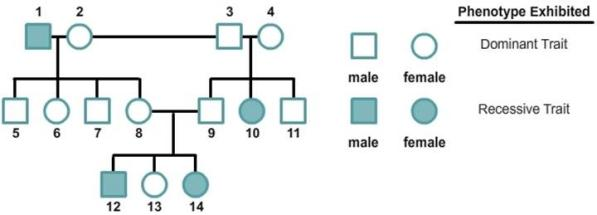
Question 1(Multiple Choice Worth 2 points) This pedigree chart tracks the inheritance of a recessive trait that is not sex-linked. Based on the information in the chart, which of the following statements is true? This pedigree chart shows three generations. The individuals are numbered from left to right, starting at the top left of the chart. Squares represent males and circles represent females. If the symbol is gray, that individual exhibits the recessive trait. If the symbol is white, the individual exhibits the dominant trait. On the first row there are two couples mated together. The first couple is made up of individuals #1 (recessive) and #2 (dominant). They have four offspring on the second row that all exhibit dominant traits: #5 (dominant), #6 (dominant), #7 (dominant), and #8 (dominant). The second couple in Generation #1 is made up of individual #3 (dominant) and individual #4 (dominant). They have three offspring in Generation 2: #9 (dominant), #10 (recessive), and #11 (dominant). Individual #8 from the first family and individual #9 from the second family mated together and produced three offspring in Generation 3. These offspring are #12 (recessive), #13 (dominant), and #14 (recessive). Individual #11 must be homozygous for the recessive trait. Individuals #3 and #4 must be heterozygous for the trait. Individual #2 must be heterozygous dominant for the trait. Individual #9 must be homozygous dominant for the trait.
 12123333333333333333:
@JSVSL7
 JSVSL7:
I'll help when I get a chance
12123333333333333333:
@DCharger96
 DCharger96:
i would suggest the last statement about individual #9 is true
12123333333333333333:
Ok. I have another question...Do you think you could help? And Imma give you a medal after Im done
12123333333333333333:
If a corn plant has a genotype Sstt, what are the possible genetic combinations that could be present in a single grain of pollen produced by the plant? Ss, tt, St, st St, st St, sT, st
DCharger96:
sure i'll try
12123333333333333333:
I put the question up. Can you see it?
DCharger96:
yeah is the genotype SsTt or Sstt
12123333333333333333:
Sstt
DCharger96:
k thx
DCharger96:
St, st
12123333333333333333:
Thx last 1 In some bees, thin stripes (S) are dominant over thick stripes (s) and black eyes (B) are dominant over gray eyes (b). Complete a dihybrid cross for parents with the genotypes SsBB and ssBb and determine the likelihood of offspring with the genotype ssBB. SB SB sB sB sB SsBB SsBB ssBB ssBB sb SsBb SsBb ssBb ssBb sB SsBB SsBB ssBB ssBB sb SsBb SsBb ssBb ssBb 1/16 4/16 3/16 2/16
12123333333333333333:
Imma put the chart up...its up on that but it isn't right...
DCharger96:
ok
 12123333333333333333:
In some bees, thin stripes (S) are dominant over thick stripes (s) and black eyes (B) are dominant over gray eyes (b). Complete a dihybrid cross for parents with the genotypes SsBB and ssBb and determine the likelihood of offspring with the genotype ssBB. 1/16 4/16 3/16 2/16
DCharger96:
i got 5/16 but go with 4/16 since it is the next closest one
12123333333333333333:
k
12123333333333333333:
I gave u a medal.. :D thx for the help
DCharger96:
your welcome glad to help anytime
Join our real-time social learning platform and learn together with your friends!
 KBaby:
Verse 1 We left our names in the dust of the driveway Watched the old town shrink
KBaby:
Lyrics Generator Use AI to write the lyrics for a song. Suggested Genres: Pop Hip
KBaby:
Verse 1 We left our names in the dust of the driveway Watched the old town shrink
KBaby:
Lyrics Generator Use AI to write the lyrics for a song. Suggested Genres: Pop Hip

 aitexturegenerator:
How are you all handling AI-generated textures for 3D models and game assets without losing the hand-made feel? I've been doing a small stylized environment
aitexturegenerator:
How are you all handling AI-generated textures for 3D models and game assets without losing the hand-made feel? I've been doing a small stylized environment

 Demon25:
Woke up feeling like that girl and that dude well he still aint crap pluse the du
Demon25:
Woke up feeling like that girl and that dude well he still aint crap pluse the du
 playtsec:
how do I get rid of stress from teachers... I just feel like running out the classroom and leaving on my own.
playtsec:
how do I get rid of stress from teachers... I just feel like running out the classroom and leaving on my own.
 JohnnyLFowler0812:
What type of gamer would play something and then get off for a while. Why not sta
JohnnyLFowler0812:
Which is better? Metallica Rap Country R&B hiphop Medal Gospel Chill Which 3 opti
JohnnyLFowler0812:
What type of gamer would play something and then get off for a while. Why not sta
JohnnyLFowler0812:
Which is better? Metallica Rap Country R&B hiphop Medal Gospel Chill Which 3 opti