
 Razor:
sCienCe, PHYSICS
 JSVSL7:
Use these tips to help you out: 1. Forces in the same direction add up. There is no need to calculate for a resultant vector. 2. Forces in exactly opposite directions subtract. Again, no need to calculate for a resultant. 3. In the case of forces that are angled, you will apply the triangle or parallelogram method. For each vector, find the component vectors. Then, add the horizontal and vertical components respectively. Last, to find the direction, you will use trig (most likely tan inverse). 4. In the case of vectors that meet at a right angle, you don't need to their respective components. Just use the Pythagorean theorem, from head to tail, to find the magnitude of the resultant. You will still need trig to find the direction.
JSVSL7:
How to graphically add vectors: Method 1: Triangle Law Align the vectors from head to tail. Then draw a new vector starting from the base tail to the upper head. Method 2: Parallelogram Law Form imaginary duplicates of each vector on the opposite vector. Then draw a line from the original tail intersection to the imaginary head intersection.
JSVSL7:
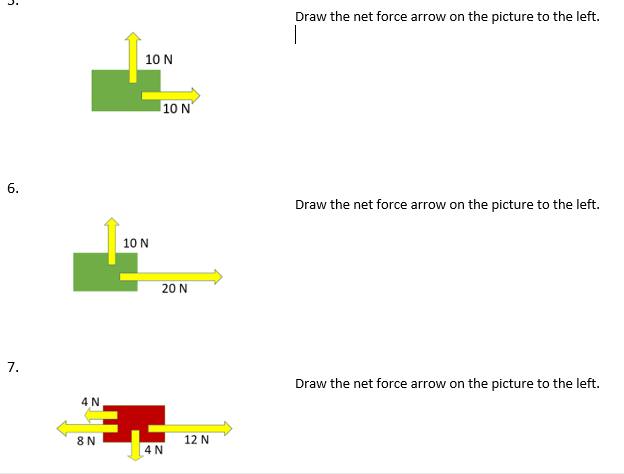
I'll do the third one (number 7) for you. Use tip #1 4N + 8N toward the LEFT is going to add as they are the same direction. So it's now 12N. Now tip #2. The 12N towards the left and right will cancel as they are opposite. This leaves only 1 vector of the object, which is 4N Down.
JSVSL7:
For number 6, you will need to use either the triangle or parallelogram laws and then use the Pythagorean theorem to calculate for the magnitude of the resultant vector.
JSVSL7:
Number 5 is the same, but there's no need for a Pythagorean theorem. You can note that there is a right angle formed, and the two magnitudes are equivalent. Using prior knowledge from geometry, you can use the 45-45-90 rules for special right triangles.
 Lazyluna678:
Use the triangle and parallelogram laws
Join our real-time social learning platform and learn together with your friends!
 KBaby:
Verse 1 We left our names in the dust of the driveway Watched the old town shrink
KBaby:
Lyrics Generator Use AI to write the lyrics for a song. Suggested Genres: Pop Hip
KBaby:
Verse 1 We left our names in the dust of the driveway Watched the old town shrink
KBaby:
Lyrics Generator Use AI to write the lyrics for a song. Suggested Genres: Pop Hip
 aitexturegenerator:
How are you all handling AI-generated textures for 3D models and game assets without losing the hand-made feel? I've been doing a small stylized environment
aitexturegenerator:
How are you all handling AI-generated textures for 3D models and game assets without losing the hand-made feel? I've been doing a small stylized environment

 Demon25:
Woke up feeling like that girl and that dude well he still aint crap pluse the du
Demon25:
Woke up feeling like that girl and that dude well he still aint crap pluse the du
 playtsec:
how do I get rid of stress from teachers... I just feel like running out the classroom and leaving on my own.
playtsec:
how do I get rid of stress from teachers... I just feel like running out the classroom and leaving on my own.
 JohnnyLFowler0812:
What type of gamer would play something and then get off for a while. Why not sta
JohnnyLFowler0812:
Which is better? Metallica Rap Country R&B hiphop Medal Gospel Chill Which 3 opti
JohnnyLFowler0812:
What type of gamer would play something and then get off for a while. Why not sta
JohnnyLFowler0812:
Which is better? Metallica Rap Country R&B hiphop Medal Gospel Chill Which 3 opti