
 prettydevil45:
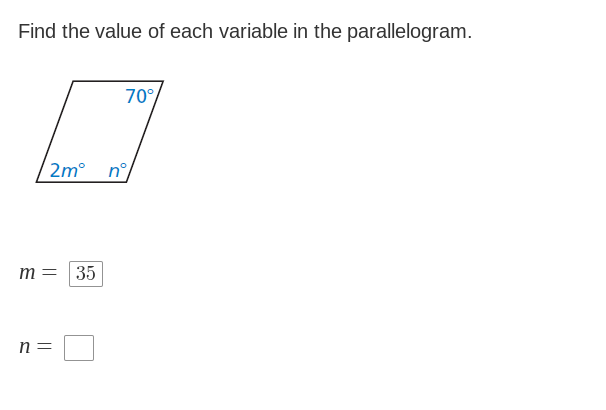
Find the value of each variable in the parallelogram.
 prettydevil45:
looking for n
prettydevil45:
@jhonyy9
prettydevil45:
@carmelle @supie @kaleighh533 @hhanan
 supie:
It's a parallelogram meaning that all the sides are parallel to each other, so the angle that said `2m˚` on it was basically 2*?=70 since the lines are parallel so 2*35=70 so m=35 so basically all the angles are equal
prettydevil45:
ya i got m i need help with n
supie:
ik
supie:
All the sides are equal.
supie:
every angle is the same amount of `˚`
supie:
Still confused?
prettydevil45:
yes
supie:
Ok, all the angles have the same amount of ˚ because it is a parallelogram meaning that all the sides are parallel meaning that all the sides have an equal amount of degrees so since the two angles diagonal from each other have the same amount of degrees then the other two diagonal from each other have to be the same as the other ones because it is a parallelogram.
supie:
So the ones diagonal from each other have an equal amount of 70˚ so both of those angles are 70˚ and all the sides are equal so that means n=?
prettydevil45:
n=71
supie:
How did you get 71?
prettydevil45:
the 70 and n =1 so 71
supie:
n=1? when did n=1?
supie:
\(n\) is the missing value,
prettydevil45:
ya but id get it
supie:
All the angles are the same every angle is 70˚ so that means the value of n would be what?
prettydevil45:
70
supie:
Exactly,,,,
prettydevil45:
no its wrong
 LandonGoma:
It's a parallelogram meaning that all the sides are parallel to each other, so the angle that said 2m˚ on it was basically 2*?=70
LandonGoma:
@sarah123
 darkknight:
@supie incorrect, all angles are not the same we can make 2 eqns \[70=2m\] and \[n+n+70+2m=360\] first find the value of m then substitute into the second eqn to find n
darkknight:
\(\color{#0cbb34}{\text{Originally Posted by}}\) @supie It's a parallelogram meaning that all the sides are parallel to each other, so the angle that said `2m˚` on it was basically 2*?=70 since the lines are parallel so 2*35=70 so m=35 so basically all the angles are equal \(\color{#0cbb34}{\text{End of Quote}}\) ??? Parallelogram meaning opposite sides are parallel, how are all sides parallel that wouldn't even make sense. Also how are all the angles equal this isn't a square, you can clearly see that 2 angles are acute and 2 are obtuse
darkknight:
\(\color{#0cbb34}{\text{Originally Posted by}}\) @supie Ok, all the angles have the same amount of ˚ because it is a parallelogram meaning that all the sides are parallel meaning that all the sides have an equal amount of degrees so since the two angles diagonal from each other have the same amount of degrees then the other two diagonal from each other have to be the same as the other ones because it is a parallelogram. \(\color{#0cbb34}{\text{End of Quote}}\) So your saying that all angles are 70 degrees? hmm... then the total sum of the shape would be 280 degrees which doesn't make a shape ¯\_(ツ)_/¯
supie:
I haven't done this in a long time, sorry 😔😞 thanks darkknight,
supie:
So would it be 110? Because it has to be 360˚ in total and the other two sides are 70˚ and \(70˚*2=140\) And angle \(n\) is obtuse meaning that is has to be over 90˚ And it has to have a total of 360 degrees so I would have to get the remaining amount of left by doing the total amount of degrees minus the amount that is already there then divide that by two because there are two angles so \(360–140=220\) \(220÷2=110\) So n=110 @darkknight?
darkknight:
Ayeee, good job!!! @supie another way to do this is to see taht this is a parallelogram, so 2 adjacent angles will add to 180,if one angle is 70 that makes the other 110. Nevertheless glad to see you came back and answered the Question!
supie:
Thanx homie
darkknight:
np
prettydevil45:
thx darkknight
Join our real-time social learning platform and learn together with your friends!
 VERNEISH:
Two objects are moving along separate linear paths where each path is described by position, d, and time, t.
VERNEISH:
Two objects are moving along separate linear paths where each path is described by position, d, and time, t.

 Maci:
what are the best stock apps for people who want to start investing?
Maci:
what are the best stock apps for people who want to start investing?
 Twaylor:
genuienly how do i get better self control i keep watcing youtube and theres this
Twaylor:
genuienly how do i get better self control i keep watcing youtube and theres this
 IzzyCookie:
|dw:1792074056138:dw| Uhm, I don't know where to ask this, but I'm in college welding at my community college, and I need help learning vertical welding for
IzzyCookie:
|dw:1792074056138:dw| Uhm, I don't know where to ask this, but I'm in college welding at my community college, and I need help learning vertical welding for

 thehearken:
not sure if this is considered spam, im sorry if it is, but does anyone have tips
thehearken:
not sure if this is considered spam, im sorry if it is, but does anyone have tips