
 kkumrimaedo:
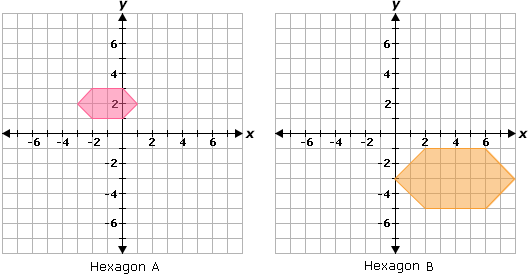
Which of the following best describes the graphs below? A. Hexagon A is similar to hexagon B by dilating hexagon A by a scale factor of 2 with the center of dilation at the origin, translating it 7 units down and 2 units left and reflecting it across the y-axis. B. Hexagon A is neither similar nor congruent to hexagon B. C. Hexagon A is congruent to hexagon B by dilating hexagon A by a scale factor with the center of dilation at the origin, translating it 7 units down and 2 units left and reflecting it across the y-axis. D. Hexagon A is similar to hexagon B by dilating hexagon A by a scale factor of 2 with the center of dilation at the origin, translating it 2 units down and 7 units left and reflecting it across the x-axis.
 kkumrimaedo:
help T^T
 jhonyy9:
any idea about this ?
kkumrimaedo:
C maybe idk
jhonyy9:
then you see the original hexagon has the top and bottom sides length two -two units and the dilated hexagon B has the top and bottom sides length 4 - 4 units so what mean this ,by what scale factor was dilated hexagon A ?
jhonyy9:
@supie
kkumrimaedo:
i dont know T^T im sorry im very bad at math
jhonyy9:
@Laylalyssa any idea here ? this is easy using my help
Join our real-time social learning platform and learn together with your friends!
VERNEISH:
Two objects are moving along separate linear paths where each path is described by position, d, and time, t.

 Maci:
what are the best stock apps for people who want to start investing?
Maci:
what are the best stock apps for people who want to start investing?
 Twaylor:
genuienly how do i get better self control i keep watcing youtube and theres this
Twaylor:
genuienly how do i get better self control i keep watcing youtube and theres this
 IzzyCookie:
|dw:1792074056138:dw| Uhm, I don't know where to ask this, but I'm in college welding at my community college, and I need help learning vertical welding for
IzzyCookie:
|dw:1792074056138:dw| Uhm, I don't know where to ask this, but I'm in college welding at my community college, and I need help learning vertical welding for

 thehearken:
not sure if this is considered spam, im sorry if it is, but does anyone have tips
thehearken:
not sure if this is considered spam, im sorry if it is, but does anyone have tips