
 xcoledd1:
Help!!
xcoledd1:
@thebone113
 Thebone113:
hm
xcoledd1:
help pls
Thebone113:
sure
 Thebone113:
oop
xcoledd1:
yea
xcoledd1:
@theydontknowally
xcoledd1:
I got #1-4 done
 theydontknowally:
xcoledd1:
#5-8 and #15-21
theydontknowally:
xcoledd1:
xcoledd1:
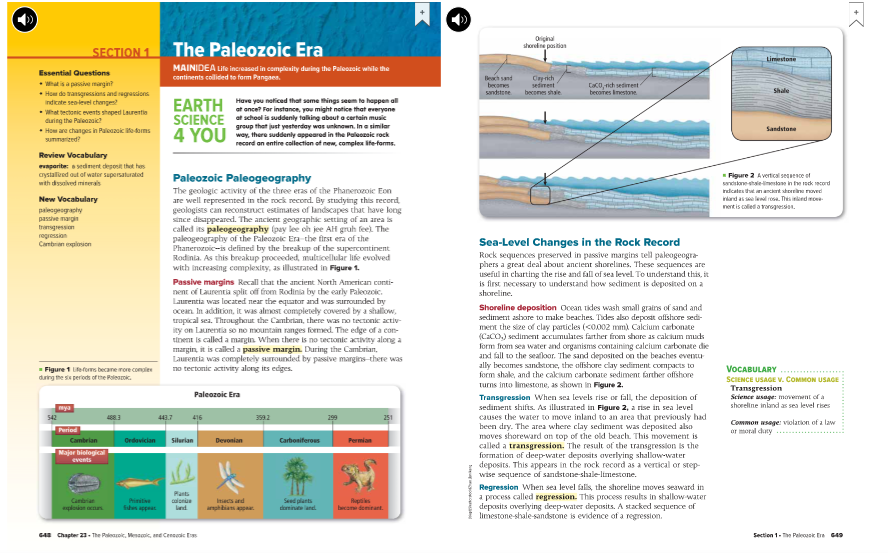
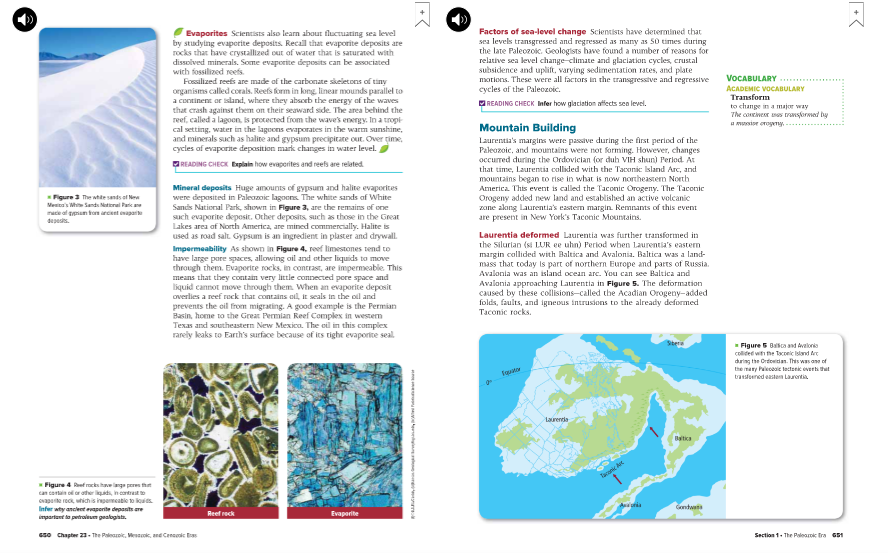
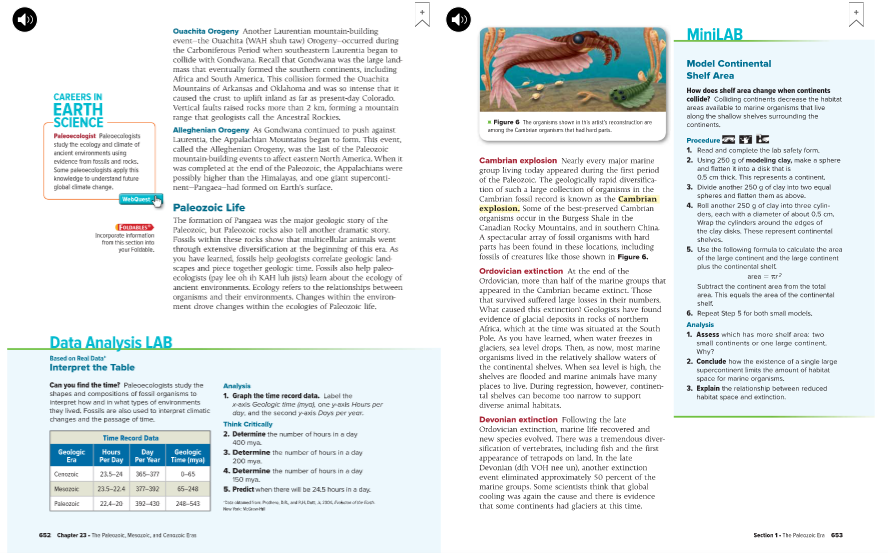
5. Evaporite minerals form in deep water environments, far from shore. 6. Oil deposits overlain by evaporate deposits rarely leak to the surface. 7. The Appalachian Mountains formed during the Alleghenian Orogeny. 8. The largest mass extinction occurred at the end of the Ordovician Period.
xcoledd1:
15. To what does the Cambrian “explosion” refer? a. the abrupt heating of Earth during the Cambrian b. the giant meteorite that struck Earth during the Cambrian c. the great increase in the diversity and abundance of life-forms during the Cambrian d. the abrupt increase in volcanic activity during the Cambrian 16. What development in animals created fossils that mark the Cambrian explosion? a. hard, mineralized skeletons b. gills c. jaws d. lobed fins In your textbook, read about reefs and evaporites of the late Paleozoic. Answer the following questions. 17. How did the formation of the Great Permian Reef Complex result in the formation of evaporites? ____________________________________________________________________________________________________________________________ ______________________________________ 18. What is found in the pore spaces of the Permian reefs of West Texas? _________________________________________________________________________________ 19. What happened to Laurasia during the Ouachita Orogeny? _________________________________________________________________________________ 20. What mountain range in and near present-day Colorado was uplifted by the collision of Gondwana and Laurasia? _________________________________________________________________________________ 21. What mountain range resulted from the Alleghenian Orogeny?_________________________________________________________________________________
xcoledd1:
xcoledd1:
xcoledd1:
The Paleozoic, Mesozoic, and Cenozoic Eras SECTION 23.1 The Paleozoic Era In your textbook, read about the continental setting of the early Paleozoic. For each statement below, write true or false. True 1. Paleogeography is the ancient geographic setting of an area. False 2. The ancient North American continent of Laurasia was once surrounded by ocean. True 3. Laurasia was surrounded by passive margins throughout the Cambrian Period. False 4. Carbonate sediments tend to accumulate in deep water as the calcium carbonate shells of organisms fall to the seafloor. False 5. Evaporite minerals form in deep water environments, far from shore. True 6. Oil deposits overlain by evaporate deposits rarely leak to the surface. True 7. The Appalachian Mountains formed during the Alleghenian Orogeny. False 8. The largest mass extinction occurred at the end of the Ordovician Period. In your textbook, read about changes in sea level during the early Paleozoic. Use each of the terms below to complete the following statements. carbonate-rich sediment clay-rich sediment limestone-shale-sandstone regression transgression vertical succession shoreline 9. A transgression occurs when sea level rises and the _________________ moves farther inland. 10. _________________ is found deposited in water slightly deeper than the beach. 11. A _________________ causes deep-water deposits to overlie shallow-water deposits. 12. A _________________ occurs when sea level falls resulting in the shoreline moving seaward. 13. A stacked sequence of _________________ deposits is evidence of a regression. 14. Sediments that are deposited adjacent to each other also end up in _________________ when sea level changes. In your textbook, read about early Paleozoic life. Circle the letter of the choice that best answers the question. 15. To what does the Cambrian “explosion” refer? a. the abrupt heating of Earth during the Cambrian b. the giant meteorite that struck Earth during the Cambrian c. the great increase in the diversity and abundance of life-forms during the Cambrian d. the abrupt increase in volcanic activity during the Cambrian 16. What development in animals created fossils that mark the Cambrian explosion? a. hard, mineralized skeletons b. gills c. jaws d. lobed fins In your textbook, read about reefs and evaporites of the late Paleozoic. Answer the following questions. 17. How did the formation of the Great Permian Reef Complex result in the formation of evaporites? __________________________________________________________________________________________________________________________________________________________________ 18. What is found in the pore spaces of the Permian reefs of West Texas? _________________________________________________________________________________ 19. What happened to Laurasia during the Ouachita Orogeny? _________________________________________________________________________________ 20. What mountain range in and near present-day Colorado was uplifted by the collision of Gondwana and Laurasia? _________________________________________________________________________________ 21. What mountain range resulted from the Alleghenian Orogeny?_________________________________________________________________________________
xcoledd1:
not 9-14
xcoledd1:
Join our real-time social learning platform and learn together with your friends!
 DoltonCarlee:
what are y'all's options on S A T essays because honestly their not that bad
DoltonCarlee:
what are y'all's options on S A T essays because honestly their not that bad

 thereneelg:
Can someone give me a summary of article 231, The war guilt clause?? I need to explain what it is, but I can't find any shortened version of what it is and
thereneelg:
Can someone give me a summary of article 231, The war guilt clause?? I need to explain what it is, but I can't find any shortened version of what it is and
 luisaam2:
What should you do when the person you want to talk to the most is the one making
luisaam2:
What should you do when the person you want to talk to the most is the one making
 Breathless:
https://medal.tv/games/roblox/clips/nAYivIl6oXB6q9QAI?invite=cr-MSxCSk4sMTY4OTA4N
Breathless:
https://medal.tv/games/roblox/clips/nAYivIl6oXB6q9QAI?invite=cr-MSxCSk4sMTY4OTA4N
 Twaylor:
I'm not that good at law can someone fact check this without bias? June 29, 2026, the Supreme Court decided Chatrie v.
Twaylor:
I'm not that good at law can someone fact check this without bias? June 29, 2026, the Supreme Court decided Chatrie v.
 Demon25:
For a hoco proposal with a cheerleader and football player, what else should be a
Demon25:
For a hoco proposal with a cheerleader and football player, what else should be a
