
 HelpMEH123:
Maya has $15 to spend. She spent $5.50, including tax, to buy a notebook. She needs to save $7.75, but she wants to buy a snack. If cookies cost $0.25 per package including tax, what inequality would show the maximum number of packages that Maya can buy? Solve your inequality by showing your work and steps.
HelpMEH123:
HELP MEH

 jimthompson5910:
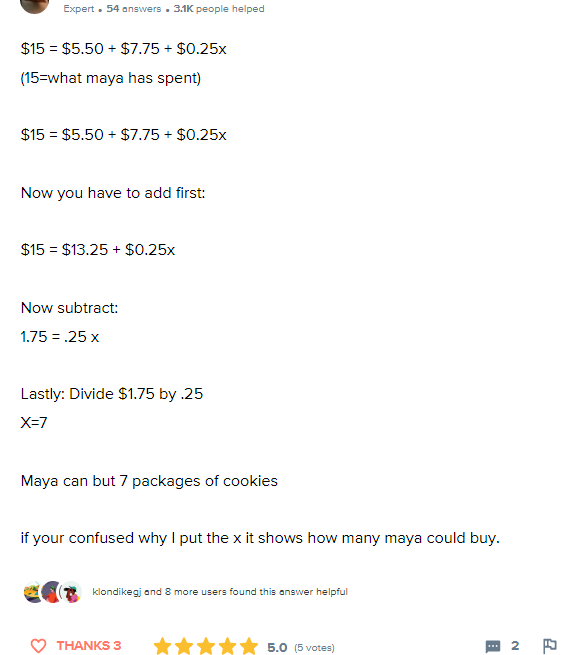
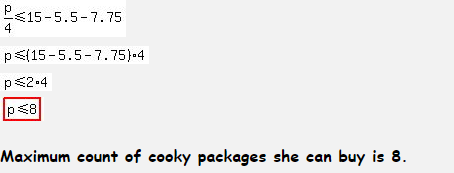
"Maya has $15 to spend" and "She needs to save $7.75" This means she can spend at most 15-7.75 = 7.25 dollars. If she spends any higher, then it will eat into the amount she wants to save. Now onto the next part " She spent $5.50" and "cookies cost $0.25 per package" This means she spends 5.50 + 0.25x x = number of packages she buys Because she spends 5.50 + 0.25x dollars and the most she can spend is 7.25 dollars, this means we can form the inequality \(\large 5.50 + 0.25x \le 7.25\) I'll let you solve for x

 jimthompson5910:
If x = 8, then, \(\large 5.50 + 0.25x \le 7.25\) \(\large 5.50 + 0.25*8 \le 7.25\) \(\large 5.50 + 2 \le 7.25\) \(\large 7.50 \le 7.25\) But the last inequality is false because 7.50 is actually larger than 7.25
jimthompson5910:
Though x = 7 does work because \(\large 5.50 + 0.25x \le 7.25\) \(\large 5.50 + 0.25*7 \le 7.25\) \(\large 5.50 + 1.75 \le 7.25\) \(\large 7.25 \le 7.25\) which is a true inequality
BluSaint:
wat de hek
Join our real-time social learning platform and learn together with your friends!
VERNEISH:
Two objects are moving along separate linear paths where each path is described by position, d, and time, t.

 Maci:
what are the best stock apps for people who want to start investing?
Maci:
what are the best stock apps for people who want to start investing?
 Twaylor:
genuienly how do i get better self control i keep watcing youtube and theres this
Twaylor:
genuienly how do i get better self control i keep watcing youtube and theres this
 IzzyCookie:
|dw:1792074056138:dw| Uhm, I don't know where to ask this, but I'm in college welding at my community college, and I need help learning vertical welding for
IzzyCookie:
|dw:1792074056138:dw| Uhm, I don't know where to ask this, but I'm in college welding at my community college, and I need help learning vertical welding for

 thehearken:
not sure if this is considered spam, im sorry if it is, but does anyone have tips
thehearken:
not sure if this is considered spam, im sorry if it is, but does anyone have tips