
 XioGonz:
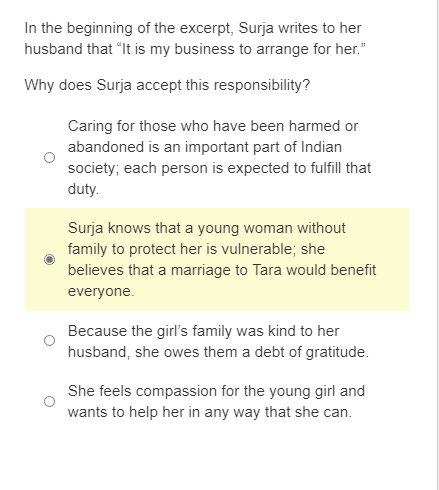
Please check my response. Read the passage. As Nagendra traveled downriver by boat, a fierce storm drove him to shore. While looking for shelter from the lashing rain, he came upon a dilapidated house where he found a girl of thirteen, Kunda Nandini, and her dying father. Unable to locate Kunda’s aunt in Calcutta, Nagendra wrote to his wife Surja Mukhi for assistance. excerpts from “Of Many and Subjects” and “Tara Charan” in The Poison Tree: A Tale of Hindu Life in Bengal by Bankim Chandra Chatterjee Surja Mukhi's reply to Nagendra's letter came in a few days. It was after this manner: "In picking up a little girl, have you forgotten me? Many unripe things are esteemed. People like green guavas, and green cucumbers; green cocoa-nuts are cooling. This low-born female is also, I think, very young, else in meeting with her why should you forget me? Joking apart, have you given up all right over this girl? If not, I beg her from you. It is my business to arrange for her. In whatever becomes yours I have the right to share, but in this case I see your sister has entire possession. Still, I shall not vex myself much if Kamal usurps my rights. "Do you ask what do I want with the girl? I wish to give her in marriage with Tara Charan. You know how much I have sought for a suitable wife for him. If Providence has sent us a good girl, do not disappoint me. If Kamal will give her up, bring Kunda Nandini with you when you come. I have written to Kamal also recommending this. I am having ornaments fashioned, and am making other preparations for the marriage. Do not linger in Calcutta. Is it not true that if a man stays six months in that city he becomes quite stupid? If you design to marry Kunda, bring her with you, and I will give her to you. Only say that you propose to marry her, and I will arrange the marriage-basket." Who Tara Charan was will be explained later. Whoever he was, both Nagendra and Kamal Mani consented to Surja Mukhi's proposal. Therefore it was resolved that when Nagendra went home Kunda Nandini should accompany him. Every one consented with delight, and Kamal also prepared some ornaments. Surja Mukhi's father's house was in Konnagar. Her father was a Kaystha of good position. He was cashier in some house at Calcutta. Surja Mukhi was his only child. In her infancy a Kaystha widow named Srimati lived in her father's house as a servant, and looked after Surja Mukhi. Srimati had one child named Tara Charan, of the same age as Surja Mukhi.
XioGonz:
With him Surja Mukhi had played, and on account of this childish association she felt towards him the affection of a sister. Srimati was a beautiful woman, and therefore soon fell into trouble. A wealthy man of the village, of evil character, having cast his eyes upon her, she forsook the house of Surja Mukhi's father. Whither she went no one exactly knew, but she did not return. Tara Charan, forsaken by his mother, remained in the house of Surja Mukhi's father, who was a very kind-hearted man, and brought up this deserted boy as his own child; not keeping him in slavery as an unpaid servant, but having him taught to read and write. Tara Charan learned English at a free mission-school. Afterwards Surja Mukhi was married, and some years later her father died. By this time Tara Charan had learned English after a clumsy fashion, but he was not qualified for any business. Rendered homeless by the death of Surja Mukhi's father, he went to her house. At her instigation Nagendra opened a school in the village, and Tara Charan was appointed master. Nowadays, by means of the grant-in-aid system in many villages, sleek-haired, song-singing, harmless Master Babus appear; but at that time such a being as a Master Babu was scarcely to be seen. Consequently, Tara Charan appeared as one of the village gods; especially as it was known in the bazaar that he had read the Citizen of the World, the Spectator, and three books of Euclid. On account of these gifts he was received into the Brahmo Samaj of Debendra Babu, the zemindar of Debipur, and reckoned as one of that Babu's retinue. Tara Charan wrote many essays on widow-marriage, on the education of women, and against idol-worship; read them weekly in the Samaj, and delivered many discourses beginning with "Oh, most merciful God!" Some of these he took from the Tattwa Bodhini, and some he caused to be written for him by the school pandit. He was forever preaching: "Abandon idol-worship, give choice in marriage, give women education; why do you keep them shut up in a cage? let women come out." There was a special cause for this liberality on the subject of women, inasmuch as in his own house there was no woman. Up to this time he had not married. Surja Mukhi had made great efforts to get him married, but as his mother's story was known in Govindpur, no respectable Kaystha consented to give him his daughter. Many a common, disreputable Kaystha girl he might have had; but Surja Mukhi, regarding Tara Charan as a brother, would not give her consent, since she did not choose to call such a girl sister-in-law. While she was seeking for a respectable Kaystha girl, Nagendra's letter came, describing Kunda Nandini's gifts and beauty. She resolved to give her to Tara Charan in marriage.
 Timmyspu:
That looks correct to me.
XioGonz:
Thank you!
Timmyspu:
No problem!
Join our real-time social learning platform and learn together with your friends!
 VERNEISH:
Two objects are moving along separate linear paths where each path is described by position, d, and time, t.
VERNEISH:
Two objects are moving along separate linear paths where each path is described by position, d, and time, t.

 Maci:
what are the best stock apps for people who want to start investing?
Maci:
what are the best stock apps for people who want to start investing?
 Twaylor:
genuienly how do i get better self control i keep watcing youtube and theres this
Twaylor:
genuienly how do i get better self control i keep watcing youtube and theres this
 IzzyCookie:
|dw:1792074056138:dw| Uhm, I don't know where to ask this, but I'm in college welding at my community college, and I need help learning vertical welding for
IzzyCookie:
|dw:1792074056138:dw| Uhm, I don't know where to ask this, but I'm in college welding at my community college, and I need help learning vertical welding for

 thehearken:
not sure if this is considered spam, im sorry if it is, but does anyone have tips
thehearken:
not sure if this is considered spam, im sorry if it is, but does anyone have tips