
 hhanan:
I think that it is the 2 one
 LjTheBaller16:
dats science
hhanan:
\(\color{#0cbb34}{\text{Originally Posted by}}\) @LjTheBaller16 dats science \(\color{#0cbb34}{\text{End of Quote}}\) its math
LjTheBaller16:
\(\color{#0cbb34}{\text{Originally Posted by}}\) @hhanan \(\color{#0cbb34}{\text{Originally Posted by}}\) @LjTheBaller16 dats science \(\color{#0cbb34}{\text{End of Quote}}\) its math \(\color{#0cbb34}{\text{End of Quote}}\) w.e bruh
hhanan:
@Convert could you help me
 Convert:
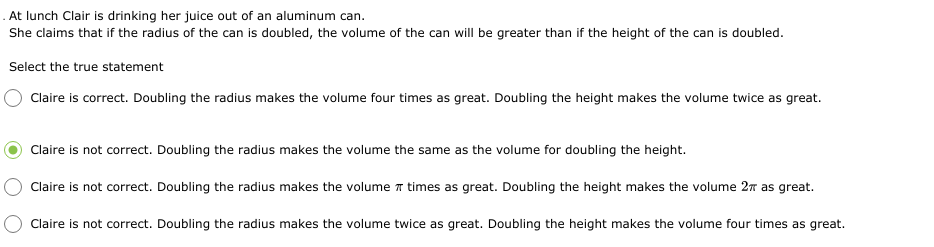
Okay so using this we can use an example: Formula: π(r^2)(h) Original: π(2^2)(2)=x π(4)(2)=x 12.57(2)=x 25.14=x Example 1 (doubling radius) : π(4^2)(2)=x π(16)(2)=x 50.27(2)=x 100.54=x Example 2 (doubling height) : π(2^2)(4)=x π(4)(4)=x 12.57(4)=x 50.28=x After seeing these we can see that example 1 is approximately twice of example 2. this concludes that the answer would be A, that the volume would be 4 times as great after doubling the radius and twice as great after doubling the height.
hhanan:
thank you
Convert:
\(\color{#0cbb34}{\text{Originally Posted by}}\) @hhanan thank you \(\color{#0cbb34}{\text{End of Quote}}\) I'm happy to help! :)
Join our real-time social learning platform and learn together with your friends!
 VERNEISH:
Two objects are moving along separate linear paths where each path is described by position, d, and time, t.
VERNEISH:
Two objects are moving along separate linear paths where each path is described by position, d, and time, t.

 Maci:
what are the best stock apps for people who want to start investing?
Maci:
what are the best stock apps for people who want to start investing?
 Twaylor:
genuienly how do i get better self control i keep watcing youtube and theres this
Twaylor:
genuienly how do i get better self control i keep watcing youtube and theres this
 IzzyCookie:
|dw:1792074056138:dw| Uhm, I don't know where to ask this, but I'm in college welding at my community college, and I need help learning vertical welding for
IzzyCookie:
|dw:1792074056138:dw| Uhm, I don't know where to ask this, but I'm in college welding at my community college, and I need help learning vertical welding for

 thehearken:
not sure if this is considered spam, im sorry if it is, but does anyone have tips
thehearken:
not sure if this is considered spam, im sorry if it is, but does anyone have tips