
 snowflake0531:
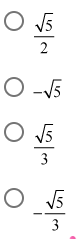
If sin Θ = 2 over 3 and tan Θ < 0, what is the value of cos Θ?
 AZ:
AZ:
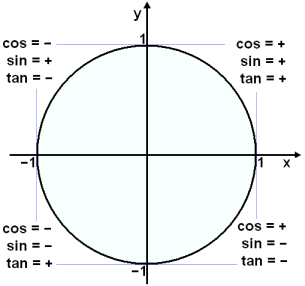
Hey! Do you know in which quadrant \(\sin\theta\) will be positive and \(\tan\theta\) will be negative?
snowflake0531:
yes, sin theta is positive when the y coordinate is positive, and tan is negative when either sin or cos is negative. i'm just thinking either the second or the last one is right
AZ:
That's good! And yes! We're able to eliminate those two answers because we know that cos has to be negative.
 snowflake0531:
um so is it the second or the fourth... both has values of a negative number
AZ:
Have you learned about the trigonometric identity \(\sin ^2\theta + \cos^2 \theta = 1\)
snowflake0531:
no? what's that
AZ:
It's called a trigonometric identity but basically it's like equations that involve trig functions that are always true
AZ:
And so we can use that to solve for \(\cos \theta\)
snowflake0531:
uh, how
AZ:
we know that \(\sin\theta = \dfrac{2}{3}\) \(\sin^2\theta = \left(\dfrac{2}{3} \right)^2\) What is \(\left(\dfrac{2}{3} \right)^2 = ?\)
snowflake0531:
4/9
AZ:
\(\sin ^2\theta + \cos^2 \theta = 1\) So now we get \(\dfrac{4}{9} + \cos^2 \theta = 1\) What is 1 - 4/9? And let's try to keep it as a fraction
snowflake0531:
5/9
AZ:
Good! So now we get \(\cos^2\theta = \dfrac{5}{9}\) and that's \(\cos^2 \theta\) and we want \(\cos\theta\) so we take the square root on both sides! Does that make sense? So \(\cos\theta = \sqrt{\dfrac{5}{9}}\) Can you simplify that? Remember \(\sqrt{\dfrac{a}{b}} = \dfrac{\sqrt{a}}{\sqrt{b}}\)
snowflake0531:
it would be sqrt5/sqrt9, simplify- sqrt5/3
snowflake0531:
oh
snowflake0531:
ohhhhhhhh, i see, thxxxxxxxxxxxx
AZ:
Good! So we know it's sqrt(5)/3 But remember the first thing we mentioned? \(\cos\theta\) has to be negative so it'll be -sqrt(5)/3
snowflake0531:
oh, right lol, well, thxx
AZ:
Of course!!! It was my pleasure :)
snowflake0531:
lol
AZ:
\(\color{#0cbb34}{\text{Originally Posted by}}\) @AZ Good! So we know it's sqrt(5)/3 But remember the first thing we mentioned? \(\cos\theta\) has to be negative so it'll be -sqrt(5)/3 \(\color{#0cbb34}{\text{End of Quote}}\) the - got stuck in the previous line but \( - \dfrac{\sqrt{5}}{3}\)
snowflake0531:
thx
AZ:
You're welcome!
Join our real-time social learning platform and learn together with your friends!
 VERNEISH:
Two objects are moving along separate linear paths where each path is described by position, d, and time, t.
VERNEISH:
Two objects are moving along separate linear paths where each path is described by position, d, and time, t.

 Maci:
what are the best stock apps for people who want to start investing?
Maci:
what are the best stock apps for people who want to start investing?
 Twaylor:
genuienly how do i get better self control i keep watcing youtube and theres this
Twaylor:
genuienly how do i get better self control i keep watcing youtube and theres this
 IzzyCookie:
|dw:1792074056138:dw| Uhm, I don't know where to ask this, but I'm in college welding at my community college, and I need help learning vertical welding for
IzzyCookie:
|dw:1792074056138:dw| Uhm, I don't know where to ask this, but I'm in college welding at my community college, and I need help learning vertical welding for

 thehearken:
not sure if this is considered spam, im sorry if it is, but does anyone have tips
thehearken:
not sure if this is considered spam, im sorry if it is, but does anyone have tips