
 iuytyuioiuytyuiop:
Use the number line to express the following: The set of all numbers greater than 2.
 iuytyuioiuytyuiop:
@AZ
 AZ:
AZ:
so greater than is that going to be a shaded circle or an empty one?
AZ:
and when it goes to infinity, it has to be an empty circle |dw:1614797215652:dw|
iuytyuioiuytyuiop:
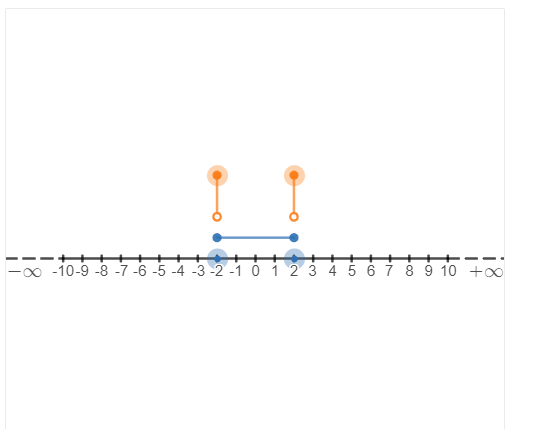
Submit your answer by dragging the movable blue points on the number line. For an interval that extends to +∞ or −∞ move the blue points to the right or left end of the number line (shown as a dashed line). You can select whether each endpoint of your chosen interval is open or closed by sliding the respective orange switches up or down. Note that the blue line segment above the number line indicates the interval you have chosen and whether the endpoints are open or closed.
AZ:
See now there's some instructions!
AZ:
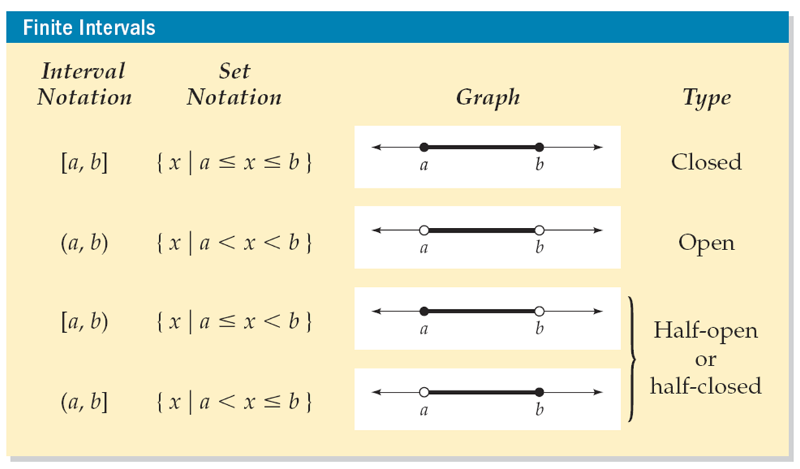
so when I say shaded, what I mean is that the endpoint is CLOSED when I say empty, that means the endpoint is OPEN
 iuytyuioiuytyuiop:
yep
AZ:
so where are you going to place your points? where do the two ends go
iuytyuioiuytyuiop:
it says set of all numbers so I don't know where to put the first point
AZ:
basically we're saying x is greater than 2 x > 2
AZ:
Set of all numbers means x can be any number that is greater than 2 Does that make sense?
iuytyuioiuytyuiop:
yep
AZ:
so where would you place the two points? one of them has to be infinity because x can be 2342352346226 and that's greater than 2 where would the other point be at?
iuytyuioiuytyuiop:
the other point is at 2?
AZ:
obviously! Good job!
AZ:
now remember what we said earlier and even in your last question? If we have < or > then it has to be an OPEN or UNSHADED or EMPTY circle if it's ≤ or ≥ then it has to be a CLOSED or SHADED circle you got that?
AZ:
so the point at 2, is it open or closed?
iuytyuioiuytyuiop:
point 2 is closed?
iuytyuioiuytyuiop:
if it's infinity it can be 1?
AZ:
is the symbol ≥ or > will it be open or closed?
AZ:
for infinity, it has to be OPEN because infinity isn't exactly a number it's just saying that the number can go on and on
iuytyuioiuytyuiop:
is point 2 closed?
AZ:
no... read what I said is the symbol ≥ or > remember we have x > 2 \(\color{#0cbb34}{\text{Originally Posted by}}\) @AZ now remember what we said earlier and even in your last question? If we have < or > then it has to be an OPEN or UNSHADED or EMPTY circle if it's ≤ or ≥ then it has to be a CLOSED or SHADED circle you got that? \(\color{#0cbb34}{\text{End of Quote}}\)
iuytyuioiuytyuiop:
point 2 is an empty circle
iuytyuioiuytyuiop:
i said is point 2 closed if an empty circle is closed then I got it correct??!!
AZ:
(I'm only using the words open and closed because that's what it said in your instruction)
AZ:
an empty circle is open
AZ:
so both of our circles have to be empty/open or basically not shaded
Join our real-time social learning platform and learn together with your friends!
VERNEISH:
Two objects are moving along separate linear paths where each path is described by position, d, and time, t.

 Maci:
what are the best stock apps for people who want to start investing?
Maci:
what are the best stock apps for people who want to start investing?
 Twaylor:
genuienly how do i get better self control i keep watcing youtube and theres this
Twaylor:
genuienly how do i get better self control i keep watcing youtube and theres this
 IzzyCookie:
|dw:1792074056138:dw| Uhm, I don't know where to ask this, but I'm in college welding at my community college, and I need help learning vertical welding for
IzzyCookie:
|dw:1792074056138:dw| Uhm, I don't know where to ask this, but I'm in college welding at my community college, and I need help learning vertical welding for

 thehearken:
not sure if this is considered spam, im sorry if it is, but does anyone have tips
thehearken:
not sure if this is considered spam, im sorry if it is, but does anyone have tips