
 kamachavis:
Can I get some Chemistry help?
 snowflake0531:
@AZ
kamachavis:
@AZ
kamachavis:
If a reaction follows the rate constant rate = k[A], what would be the units on the rate constant? Group of answer choices L/mol-s s 1/s mol/L-s
kamachavis:
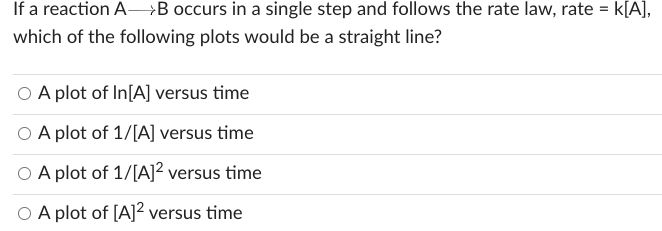
If a reaction ALaTeX: \longrightarrow⟶B occurs in a single step and follows the rate law, rate = k[A], which of the following plots would be a straight line? Group of answer choices A plot of ln[A] versus time A plot of 1/[A] versus time A plot of 1/[A]2 versus time A plot of [A]2 versus time
 kamachavis:
That's the second question in picture form
 AZ:
AZ:
one question at a time haha
kamachavis:
Okay my bad, thats just two questions and I had to send a picture of the second one because it messed up in the text.
AZ:
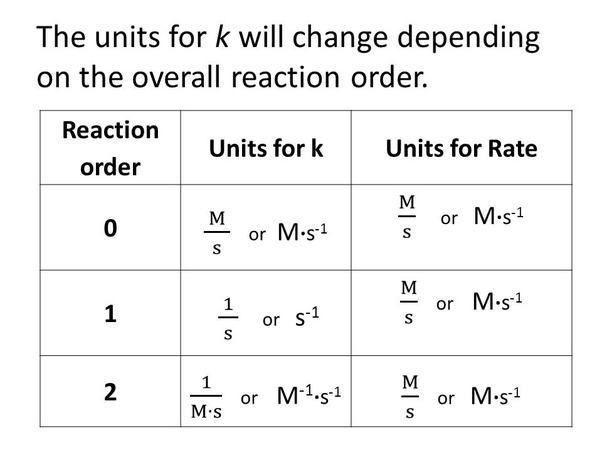
For the first question, it's something you need to understand and then figure it out or you can just straight up memorize it reaction rate has units of M/s but the units for the constant, k, will depend on the order of the reaction so if was a zero order rate = k * [A]^0 rate = k so k has the same units as the rate so it would be M/s (that's Molar which is moles/liter, just in case you weren't aware) if it was first order, now you have rate = k * [A]^1 we know the units for rate are M/s and [A] has units of M so the units for K has to be just 1/s and similarly for second order rate = k * [A]^2 M/s = ?? * M^2 and if you divide M^2 on both sides to determine the units of k in a second order reaction, you'll see that the units are 1/(M*s) so it's just something you need to memorize or if you understand it, something you can just derive and figure out
 AZ:
AZ:
remember that M = moles of liter so you can replace that but be careful when dealing with the fractions
kamachavis:
So the first question would be L/mol-s
kamachavis:
I know its not mol/L-s for a fact.
AZ:
\(\color{#0cbb34}{\text{Originally Posted by}}\) @kamachavis So the first question would be L/mol-s \(\color{#0cbb34}{\text{End of Quote}}\) That's correct
AZ:
M^-1 s^-1 and 1/M is going to be 1/(moles/liter) = liters/mole
AZ:
so good job :)
kamachavis:
I have a feeling that the second question is "A plot of 1/[A]^2 versus time"
kamachavis:
But I am not sure that is why I came here to check behind myself.
kamachavis:
\(\color{#0cbb34}{\text{Originally Posted by}}\) @AZ so good job :) \(\color{#0cbb34}{\text{End of Quote}}\) Thank you!
AZ:
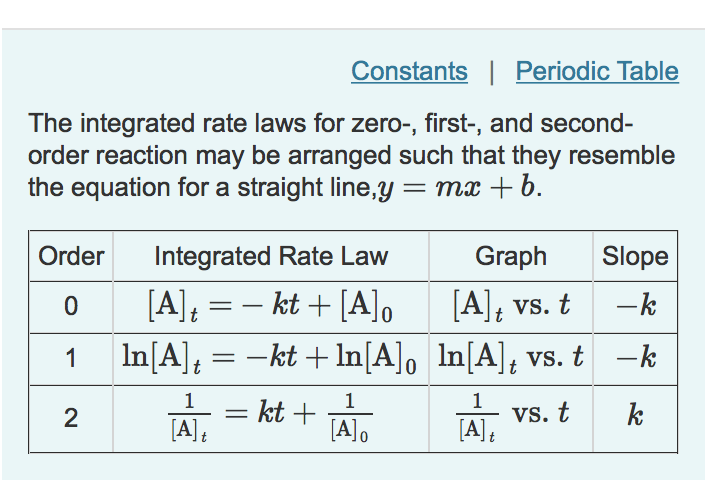
For your second question, once again, you're going to have to memorize the equations and then think of the equations as if they're in the form of y = mx + b t is the variable that changes (basically our 'x') so the slope is going to be k or -k the other term being added is the constant and y would be whatever is on the other side of the equal sign and so the graph would be y vs x
 kamachavis:
so it would be ln[A]
kamachavis:
a plot of ln[a] versus time
AZ:
\(\color{#0cbb34}{\text{Originally Posted by}}\) @kamachavis a plot of ln[a] versus time \(\color{#0cbb34}{\text{End of Quote}}\) exactly, because it's a first order reaction
kamachavis:
Thank you!
AZ:
You're welcome!
Join our real-time social learning platform and learn together with your friends!
VERNEISH:
Two objects are moving along separate linear paths where each path is described by position, d, and time, t.

 Maci:
what are the best stock apps for people who want to start investing?
Maci:
what are the best stock apps for people who want to start investing?
 Twaylor:
genuienly how do i get better self control i keep watcing youtube and theres this
Twaylor:
genuienly how do i get better self control i keep watcing youtube and theres this
 IzzyCookie:
|dw:1792074056138:dw| Uhm, I don't know where to ask this, but I'm in college welding at my community college, and I need help learning vertical welding for
IzzyCookie:
|dw:1792074056138:dw| Uhm, I don't know where to ask this, but I'm in college welding at my community college, and I need help learning vertical welding for

 thehearken:
not sure if this is considered spam, im sorry if it is, but does anyone have tips
thehearken:
not sure if this is considered spam, im sorry if it is, but does anyone have tips