
 sofiabas50923:
Once she completes a wall, Sabrina notices that the number of squares along each side of the wall is equal to the number of square centimeters in each tile’s area. Write an equation for the number of squares on the wall, SW, in terms of c. Then, solve for the number of squares on the wall. In the previous question the answer to the area of the tiles is 100
Fadlalmola:
Methode of generating random number from bilateral distribution
 jhonyy9:
@AZ idk if i understand it right - maybe something in this way xSW = 100c ???
 AZ:
AZ:
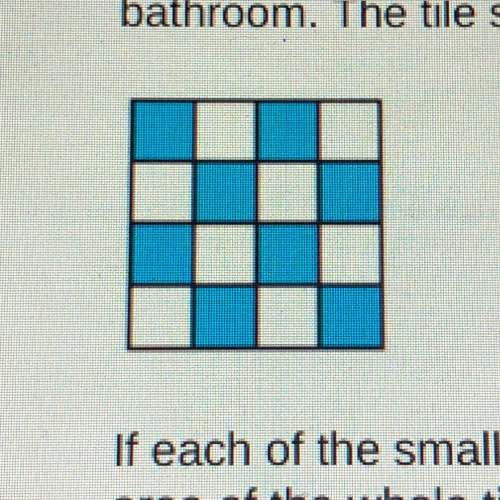
So building off the actual complete question found here: https://questioncove.com/study#/updates/5ecd592442373adbcae2c40 Here is the complete information regarding this part: Part E After seeing her remodeled bathroom, Paulina’s friend Sabrina also wants to remodel her bathroom. The tile she has chosen is shown below. a square tile in a blue and white checkerboard pattern with four small squares per side If all of the smaller squares have sides c centimeters long, write an expression for the area of the whole tile, AT, and find the area of the tile if the length of the small squares is 2.5 centimeters. Part F Once she completes a wall, Sabrina notices that the number of squares along each side of the wall is equal to the number of square centimeters in each tile’s area. Write and solve an equation for the number of squares on the wall, SW.
 AZ:
AZ:
So the answer to part E was 100 cm^2 according to OP In Part F We were originally told `number of squares along each side of the wall is equal to the number of square centimeters in each tile’s area.` And we want to `Write an equation for the number of squares on the wall, SW, in terms of c` we know that the smaller squares have sides c centimeter long so the area of the entire tile is (4c)^2 = 16c^2 (which is something you've already determined in part E) SW is how many squares there are on the wall so sqrt(SW) would give us the number of squares along each side of the wall number of square centimeters in each tile’s area would be the area of the tile but none of the numbers make sense to make that original statement true so
AZ:
@surjithayer would you like to give this question an attempt?
Join our real-time social learning platform and learn together with your friends!
VERNEISH:
Two objects are moving along separate linear paths where each path is described by position, d, and time, t.

 Maci:
what are the best stock apps for people who want to start investing?
Maci:
what are the best stock apps for people who want to start investing?
 Twaylor:
genuienly how do i get better self control i keep watcing youtube and theres this
Twaylor:
genuienly how do i get better self control i keep watcing youtube and theres this
 IzzyCookie:
|dw:1792074056138:dw| Uhm, I don't know where to ask this, but I'm in college welding at my community college, and I need help learning vertical welding for
IzzyCookie:
|dw:1792074056138:dw| Uhm, I don't know where to ask this, but I'm in college welding at my community college, and I need help learning vertical welding for

 thehearken:
not sure if this is considered spam, im sorry if it is, but does anyone have tips
thehearken:
not sure if this is considered spam, im sorry if it is, but does anyone have tips