
 xxcoffee:
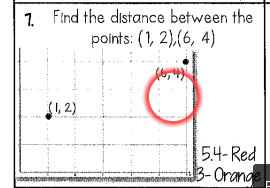
agian sorry guys pythagorean theorem
 xxcoffee:
@MrMudd183
 MrMudd183:
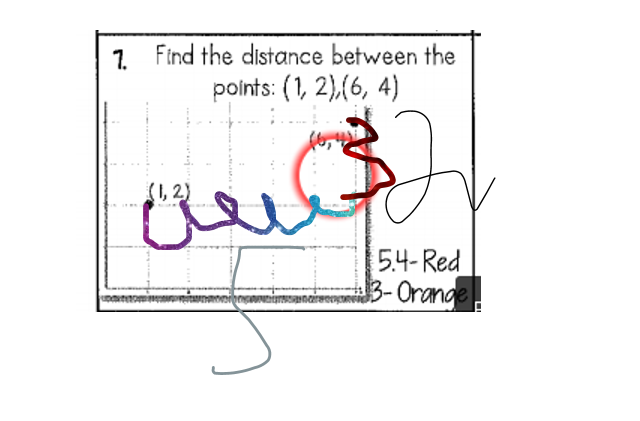
So here's what I would do in this... They provide a grid on this problem, so count up the units between each line the plots fall on. I will do an example on the provided picture
 MrMudd183:
So after we count the distance between the plots, we have the units for A^2 and B^2 Now the order you place them in doesn't matter
xxcoffee:
\(\color{#0cbb34}{\text{Originally Posted by}}\) @MrMudd183 So after we count the distance between the plots, we have the units for A^2 and B^2 Now the order you place them in doesn't matter \(\color{#0cbb34}{\text{End of Quote}}\) ight so it wuld be 5² +3²=2²
MrMudd183:
Not quite
MrMudd183:
The triangle is 5 units across, and 2 units upwards
xxcoffee:
ohh
MrMudd183:
After that, you would square the 2 and 5 then add them together to get C whenever it's squared....to find the true answer, you would have to take the squareroot of the product of A and B after you square them and add them
xxcoffee:
huhhhhhhh
xxcoffee:
u gotta dumb that down for me
MrMudd183:
Let me rephrase After you add square A & B, and after you add them together, that will give you the product of C whenever it's squared To find the true unit measurement, you would have to take the squareroot of C
xxcoffee:
sooo 2²+5² then go on
MrMudd183:
\(\color{#0cbb34}{\text{Originally Posted by}}\) @xxcoffee sooo 2²+5² then go on \(\color{#0cbb34}{\text{End of Quote}}\) First you square the 2, then square the 5
xxcoffee:
kk
MrMudd183:
After you square them, you add them together to get the squared product of C
xxcoffee:
ohh
MrMudd183:
And to find the actual product of C, you would have to take the squareroot of it
xxcoffee:
5.38 ?
xxcoffee:
noo 5.4
MrMudd183:
\(\color{#0cbb34}{\text{Originally Posted by}}\) @xxcoffee noo 5.4 \(\color{#0cbb34}{\text{End of Quote}}\) Yep, correct
xxcoffee:
\(\color{#0cbb34}{\text{Originally Posted by}}\) @MrMudd183 \(\color{#0cbb34}{\text{Originally Posted by}}\) @xxcoffee noo 5.4 \(\color{#0cbb34}{\text{End of Quote}}\) Yep, correct \(\color{#0cbb34}{\text{End of Quote}}\) yayy
Join our real-time social learning platform and learn together with your friends!
 VERNEISH:
Two objects are moving along separate linear paths where each path is described by position, d, and time, t.
VERNEISH:
Two objects are moving along separate linear paths where each path is described by position, d, and time, t.

 Maci:
what are the best stock apps for people who want to start investing?
Maci:
what are the best stock apps for people who want to start investing?
 Twaylor:
genuienly how do i get better self control i keep watcing youtube and theres this
Twaylor:
genuienly how do i get better self control i keep watcing youtube and theres this
 IzzyCookie:
|dw:1792074056138:dw| Uhm, I don't know where to ask this, but I'm in college welding at my community college, and I need help learning vertical welding for
IzzyCookie:
|dw:1792074056138:dw| Uhm, I don't know where to ask this, but I'm in college welding at my community college, and I need help learning vertical welding for

 thehearken:
not sure if this is considered spam, im sorry if it is, but does anyone have tips
thehearken:
not sure if this is considered spam, im sorry if it is, but does anyone have tips