
 jknkjkjnjjjkl:
math problem
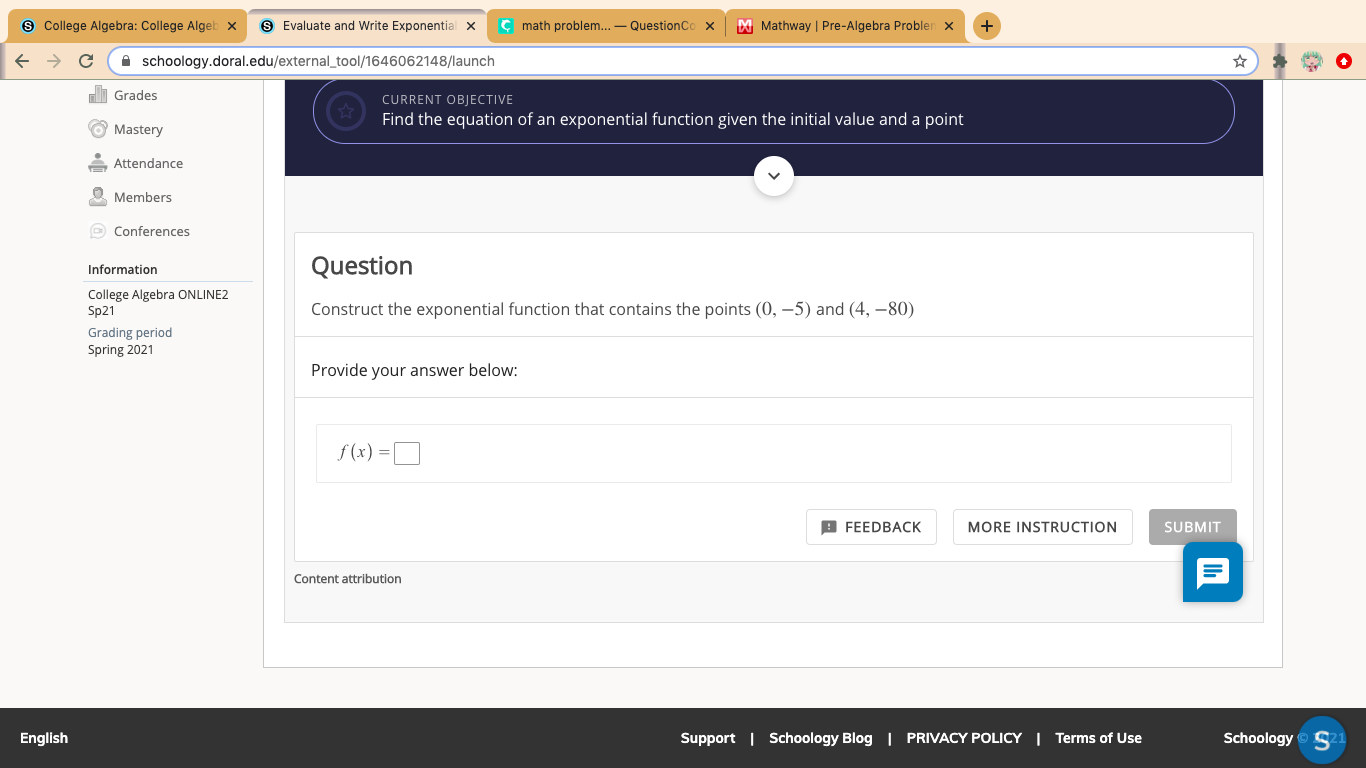 jknkjkjnjjjkl:
@florisalreadytaken
jknkjkjnjjjkl:
@snowflake0531
Florisalreadytaken:
ok, so following your previous post, we will do it the way it explained it -- so the form we want it to be is\[ f(x)=a(b)^x \] right?
jknkjkjnjjjkl:
yep
Florisalreadytaken:
"Since the points have consecutive x values, the ratio of the y values gives the common ratio" \( \frac{-80}{-5} \Rightarrow b= 16 \) thus, \[ f(x)=a(16)^x \]
jknkjkjnjjjkl:
thanks
Florisalreadytaken:
we're not done yet haha
Florisalreadytaken:
we have to plug in the values for the 1st point: \[ -5 =a(16)^0 \Rightarrow a=? \]
jknkjkjnjjjkl:
a
Florisalreadytaken:
?
jknkjkjnjjjkl:
a=-5
Florisalreadytaken:
great! \[ a=-5 \] thus, we end up on this formula: \[ f(x)=-5 · (16)^x \]
jknkjkjnjjjkl:
thanks
Florisalreadytaken:
DO NOT forget the exponential \(x\) haha
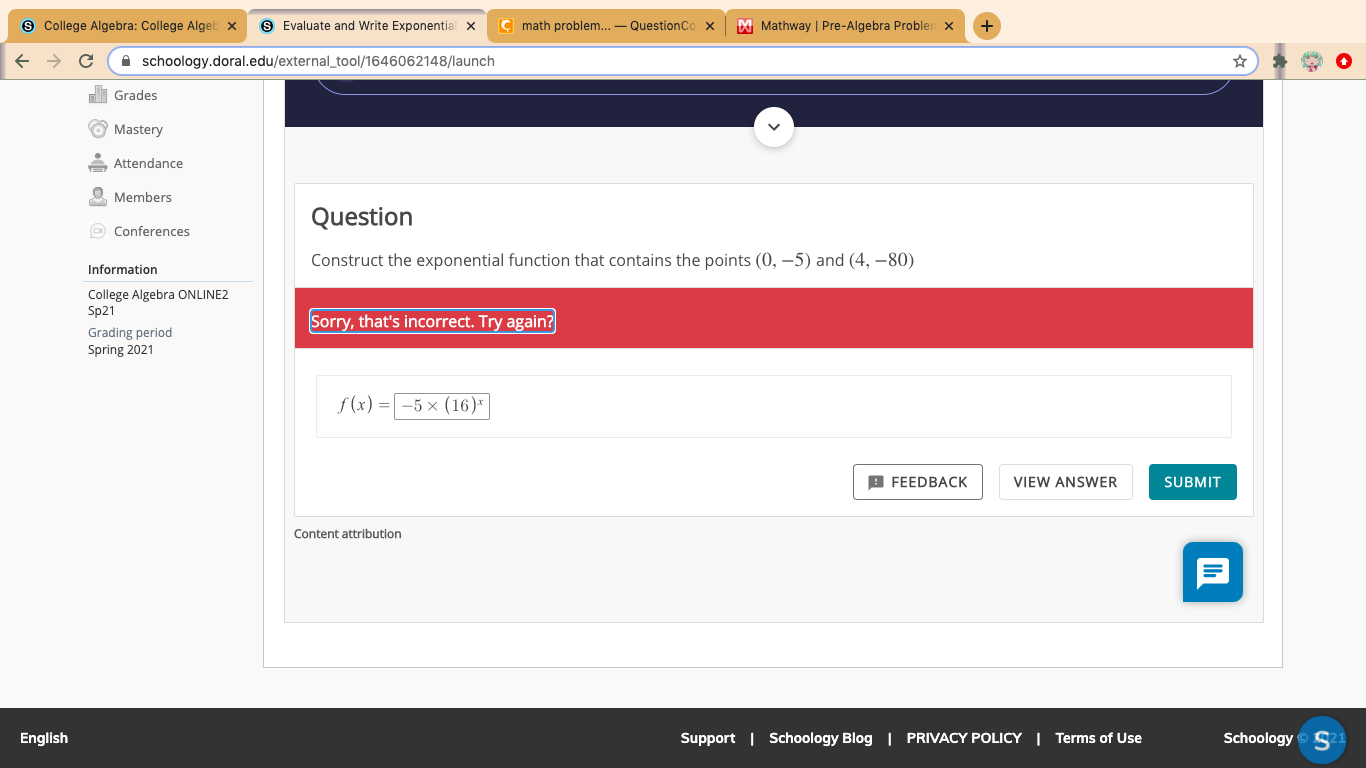 Florisalreadytaken:
ahh lapsus -- we have to solve for b too... let's do that then plug in the values of the 2nd point: \[ −80=(−5) * b^4 \] \[ b=2 \] THUS, we get this equation: \[ \Large f(x)=-5 \cdot 2^{x} \]
Join our real-time social learning platform and learn together with your friends!
VERNEISH:
Two objects are moving along separate linear paths where each path is described by position, d, and time, t.

 Maci:
what are the best stock apps for people who want to start investing?
Maci:
what are the best stock apps for people who want to start investing?
 Twaylor:
genuienly how do i get better self control i keep watcing youtube and theres this
Twaylor:
genuienly how do i get better self control i keep watcing youtube and theres this
 IzzyCookie:
|dw:1792074056138:dw| Uhm, I don't know where to ask this, but I'm in college welding at my community college, and I need help learning vertical welding for
IzzyCookie:
|dw:1792074056138:dw| Uhm, I don't know where to ask this, but I'm in college welding at my community college, and I need help learning vertical welding for

 thehearken:
not sure if this is considered spam, im sorry if it is, but does anyone have tips
thehearken:
not sure if this is considered spam, im sorry if it is, but does anyone have tips