
 theyadoreshayyy:
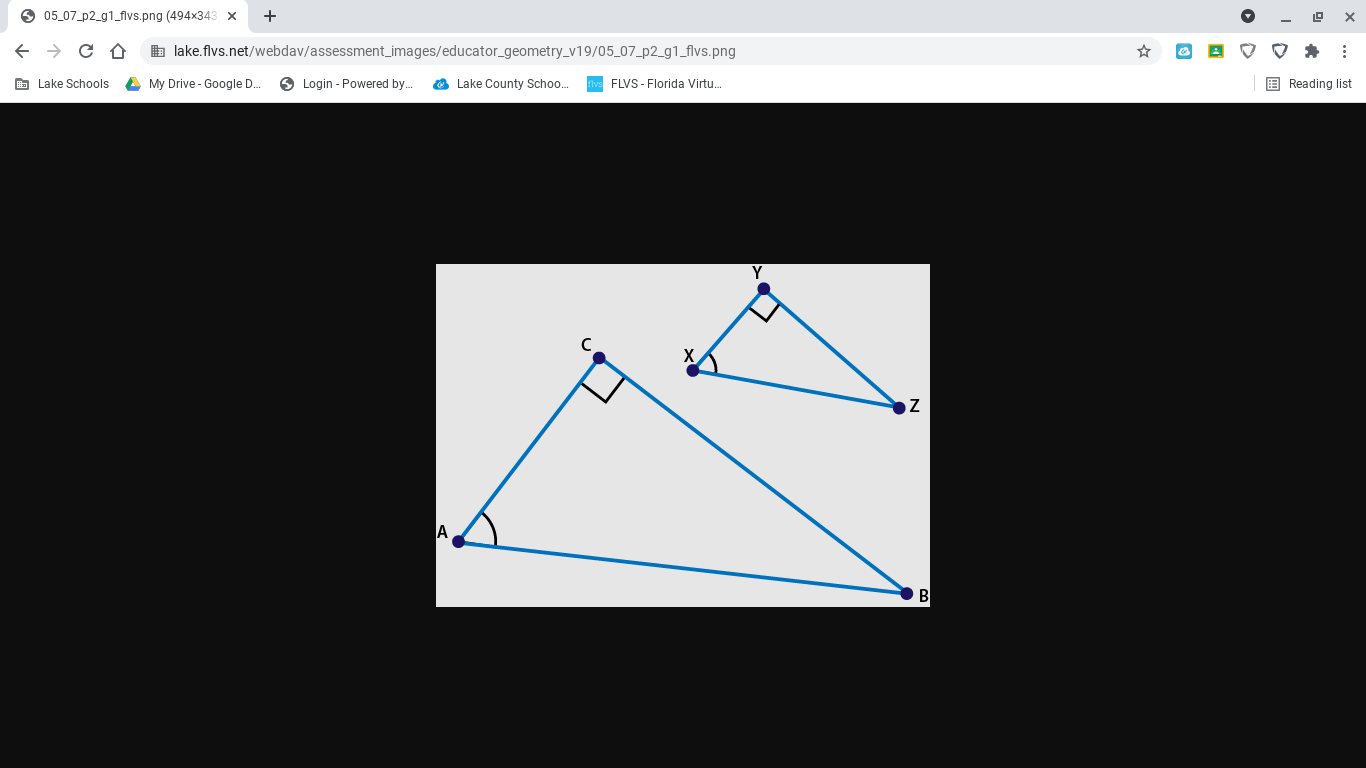
Triangle XYZ was dilated by a scale factor of 2 to create triangle ACB and tan ∠X = 5 over 2 and 5 tenths. Part A: Use complete sentences to explain the special relationship between the trigonometric ratios of triangles XYZ and ACB. You must show all work and calculations to receive full credit. Part B: Explain how to find the measures of segments AC and CB. You must show all work and calculations to receive full credit.
 Imagine:
Hi, I will be answering your question, do you have any questions for me off the start?
theyadoreshayyy:
yes, how exactly do i solve trigonometric ratios ?
Imagine:
Well, you will be using this Equation; \[\sin \theta=\frac{ a }{ h }\] Could you go further into explaining what you need help with?
theyadoreshayyy:
well i dont know how to solve the question
Imagine:
Okay, so; \[\theta=\] Angle Theta \[a=\] Length of the opposite side a \[h=\] Length of hypotenuse h Does that help a little?
theyadoreshayyy:
yes a little, but what numbers do i put for a and h ?
Imagine:
I will give you some formulas that are labeled. " b mid-length " c hypotenuse angle "a" which is the (alpha) opposite side a " β(beta) " " b " y(gamma) " " c The major formal you're going to want to use to solve this equation is: \[a^2+b^2=c^2\]
Imagine:
As for solving <ACB; the angle is y which is a right angle.
Imagine:
Now, Given that: \[\tan<x=\frac{ 5 }{ 2 }+\frac{ 1 }{ 2 }=\frac{ 6 }{ 2 }=3atan=71.565=\beta \] That meaning : \[a=18.44\] Also given, \[y=rt~<\] To get the sides use the formulas, use both: \[a^2+b^2=c^2\] & \[a/\sin~a=b/\sin \beta=c~\sin~y\] Also, Remeber: \[a+\beta+y=180^{o}\]
Imagine:
@snowflake0531- your thoughts, please. tyvm
 snowflake0531:
the 'special relationship' is just that they're similar, and that the sides are proportional to one another, I think Because with proportional sides and equal angles, the fraction on the other side of the equal sign reduces/simplifies to the other fraction, in simpler form. For example, if itwas sin(35) = 5/7, and the other triangle's equation was sin(35) = 10/14, it simplifies to 4/6, and so it proves that the sides are proportional So for Par tA to prove ^^^^ Just take the sin, cos, or tangent, doesn't really matter which, but then do the same sin/cos/tan with the other triangle to prove that the equation ends up being the same, I think o-O
Join our real-time social learning platform and learn together with your friends!
 VERNEISH:
Two objects are moving along separate linear paths where each path is described by position, d, and time, t.
VERNEISH:
Two objects are moving along separate linear paths where each path is described by position, d, and time, t.

 Maci:
what are the best stock apps for people who want to start investing?
Maci:
what are the best stock apps for people who want to start investing?
 Twaylor:
genuienly how do i get better self control i keep watcing youtube and theres this
Twaylor:
genuienly how do i get better self control i keep watcing youtube and theres this
 IzzyCookie:
|dw:1792074056138:dw| Uhm, I don't know where to ask this, but I'm in college welding at my community college, and I need help learning vertical welding for
IzzyCookie:
|dw:1792074056138:dw| Uhm, I don't know where to ask this, but I'm in college welding at my community college, and I need help learning vertical welding for

 thehearken:
not sure if this is considered spam, im sorry if it is, but does anyone have tips
thehearken:
not sure if this is considered spam, im sorry if it is, but does anyone have tips