
 Username0:
Physics
 xxemilianaxx:
https://www.khanacademy.org/science/high-school-physics/forces-and-newtons-laws-of-motion/newtons-second-law/v/newton-s-second-law-of-motion i hope this helps
 lazyking4life:
what u solve for
 darkknight:
net torque * time = L where L is angular momentum Fnet = m*a is newton's second law
lazyking4life:
Multiply to remove the faction then set equal to 0 and solve L=tt
Username0:
What? That doesn't make any sense.
darkknight:
net torque = a force times distance applied from the AOR (axis of rotation) L is measured in rotational inertia times angular velocity, units of mR^2 and w^2 where w = v/R so angular momentum in mv^2 because mR^2*(v^2/R^2) = mv^2
darkknight:
lazyking4life:
i didnt mean to send that
darkknight:
actually I dont remember how to do this exactly off the top of my head, ill have to look at my notes which ill do after school ^.^
 Itzjxdn14:
huh
Florisalreadytaken:
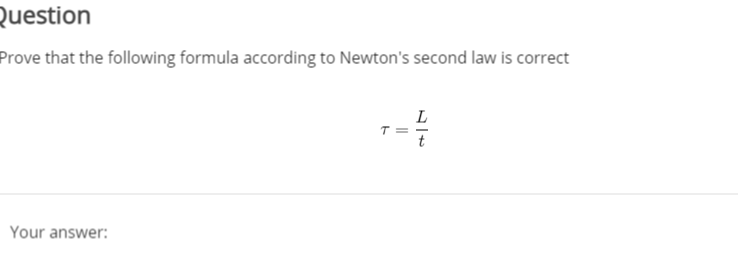
mmh batman has got an idea, but not up the pole for what we're asked -- so this quite a wide topic so imma try and make it as short as possible -- since we are into angular momentum we know that \( L= I \times \omega \) AND \( L_0=I \times \omega \) right? acoording to the 2nd law of newton we know that \( \sum \tau = I \times \alpha \) as mass is replaced by \( I\), and accleration by \( \alpha \). to get a little deeper into the formula itself, we can break alpha into its formula: \[ \sum \tau = I \times \frac{\Delta \omega}{\Delta t}\] is it all clear till now?
Username0:
Yes
Florisalreadytaken:
Great! so now we can write delta omega as the change of both omegas: \[ \sum \tau = I \times \frac{ ( \omega-\omega_0)}{\Delta t} \] that is the same as writing: \[ \sum \tau = \frac{ I \times\omega- I \times\omega_0}{\Delta t} \] clear?
Florisalreadytaken:
another formula comes into the game, and that is \( \Delta L= I \times\omega- I \times\omega_0 \) knowing that we can put that into the equation we were doing: \( \sum \tau = \frac{\Delta L}{\Delta t} \Rightarrow \sum \tau = \frac{L-L_0}{\Delta t} \) any idea what we are going to do now? look at the first reply i made.
Username0:
We write delta t as t1-t0?
Florisalreadytaken:
youre actually right! \[ \sum \tau = \frac{\Delta L}{t-t_0} \] \( t_0=0 \) right? thats why we write that expression as: \[ \sum \tau = \frac{\Delta L}{t-\cancel{t_0}} \Rightarrow \sum \tau = \frac{\Delta L}{t} \] remeber when i said that \( L_0=I \times \omega_0 \) ? if \( \omega \) is 0, it means that \( L_0 \) is 0 as well yes?
Username0:
So we cancel l0 out just ike we did with t0?
Florisalreadytaken:
yes, well done! so we get: \[ \sum \tau = \frac{L-L_0}{t} \Rightarrow \sum \tau = \frac{L-\cancel{L_0}}{t} \] \[ \sum \tau = \frac{L}{t} \] and here it is -- we have confirmed that!
Username0:
Thanks
Join our real-time social learning platform and learn together with your friends!
VERNEISH:
Two objects are moving along separate linear paths where each path is described by position, d, and time, t.

 Maci:
what are the best stock apps for people who want to start investing?
Maci:
what are the best stock apps for people who want to start investing?
 Twaylor:
genuienly how do i get better self control i keep watcing youtube and theres this
Twaylor:
genuienly how do i get better self control i keep watcing youtube and theres this
 IzzyCookie:
|dw:1792074056138:dw| Uhm, I don't know where to ask this, but I'm in college welding at my community college, and I need help learning vertical welding for
IzzyCookie:
|dw:1792074056138:dw| Uhm, I don't know where to ask this, but I'm in college welding at my community college, and I need help learning vertical welding for

 thehearken:
not sure if this is considered spam, im sorry if it is, but does anyone have tips
thehearken:
not sure if this is considered spam, im sorry if it is, but does anyone have tips