
 remi2019:
Ali is at a charity fundraiser and has a chance of receiving a gift. The odds in favor of receiving a gift are 4/19. Find the probability of Ali receiving a gift.
 Extrinix:
Simple, just divide 4 by 19 and find the decimal, \(\dfrac{4}{19} \approx 0.211\) then take the decimal and move it to the right 2 spaces, \(021.1\) or just \(21\), so your answer would be \(\approx\) 21%.
 mayathegamergrl:
....
remi2019:
it would have to be a fraction though
mayathegamergrl:
i can never compete with trying to answer fast with ext here...
Extrinix:
Probability is a percentage.
Extrinix:
"Ali has a 21% probability of recieving a gift."
mayathegamergrl:
ig u could say 21/100 which is also equal to 21%
Extrinix:
remi2019:
ok thx
mayathegamergrl:
np
Extrinix:
You're welcome.
 jhonyy9:
using the rule of 3 simple you can write in this way 4 gift from 19 x from 100 and now cross multiplie to calcul ethe x value x = 4*100/19 =21%
remi2019:
ok
jhonyy9:
Extrinix:
Thanks I guess? Lol.
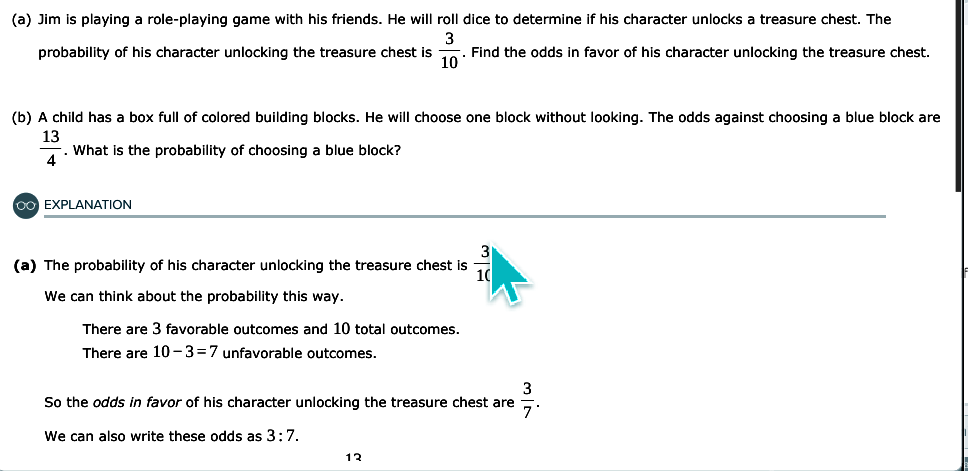 remi2019:
so i am a bit confused
Extrinix:
Ohh, okay. So just do this: 19 gifts total 4 her chances remove 4 from 19, 19-4=15 So your probability would be `4:15`
remi2019:
oh ok
mayathegamergrl:
Extrinix:
15 would be the amount unfavorable towards Ali, and 4 would be the favorable amount towards Ali, 19 is the total amount of gifts.
remi2019:
but when is says odds in favor what do i do
remi2019:
here is the question A child has a box of candy which might have a toy inside. The probability of the box having a toy is 13/18. What are the odds against the box having a toy?
Extrinix:
Odds in favor is 4 because the unfavorable amount is 15, and 15+4=9.
jhonyy9:
Extrinix:
Oops, keyboard lagged the 1.
remi2019:
oh ok
remi2019:
so i would do 18+13 and it would be 13/31??????
Extrinix:
13/18 probability, 18-13=5 5:13 probability, so the unfavorable amount would be 13.
 kittybasil:
Hi! Welcome to QC. Sorry for intruding, but we prefer to keep 1 question per post/thread because it is easier to handle than 20 comments in 1 single post. Hope that makes sense. If you feel that a tutor has helped you feel free to give them a medal (:
Extrinix:
\(P_\text{total}-P_\text{favorable}=P_\text{unfavorable}\) If that makes any sense.
 NineTailedFox:
ok i get that, actually helps with a question on a quiz i might have today.
Extrinix:
Example: Probabiliy: \(\dfrac{\color{tomato}{3}}{\color{lime}{15}}\) \(\color{lime}{15}-\color{tomato}{3}=\color{cyan}{12}\) So you would convert this to a probability: \(\color{tomato}{3}:\color{cyan}{12}\) This is what your answer would be, but to check yourself \(\downarrow\) Now if you were to change that : to a +, you would get: \(\color{tomato}{3}+\color{cyan}{12}\) = \(\color{lime}{15}\)
NineTailedFox:
wow, this is a mini study guide for me today
kittybasil:
Eh? Same user? 🤔
Extrinix:
Possibly?
kittybasil:
Hmm, doesn't seem like it. Eh well, I'd close this post cause it's getting a bit long
Extrinix:
@remi2019 close this post if it has been answered please, thank you.
 AZ:
AZ:
no no no You're getting it all wrong Extrinix
AZ:
Jhonyy9 correctly pointed this out
Extrinix:
AZ:
You need to understand the difference between PROBABILITY and ODDS For the initial question `Ali is at a charity fundraiser and has a chance of receiving a gift. The odds in favor of receiving a gift are 4/19. Find the probability of Ali receiving a gift.` The ODDS in favor of receiving a gift are 4/19 odds is chances of it happening / chances of it not happening The way the number is listed is: 4/19 4 is the chances of getting a gift 19 is the chances of NOT getting a gift so now when you try to calculate probability probability is = number of the favorable outcomes divided by TOTAL number of outcomes so we want to know the probability of getting a gift The chance of getting a gift is 4 What is the total number of outcomes? It's going to be 4 + 19
remi2019:
can you help me with my other question i am already off of that question
kittybasil:
AZ:
I don't know what you're referring to by "the keyboard lagged the 1" The work that you posted showed you subtracting 4 from 19 instead of adding it
AZ:
AZ:
AZ:
You still didn't understand the concept of odds vs probability
kittybasil:
Why are you saying "still" I'm not the question asker lol
remi2019:
can you just help me with my other question please
AZ:
Yeah, but you're responding to the post when you're talking about ODDS odds of something occurring is probability of the event occurring / probability of the event NOT occuring 4 / 19 means out of a total of 4+19 outcomes It would occur 4 times It would NOT occur 19 times
remi2019:
but i am not on that question any more
remi2019:
and i did respond
Extrinix:
Extrinix:
4* not 3
AZ:
\(\sf probability = \dfrac{favorable~outcomes~}{total~outcomes} = \dfrac{favorable~outcomes}{favorable~outcome+unfavorable~outcome}\) \(\sf odds = \dfrac{favorable~outcomes}{unfavorable~outcomes}\)
AZ:
They told us the odds Just because the denominator is 19 does not mean that it's the total outcomes we have to be careful and make sure whether we're dealing with odds or probability
kittybasil:
AZ:
kittybasil:
If you feel like I have mistyped anything, feel free to let me know. I will remove the content
AZ:
I guess my last attempt at trying to explain this question https://sphweb.bumc.bu.edu/otlt/mph-modules/bs/bs704_confidence_intervals/BS704_Confidence_Intervals10.html "The probability that an event will occur is the fraction of times you expect to see that event in many trials. Odds. Probabilities always range between 0 and 1. The odds are defined as the probability that the event will occur divided by the probability that the event will not occur." Odds are defined as probability event occurs / event does not occur so the 4/19 means out of a total of (4+19) times, it would occur 4 times and it would not occur 19 times The 19 is not the total If they said the probability was 4/19 Then it occurs 4 times out of a total of 19 times Which means that 19 - 4 tells you how many times it's unfavorable
kittybasil:
well, if you feel that the post is getting cluttered perhaps we can make a new version of it. That happened once when five people answered a question at once and it got so crazy I reposted the question off my own profile. As I am not sure about the question contexts I will leave it up to you guys who know the material better.
Join our real-time social learning platform and learn together with your friends!
VERNEISH:
Two objects are moving along separate linear paths where each path is described by position, d, and time, t.

 Maci:
what are the best stock apps for people who want to start investing?
Maci:
what are the best stock apps for people who want to start investing?
 Twaylor:
genuienly how do i get better self control i keep watcing youtube and theres this
Twaylor:
genuienly how do i get better self control i keep watcing youtube and theres this
 IzzyCookie:
|dw:1792074056138:dw| Uhm, I don't know where to ask this, but I'm in college welding at my community college, and I need help learning vertical welding for
IzzyCookie:
|dw:1792074056138:dw| Uhm, I don't know where to ask this, but I'm in college welding at my community college, and I need help learning vertical welding for

 thehearken:
not sure if this is considered spam, im sorry if it is, but does anyone have tips
thehearken:
not sure if this is considered spam, im sorry if it is, but does anyone have tips