
 Gucchi:
A Brief Study of Guts You may not know this, but you are home to a colony of bacteria. You may also not know it, but the health and happiness of that colony of bacteria have a direct effect on your own health and happiness. In short, if we are what we eat, then we may need to make bacteria part of our balanced breakfast. Microbes are single-celled organisms. They are literally everywhere. Microbes are in the air we breathe, on the surfaces of everything we touch, and inside our bodies. Microbes can be bacteria, fungi, protozoa, or viruses. A few years ago, scientists began studying the microbial life of our stomachs. Called The American Gut project, this study aims to understand the life of the bacteria that live in our digestive system. According to an article in the New York Times by Michael Pollan, the goal is to gather information on the types and amounts of bacteria in the human gut. Scientists want to describe what a normal healthy microbe and human relationship should look like inside our digestive system. While the research is still in the very early stages, scientists have learned the following: The strongest and healthiest microbe systems are those with a lot of variety. The guts of Americans have much less variety than the guts of other populations. Diets that include a lot of processed foods support less variation in bacteria. Studying the makeup of our individual bacteria communities will help scientists get a better idea of which bacteria help human bodies. We used to think that bacteria in our bodies were invaders. This new research suggests that bacteria are part of the protective army that keeps us healthy. In fact, our bodies have a hard time recovering from medicines like antibiotics because they disrupt the balance of helpful bacteria. It seems clear from the early evidence that living with bacteria helps us resist invasion from things that make us sick. Scientists have also learned that microbes might help our guts do things like process vitamins and important nutrients. Some microbes may help us deal with stress, or adapt to changes. Furthermore, there may come a time—in your lifetime—when illness is treated not with antibiotics, but with extra-special microbes that help us defend our bodies from illness. All of this new information should make us think twice about things like antibacterial soap, which gets into our water supply. While many bacteria are very dangerous, we should perhaps be careful not to eliminate the good with
Gucchi:
the bad. While we figure out how to do that, feel free to let your dog lick your face. Rover's microbes may just be saving your life one day. Works Cited Pollan, Michael. "Some of My Best Friends Are Germs." New York Times Magazine 19 May 2013: 36-43, 50, 58-59.
 Gucchi:
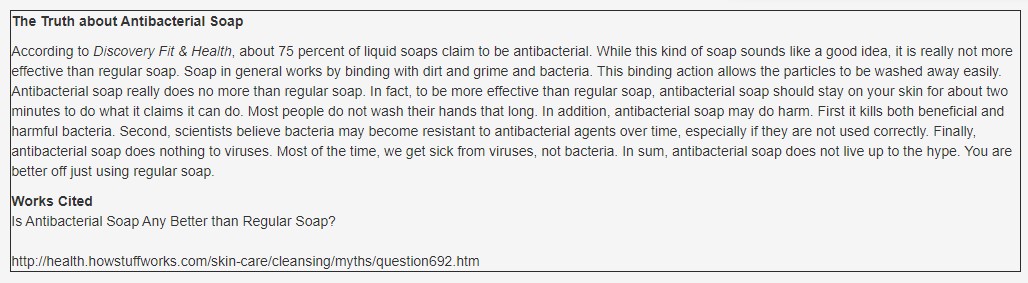
Read these lines from "The Truth about Antibacterial Soap": In addition, antibacterial soap may do harm. First it kills both beneficial and harmful bacteria. Second, scientists believe bacteria may become resistant to antibacterial agents over time, especially if they are not used correctly. Which best summarizes the main idea of the text? Antibacterial soap causes resistance in some bacteria. Antibacterial soap harms mainly beneficial bacteria. Antibacterial soap may have harmful effects. Antibacterial soap should be used correctly at all times.
Gucchi:
Am I right with C?
Gucchi:
@axie
 axie:
axie:
yes
Gucchi:
ty
Join our real-time social learning platform and learn together with your friends!
 VERNEISH:
Two objects are moving along separate linear paths where each path is described by position, d, and time, t.
VERNEISH:
Two objects are moving along separate linear paths where each path is described by position, d, and time, t.

 Maci:
what are the best stock apps for people who want to start investing?
Maci:
what are the best stock apps for people who want to start investing?
 Twaylor:
genuienly how do i get better self control i keep watcing youtube and theres this
Twaylor:
genuienly how do i get better self control i keep watcing youtube and theres this
 IzzyCookie:
|dw:1792074056138:dw| Uhm, I don't know where to ask this, but I'm in college welding at my community college, and I need help learning vertical welding for
IzzyCookie:
|dw:1792074056138:dw| Uhm, I don't know where to ask this, but I'm in college welding at my community college, and I need help learning vertical welding for

 thehearken:
not sure if this is considered spam, im sorry if it is, but does anyone have tips
thehearken:
not sure if this is considered spam, im sorry if it is, but does anyone have tips