
 rxcklesskaisher:
area
 Extrinix:
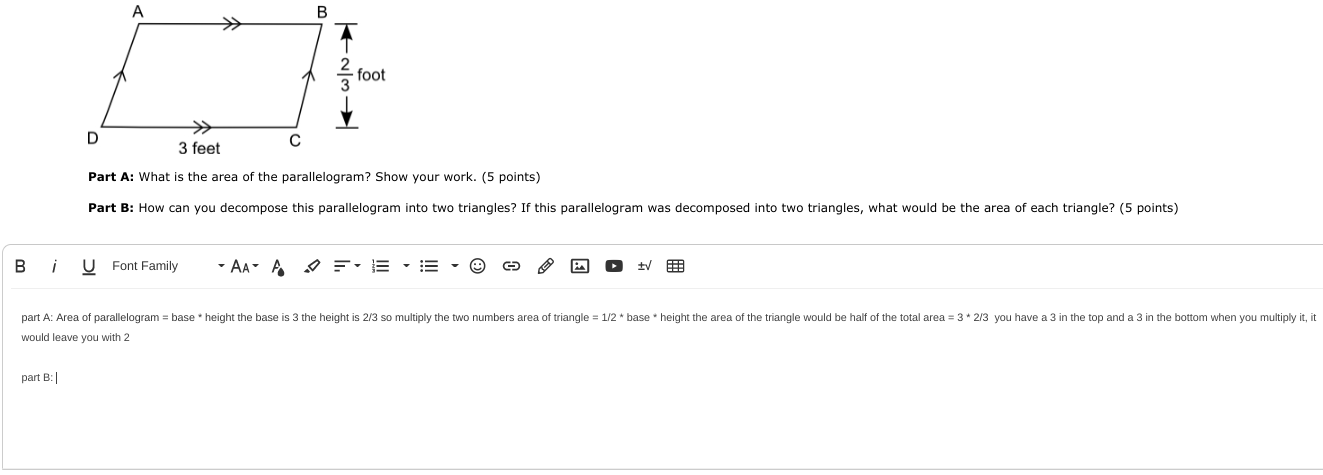
Think, this is a rhombus, so the only way to split it into two triangles would be to cut it diagonally.
rxcklesskaisher:
6?
Extrinix:
Incorrect, assuming that you split the `area of the rhombus` into 2 triangles, meaning that it would just be half of 2.
rxcklesskaisher:
half of 3\2?
 Florisalreadytaken:
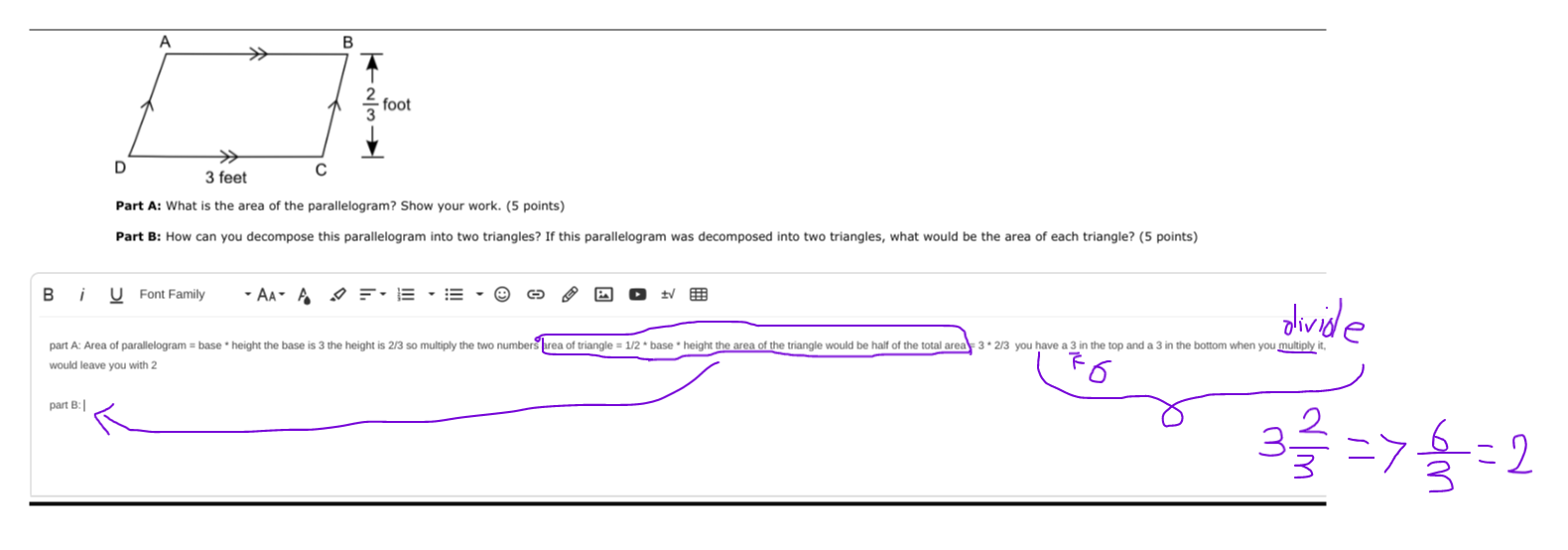
right you keep going with the triangles -- the answer you gave for A is mashed up -- check image which i am attaching
 rxcklesskaisher:
i type all of it from there
 mhanifa:
Area of a parallelogram is A = bh You have b = 3, h = 2/3 So the area is: A = 3*(2/3)
Extrinix:
mhanifa:
You can split the parallelogram in half by adding any diagonal
rxcklesskaisher:
ok the answer is 2?
mhanifa:
Yes for the parallelogram
Extrinix:
The area of the rhombus is 2 yeah.
rxcklesskaisher:
ok thanks so i type what in words
Extrinix:
So splitting it into 2 `even` triangles would just be `1` for each.
rxcklesskaisher:
ok
mhanifa:
You decompose the parallelogram by adding a diagonal AC or BD
mhanifa:
Both the triangles will have same area as both have same base and height
rxcklesskaisher:
i got the first part
mhanifa:
My last two posts are about part B
Extrinix:
|dw:1622059312378:dw| tThis is what s/he means by splitting it by it's diagonals.
rxcklesskaisher:
do i put then?
rxcklesskaisher:
then you decompose?
mhanifa:
Each of the triangles will have area: A = 1/2bh
Extrinix:
|dw:1622059476849:dw| And this is where they say all angles and sides would be congruent.
mhanifa:
You have the value of bh already, its 2
Extrinix:
 Florisalreadytaken:
as I said, why are you mashing it all up it is such an eh work you did there id suggest you use this, which I pre-wrote for you :D Part A: Area of parallelogram = base * height; based on the image, the parallelogram base is 3, and the size is 2/3. substituting that into the formula will be area of parallelogram = 3 * 2/3, which is equal to 6/3. 6/3 simplified is 2. We can say that the area of the parallelogram is 2 feet square. Part B: we can decompose this parallelogram into two triangles by adding one of its diagonals, respectively AC or BD. to find the area of each triangle, the formula is area of one triangle=1/2*base*height where just like in the parallelogram, the base of the parallelogram is 3, and the height is 2/3. Knowing that the area of one of the triangles would be 1/2*3*2/3, which is the same as 1/2*2. so the area of one triangle is 1 foot square
rxcklesskaisher:
keep part A?
Florisalreadytaken:
no do not keep it -- its confusing; use the one i did. so many replies above to get to one single conclusion eh :\
rxcklesskaisher:
ok
rxcklesskaisher:
thanks again
Join our real-time social learning platform and learn together with your friends!
VERNEISH:
Two objects are moving along separate linear paths where each path is described by position, d, and time, t.

 Maci:
what are the best stock apps for people who want to start investing?
Maci:
what are the best stock apps for people who want to start investing?
 Twaylor:
genuienly how do i get better self control i keep watcing youtube and theres this
Twaylor:
genuienly how do i get better self control i keep watcing youtube and theres this
 IzzyCookie:
|dw:1792074056138:dw| Uhm, I don't know where to ask this, but I'm in college welding at my community college, and I need help learning vertical welding for
IzzyCookie:
|dw:1792074056138:dw| Uhm, I don't know where to ask this, but I'm in college welding at my community college, and I need help learning vertical welding for

 thehearken:
not sure if this is considered spam, im sorry if it is, but does anyone have tips
thehearken:
not sure if this is considered spam, im sorry if it is, but does anyone have tips