
 kaydademon:
ss math below
 kaydademon:
@snowflake0531 @Florisalreadytaken @AZ
 xxemilianaxx:
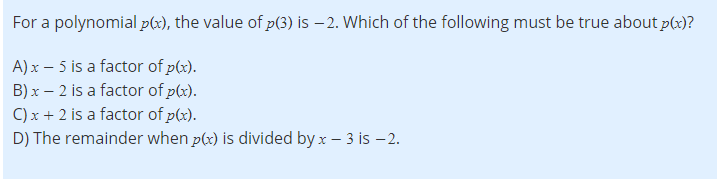
The question states that p(3)=−2, So it must be true that.. (insert the true equation here)
kaydademon:
2=p(3)=(3+k)q(3)+r ?
xxemilianaxx:
Good, Now we can plug in all the possible answers. If the answer is A, B, or C, r will be 0, while if the answer is D, r will be −2. A. −2=p(3)=(3+(−5))q(3)+0 − 2=(3−5)q(3) −2=(−2)q(3) This could be true but, Only if what?
xxemilianaxx:
Apologies I messed up a bit A. −2=p(3)=(3+(−5))q(3)+0 -2=(3−5)q(3) −2=(−2)q(3)
kaydademon:
its okay but it would be true if q(3)=-2
xxemilianaxx:
Try that again
kaydademon:
-1?
xxemilianaxx:
No, But close
kaydademon:
oh wait i see its 1
xxemilianaxx:
Yes
xxemilianaxx:
B. −2=p(3)=(3+(−2))q(3)+0 −2=(3−2)q(3) −2=(−1)q(3) This could be true if
kaydademon:
q(3)=.2
xxemilianaxx:
.2?
kaydademon:
mb i just meant 2
xxemilianaxx:
Mhm, Now this might get a little tricky if you don't do the math right. C. −2=p(3)=(3+2)q(3)+0 −2=(5)q(3) This would be true if?
kaydademon:
q(3)= 2/5 i did it im just making sure its right and trying to learn to do it more
xxemilianaxx:
I see, You keep confusing your positives with negatives lol
xxemilianaxx:
Try it again and take your time, No rush
kaydademon:
q(3)= −2/5
xxemilianaxx:
Great, D. −2=p(3)=(3+(−3))q(3)+(−2) −2=(3−3)q(3)+(−2) −2=(0)q(3)+(−2) This will always be true no matter what q(3) is
kaydademon:
Of the answer choices the only one that is true about p(x) is D when the remainder when p(x) is divided by x−3 is -2 so then D is correct one?
xxemilianaxx:
It is
xxemilianaxx:
That's it right?
kaydademon:
ima post another q
Join our real-time social learning platform and learn together with your friends!
 VERNEISH:
Two objects are moving along separate linear paths where each path is described by position, d, and time, t.
VERNEISH:
Two objects are moving along separate linear paths where each path is described by position, d, and time, t.

 Maci:
what are the best stock apps for people who want to start investing?
Maci:
what are the best stock apps for people who want to start investing?
 Twaylor:
genuienly how do i get better self control i keep watcing youtube and theres this
Twaylor:
genuienly how do i get better self control i keep watcing youtube and theres this
 IzzyCookie:
|dw:1792074056138:dw| Uhm, I don't know where to ask this, but I'm in college welding at my community college, and I need help learning vertical welding for
IzzyCookie:
|dw:1792074056138:dw| Uhm, I don't know where to ask this, but I'm in college welding at my community college, and I need help learning vertical welding for

 thehearken:
not sure if this is considered spam, im sorry if it is, but does anyone have tips
thehearken:
not sure if this is considered spam, im sorry if it is, but does anyone have tips