
 ohyhyh:
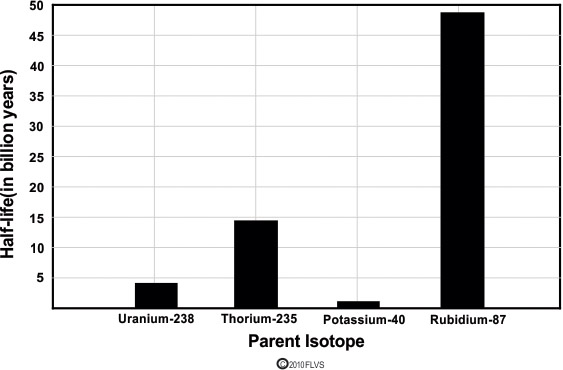
The graph below shows the half life values of parent isotopes. The bar graph shows 'Parent Isotope' labeled on the x axis and 'Half-life (in billion years)' labeled on the y axis. The first bar is labeled Uranium-238 and its height is 4. The second bar is labeled 'Thorium-235' and its height is 14, the third bar is labeled 'Potassium-40' and its height is 1.5', and the fourth bar is labeled 'Rubidium-87' and its height is 49. Based on the graph, it can be concluded that the isotope which is most likely to be found with 6.25% of its original amount in 16 billion years? Rubidium-87 Uranium-238 Potassium-40 Thorium-235
 KyanTheDoodle:
Ok, I'm not gonna try to plug a formula for this one. Putting this simply, every substance starts at 100% of it's value. After a half life, it will be 50%. Another half life, it will be 25%. How many half lifes will it take to get to 6.25%?
ohyhyh:
5
KyanTheDoodle:
100/2 = 50 50/2 = 25 25/2 = 12.5 12.5/2 = 6.25
ohyhyh:
so 4
KyanTheDoodle:
yes
ohyhyh:
so what next?
KyanTheDoodle:
so now that we know how many half lives it takes to get to 6.25%, let's divide the given time, 16 billion years, by 4
KyanTheDoodle:
and that will get you the half life of the right element
ohyhyh:
c?
KyanTheDoodle:
potassium has a half life of 1.5 billion, it would go through over 10 half lives by then
ohyhyh:
d?
KyanTheDoodle:
what is 16 divided by 4?
ohyhyh:
4
KyanTheDoodle:
which element has a half life of 4 billion years?
ohyhyh:
i mean itd have to be one of the two left but idk bc im confused
ohyhyh:
again
KyanTheDoodle:
let's start from the beginning
KyanTheDoodle:
how many half lives does it take to get to 6.25% of the original size?
ohyhyh:
4
KyanTheDoodle:
so then in 16 billion years, the element we're looking for would have to go through 4 half lives
KyanTheDoodle:
which means in one half life, it would be 16 billion years divided by 4
KyanTheDoodle:
you said 16 billion divided by 4 is 4 billion years. which bar is at the value of 4 billion years?
ohyhyh:
b
KyanTheDoodle:
that's correct
ohyhyh:
lol only took me 3 tries lol
ohyhyh:
All scientific theories on the solar system are based on biased scientific data non-testable facts non-observable information study of current evidences
ohyhyh:
i think this one is d?
KyanTheDoodle:
yes
ohyhyh:
ok cool
ohyhyh:
finally on q30
ohyhyh:
Scientists have discovered a solar system at a distance of 2000 AU from Earth. What is the distance, in kilometers, between the new solar system and Earth? 300 million kilometers 300 billion kilometers 20 million kilometers 20 billion kilometers
ohyhyh:
b?
KyanTheDoodle:
every AU is 149,597,870.7 km
KyanTheDoodle:
oh wait
KyanTheDoodle:
sorry I didn't see you already had an answer
KyanTheDoodle:
yes that's correct
ohyhyh:
which of these statements best compares P waves and S waves of an earthquake? Both S waves and P waves travel through oxygen gas. Both S waves and P waves travel through carbon dioxide gas. S waves do not tavel through molten rocks but P waves travel through molten rocks. P waves do not tavel through molten rocks but S waves travel through molten rocks.
ohyhyh:
i think c
KyanTheDoodle:
A and B are comparisons, C and D are contrasts
KyanTheDoodle:
but I'm starting to think whoever wrote the question didn't care about that
ohyhyh:
yeah
KyanTheDoodle:
yeah C is right
ohyhyh:
okay cool
ohyhyh:
im gonna start a new question
Join our real-time social learning platform and learn together with your friends!
VERNEISH:
Two objects are moving along separate linear paths where each path is described by position, d, and time, t.

 Maci:
what are the best stock apps for people who want to start investing?
Maci:
what are the best stock apps for people who want to start investing?
 Twaylor:
genuienly how do i get better self control i keep watcing youtube and theres this
Twaylor:
genuienly how do i get better self control i keep watcing youtube and theres this
 IzzyCookie:
|dw:1792074056138:dw| Uhm, I don't know where to ask this, but I'm in college welding at my community college, and I need help learning vertical welding for
IzzyCookie:
|dw:1792074056138:dw| Uhm, I don't know where to ask this, but I'm in college welding at my community college, and I need help learning vertical welding for

 thehearken:
not sure if this is considered spam, im sorry if it is, but does anyone have tips
thehearken:
not sure if this is considered spam, im sorry if it is, but does anyone have tips