
 WesternSparrows:
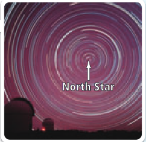
The arcs in the photo at the right appear to be paths rotating about the North Star. To produce this effect, the photographer set a camera on a tripod and left the shutter open for an extended time. If the photographer left the shutter open for a full 24 hours, each arc would be a complete circle. You can model a star's "rotation" in the coordinate plane. Place the North Star at the origin. Let P(1,0) be the position of the star at the moment the camera's shutter opens. Suppose the shutter is left open for 2 hr. 40 min, with the arc ending at P'. c. What translation rule maps P onto P"?
 WesternSparrows:
I already know that the angle of rotation maps P onto P' is 40 degrees and that the x and y coordinates of P' are (cos 40, sin 40)
 SmokeyBrown:
WesternSparrows:
Ok, when you say that I need to find the difference, what do you mean exactly?
WesternSparrows:
so the coordinates would be: (0.67, 0.7)?
SmokeyBrown:
Sure, to give another example, say that we let the camera wait for 6 hours, and the point changed from initial position (1,0) to position (0,1). The difference between Final point (0,1) and Initial point (1,0) (xF - xI, yF-yI) or (0-1, 1-0) or (-1, 1) Just a roundabout way of saying we move to the left by 1 and move up by 1 to get from the initial point to the final point
SmokeyBrown:
WesternSparrows:
Oh, okay. That part makes sense, but what does the (xF - xI, yF-yI) mean?
 axie:
axie:
@smokeybrown
SmokeyBrown:
WesternSparrows:
nope thax for ur help anyways. It makes much more sense than before:)
Join our real-time social learning platform and learn together with your friends!
VERNEISH:
Two objects are moving along separate linear paths where each path is described by position, d, and time, t.

 Maci:
what are the best stock apps for people who want to start investing?
Maci:
what are the best stock apps for people who want to start investing?
 Twaylor:
genuienly how do i get better self control i keep watcing youtube and theres this
Twaylor:
genuienly how do i get better self control i keep watcing youtube and theres this
 IzzyCookie:
|dw:1792074056138:dw| Uhm, I don't know where to ask this, but I'm in college welding at my community college, and I need help learning vertical welding for
IzzyCookie:
|dw:1792074056138:dw| Uhm, I don't know where to ask this, but I'm in college welding at my community college, and I need help learning vertical welding for

 thehearken:
not sure if this is considered spam, im sorry if it is, but does anyone have tips
thehearken:
not sure if this is considered spam, im sorry if it is, but does anyone have tips