
 lifewmylilweeb:
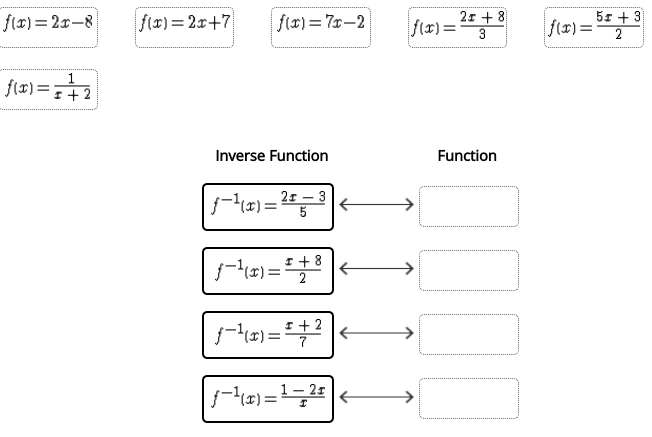
i need help
 lifewmylilweeb:
uhm hello?
lifewmylilweeb:
@extrinix
lifewmylilweeb:
@thisgirlpretty
lifewmylilweeb:
i guess no one is going to help me
lifewmylilweeb:
@joe348
 Extrinix:
So it's easier to convert \(f(x)=zx+b\) to inverse than it is to convert \(f^{-1}(x)=zx=b\) Let's start off with \(f(x)=2x-8\) Understand that we need to switch y and x, then solve for y. \(y=2x-8\) Swap them \(x=2y-8\) Now solve the equation, what would you get?
lifewmylilweeb:
\[\frac{ x+8 }{ 2}\]
lifewmylilweeb:
so the first one goes with the second one
Extrinix:
Which would give you \(\dfrac{1}{2}x+4\), which is your inverse Inverse: \(f^{-1}(x)=\dfrac{1}{2}x+4\)
Extrinix:
Correct ^^
Extrinix:
Most teachers don't force you to simplify completely, but knowing how to simplify it completely could help if there's a question that asks for it...
Extrinix:
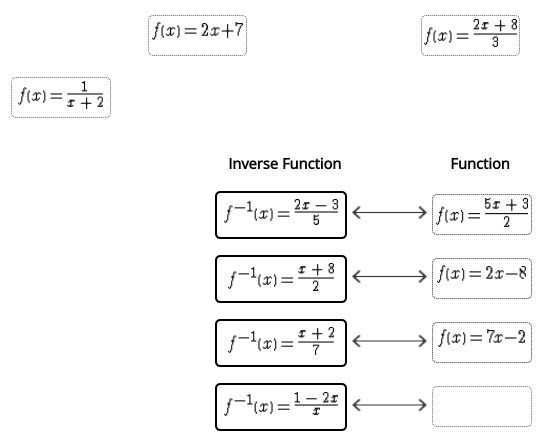
Anyways, onto #2 \(f(x)=2x+7\) Swap x and y then solve for y, as the other one was \(x=2y+7\) What would you get?
 Extrinix:
Good job, you're catching the hang of it ^^
lifewmylilweeb:
i think the last one is f(x)=1/x+2
Join our real-time social learning platform and learn together with your friends!
 VERNEISH:
Two objects are moving along separate linear paths where each path is described by position, d, and time, t.
VERNEISH:
Two objects are moving along separate linear paths where each path is described by position, d, and time, t.

 Maci:
what are the best stock apps for people who want to start investing?
Maci:
what are the best stock apps for people who want to start investing?
 Twaylor:
genuienly how do i get better self control i keep watcing youtube and theres this
Twaylor:
genuienly how do i get better self control i keep watcing youtube and theres this
 IzzyCookie:
|dw:1792074056138:dw| Uhm, I don't know where to ask this, but I'm in college welding at my community college, and I need help learning vertical welding for
IzzyCookie:
|dw:1792074056138:dw| Uhm, I don't know where to ask this, but I'm in college welding at my community college, and I need help learning vertical welding for

 thehearken:
not sure if this is considered spam, im sorry if it is, but does anyone have tips
thehearken:
not sure if this is considered spam, im sorry if it is, but does anyone have tips