
 SoulEater1134:
Can you guys please help me with my Bio work?
 SoulEater1134:
@oliver69 can you help please?
 KyledaGreat:
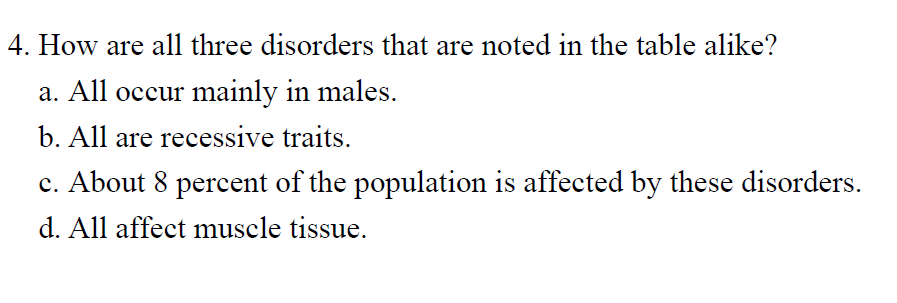
None of the given options is completely correct. The correct answer is: b. All are caused by genetic mutations on the X chromosome. Colorblindness, Duchenne muscular dystrophy, and impaired blood clotting are all caused by mutations on genes that are located on the X chromosome. Since males only have one X chromosome, they are more likely to be affected by X-linked disorders than females, who have two X chromosomes and can potentially have a normal gene on one X chromosome that can compensate for a mutated gene on the other X chromosome. Therefore, option a is partially correct. Option c is incorrect because the prevalence of each disorder varies, and 8 percent is not an
 OLIVER69:
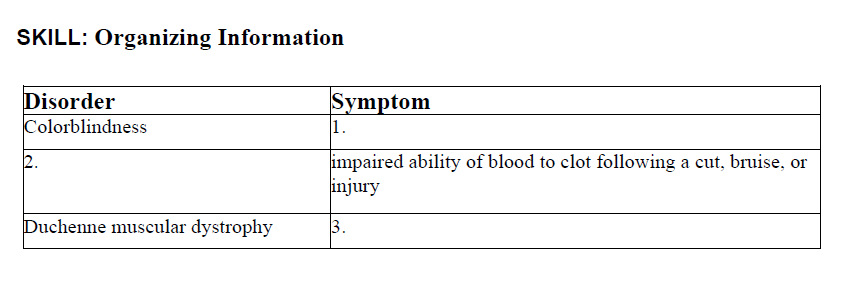
So for the first picture, the symptom of Colorblindness is trouble seeing colors and the brightness of colors in the usual way. The disorder for the second blank is Hemophilia is a disorder that prevents blood from clotting properly, resulting in bruising and bleeding. And the symptom of Duchenne muscular dystrophy is Frequent falls, difficulty rising from a lying or sitting position, trouble running and jumping, waddling gait, and walking on the toes.
KyledaGreat:
Join our real-time social learning platform and learn together with your friends!
 DoltonCarlee:
what are y'all's options on S A T essays because honestly their not that bad
DoltonCarlee:
what are y'all's options on S A T essays because honestly their not that bad

 thereneelg:
Can someone give me a summary of article 231, The war guilt clause?? I need to explain what it is, but I can't find any shortened version of what it is and
thereneelg:
Can someone give me a summary of article 231, The war guilt clause?? I need to explain what it is, but I can't find any shortened version of what it is and
 luisaam2:
What should you do when the person you want to talk to the most is the one making
luisaam2:
What should you do when the person you want to talk to the most is the one making
 Breathless:
https://medal.tv/games/roblox/clips/nAYivIl6oXB6q9QAI?invite=cr-MSxCSk4sMTY4OTA4N
Breathless:
https://medal.tv/games/roblox/clips/nAYivIl6oXB6q9QAI?invite=cr-MSxCSk4sMTY4OTA4N
 Twaylor:
I'm not that good at law can someone fact check this without bias? June 29, 2026, the Supreme Court decided Chatrie v.
Twaylor:
I'm not that good at law can someone fact check this without bias? June 29, 2026, the Supreme Court decided Chatrie v.
 Demon25:
For a hoco proposal with a cheerleader and football player, what else should be a
Demon25:
For a hoco proposal with a cheerleader and football player, what else should be a
