
 zarkam21:
help
 zarkam21:
@Vocaloid
zarkam21:
@Vocaloid
zarkam21:
@Zepdrix
zarkam21:
@pooja195
zarkam21:
@Vocaloid
 Vocaloid:
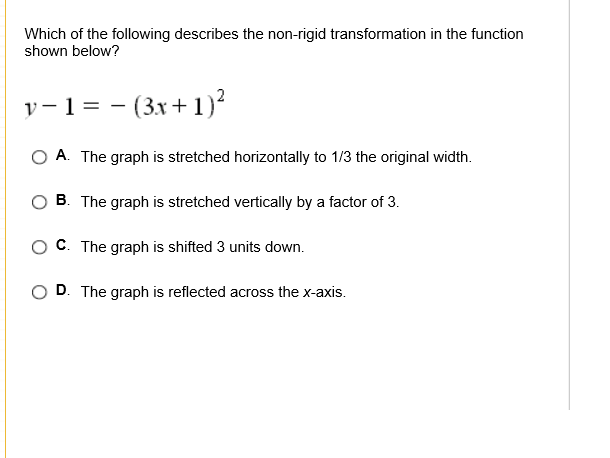
@angle if you could double check me on this one that would be appreciated ;; non-rigid implies that the graph is being stretched or shrunk, which eliminates c/d and there's no vertical transformation so...a? the answer a doesn't seem exactly right either
 Angle:
The terminology for what it means to be "stretched horizontally" versus "stretched vertically" is vague. Because technically the graph is doing both. Therefore, in order to pick between A and B you need to understand the difference between "stretched horizontally" and "stretched vertically". Here is a picture I found that describes this: |dw:1512439717619:dw|
Angle:
From the picture we can see that: - Stretching horizontally Does Not change the y-intercepts, but Does change the x intercepts - Stretching vertically Does change the y-intercepts, but Does Not change the x intercepts Now let's see how the given equation changes when we fiddle with the number where the (3) is... y-1 = -(x+1)^2 has y-intercept at y = 0 and x intercepts at x = -2, 0 y-1 = -(2x+1)^2 has y-intercept at y = 0 and x intercepts at x = -1, 0 y-1 = -(3x+1)^2 has y-intercept at y = 0 and x intercepts at x = -2/3, 0 So with this, we can see that the y-intercept is Not changing, but the x-intercepts Are So this graph is being Horizontally stretched
Angle:
@Vocaloid is correct
zarkam21:
I'm sorry had to go for a little bit is it a?
Angle:
yup :D
Join our real-time social learning platform and learn together with your friends!
 VERNEISH:
Two objects are moving along separate linear paths where each path is described by position, d, and time, t.
VERNEISH:
Two objects are moving along separate linear paths where each path is described by position, d, and time, t.

 Maci:
what are the best stock apps for people who want to start investing?
Maci:
what are the best stock apps for people who want to start investing?
 Twaylor:
genuienly how do i get better self control i keep watcing youtube and theres this
Twaylor:
genuienly how do i get better self control i keep watcing youtube and theres this
 IzzyCookie:
|dw:1792074056138:dw| Uhm, I don't know where to ask this, but I'm in college welding at my community college, and I need help learning vertical welding for
IzzyCookie:
|dw:1792074056138:dw| Uhm, I don't know where to ask this, but I'm in college welding at my community college, and I need help learning vertical welding for

 thehearken:
not sure if this is considered spam, im sorry if it is, but does anyone have tips
thehearken:
not sure if this is considered spam, im sorry if it is, but does anyone have tips