
 zarkam21:
Well it cant be D
 zarkam21:
I'm thinking A/
zarkam21:
I know its not D because it does not have the +-sign
 Vocaloid:
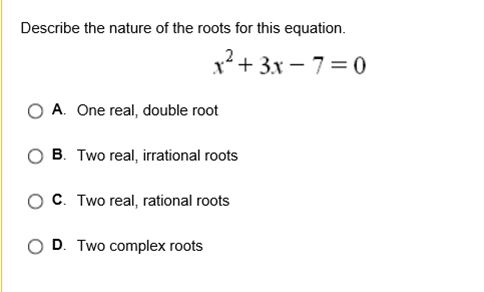
if you solve the quadratic equation you get two complex roots
zarkam21:
OKay so for problems like these i just solve for the quadratic equation and see how many roots I get
Vocaloid:
yes, in general complex roots come in pairs
 eriley:
i think it is a
zarkam21:
Okay perfect thanks
Vocaloid:
OR you can graph them and see if the graph touches the x-axis
zarkam21:
Okay and see how many times it touches??
eriley:
no problem
Vocaloid:
in this case, the graph does not touch the x-axis at all so there cannot be any real roots
zarkam21:
Got it. So it is D
Vocaloid:
wait hold on I graphed the wrong function ugh
Vocaloid:
when you graph/solve this you actually get two distinct, real roots ;_;
zarkam21:
SO c/
Vocaloid:
yeah sorry about that ;;
zarkam21:
No no don't worry about it ,, it was like the first mistake you ever made ;o
Vocaloid:
I need to go pick up lunch, hopefully blackghost can help rn
zarkam21:
OKay thanks for everything
Join our real-time social learning platform and learn together with your friends!
VERNEISH:
Two objects are moving along separate linear paths where each path is described by position, d, and time, t.

 Maci:
what are the best stock apps for people who want to start investing?
Maci:
what are the best stock apps for people who want to start investing?
 Twaylor:
genuienly how do i get better self control i keep watcing youtube and theres this
Twaylor:
genuienly how do i get better self control i keep watcing youtube and theres this
 IzzyCookie:
|dw:1792074056138:dw| Uhm, I don't know where to ask this, but I'm in college welding at my community college, and I need help learning vertical welding for
IzzyCookie:
|dw:1792074056138:dw| Uhm, I don't know where to ask this, but I'm in college welding at my community college, and I need help learning vertical welding for

 thehearken:
not sure if this is considered spam, im sorry if it is, but does anyone have tips
thehearken:
not sure if this is considered spam, im sorry if it is, but does anyone have tips