
 PandaSurvive:
Can someone explain how I do this?
 Vocaloid:
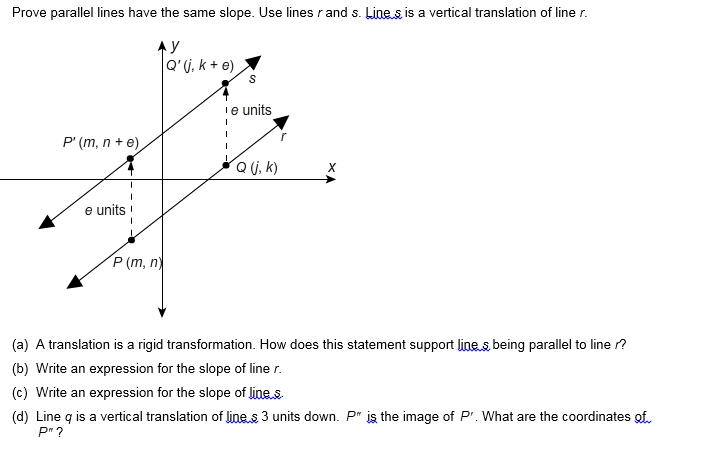
for a) a rigid transformation means that the line is translated without changing the slope since all of the points are moved the exact same y-distance and x-distance. thus, since s and are parallel before they are also parallel after for b) and c) you will plug the points into the slope formula (this time we are using variables instead of numbers but the core concept is the same for d) line q is 3 units below line s, so take the coordinates for P' (make sure you are looking at P' not P) and subtract 3 from the y-coordinate to get P''
PandaSurvive:
For d how am I supposed to subtract without any numbers though? Thats what I do not understand.
Vocaloid:
P' = (m, n + e) P'' = (m, n + e - 3)
PandaSurvive:
and if e=3 then its just m,n?
Vocaloid:
e is not equal to 3 (none of the variables in this problem have assigned values) so you would just leave it like that
 Vocaloid:
the original value for the P' coordinate is (m, n+e) the +e is not related to the translation 3 down
PandaSurvive:
ah ok
Join our real-time social learning platform and learn together with your friends!
 VERNEISH:
Two objects are moving along separate linear paths where each path is described by position, d, and time, t.
VERNEISH:
Two objects are moving along separate linear paths where each path is described by position, d, and time, t.

 Maci:
what are the best stock apps for people who want to start investing?
Maci:
what are the best stock apps for people who want to start investing?
 Twaylor:
genuienly how do i get better self control i keep watcing youtube and theres this
Twaylor:
genuienly how do i get better self control i keep watcing youtube and theres this
 IzzyCookie:
|dw:1792074056138:dw| Uhm, I don't know where to ask this, but I'm in college welding at my community college, and I need help learning vertical welding for
IzzyCookie:
|dw:1792074056138:dw| Uhm, I don't know where to ask this, but I'm in college welding at my community college, and I need help learning vertical welding for

 thehearken:
not sure if this is considered spam, im sorry if it is, but does anyone have tips
thehearken:
not sure if this is considered spam, im sorry if it is, but does anyone have tips