
 zarkam21:
How to solve this with Angle?
 Vocaloid:
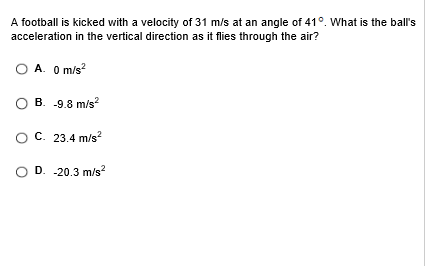
you have to resolve it into it's vertical component vertical component = velocity * sin(theta) where theta is the angle 41 degrees make sure your calc is in degree mode
zarkam21:
SO from that It would be D?
Vocaloid:
actually @sillybilly123 may I have some assistance on this one, physics isn't really my thing
 sillybilly123:
31 sin 41
Vocaloid:
yeah, that's what I was thinking at first, but it's asking for the acceleration not velocity, how do I proceed from there? (having a brain fart)
zarkam21:
i got 20.3
sillybilly123:
voca it's - g
Vocaloid:
so is the final answer just -g (B) or do I have to also account for the initial velocity?
sillybilly123:
B
Vocaloid:
ok, then it's just B as your answer zark
zarkam21:
Oh okay. So how did we get that?
zarkam21:
9.8 is the rate is it just that?
Vocaloid:
there's only one force acting in the y-direction (not accounting for air resistance) so the only force causing acceleration in the y direction is from gravity
sillybilly123:
+1
zarkam21:
okay so B
Vocaloid:
yes
sillybilly123:
\(\huge \checkmark\)
Join our real-time social learning platform and learn together with your friends!
 VERNEISH:
Two objects are moving along separate linear paths where each path is described by position, d, and time, t.
VERNEISH:
Two objects are moving along separate linear paths where each path is described by position, d, and time, t.

 Maci:
what are the best stock apps for people who want to start investing?
Maci:
what are the best stock apps for people who want to start investing?
 Twaylor:
genuienly how do i get better self control i keep watcing youtube and theres this
Twaylor:
genuienly how do i get better self control i keep watcing youtube and theres this
 IzzyCookie:
|dw:1792074056138:dw| Uhm, I don't know where to ask this, but I'm in college welding at my community college, and I need help learning vertical welding for
IzzyCookie:
|dw:1792074056138:dw| Uhm, I don't know where to ask this, but I'm in college welding at my community college, and I need help learning vertical welding for

 thehearken:
not sure if this is considered spam, im sorry if it is, but does anyone have tips
thehearken:
not sure if this is considered spam, im sorry if it is, but does anyone have tips