
 zarkam21:
Help
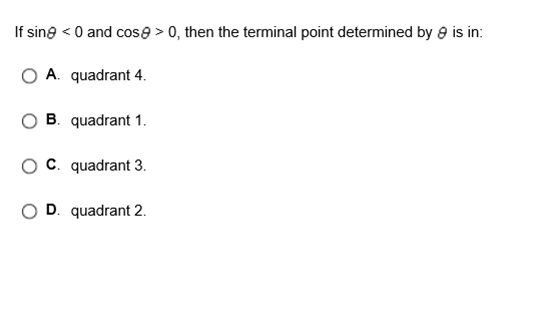 zarkam21:
I'm leaning towards choice A
 Shadow:
@Vocaloid Okay fine. :)
 Vocaloid:
if you want to solve it i'm ok with that
Shadow:
No no no, all you birthday girl
Vocaloid:
so for this one it's kind of trial and error-ish, I'd start by trying to figure out what quadrant it needs to be in for opposite/hypotenuse to be negative, but adjacent/hypotenuse to be positive
Vocaloid:
hypotenuse is always positive, so we just need to consider the sign of cos and sin if cos is positive, then the x-value should be positive, and if sin is negative, then we should expect the y value to be negative so your intuition is correct, it ends up being q4
 Vocaloid:
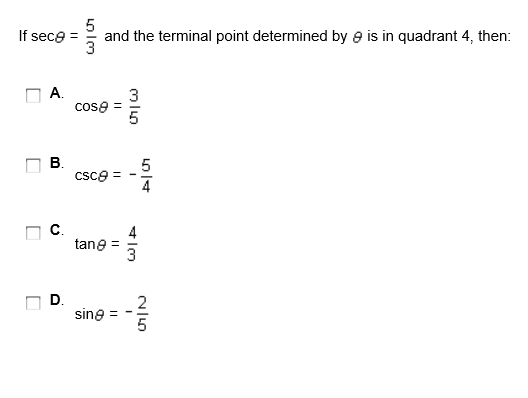
remember that sec = 1/cos, so cos = 3/5, with the terminal point being in quadrant 4, so try sketching this out and seeing which answer choices are mathematically valid
zarkam21:
Um a
Vocaloid:
if my calculations are correct there are exactly 2 correct choices
zarkam21:
and c
Vocaloid:
have to be careful with signs
Vocaloid:
|dw:1519955563808:dw|
Vocaloid:
since the 4 is below the x-axis it's -4 so tan(theta) would be -4/3 any other possibilities? as a hint, try calculating sin(theta)
zarkam21:
D
Vocaloid:
the side lengths are 3, 4, and 5 so there's no way sign can be -2/5
Vocaloid:
sin(theta) = opposite/hypotenuse = ?
zarkam21:
Its definitely a I'm stuck between b and c
Vocaloid:
the side "opposite" to the angle theta is -4 the hypotenuse is 5 so sin(theta) = ?
zarkam21:
b
Vocaloid:
good, sin(theta) = -4/5 so csc(theta) = -5/4 so A + B = your ans
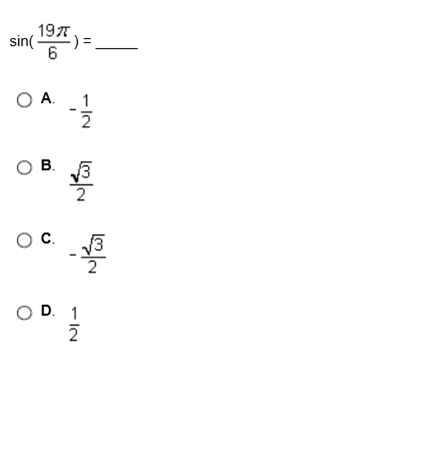 zarkam21:
A
Vocaloid:
good
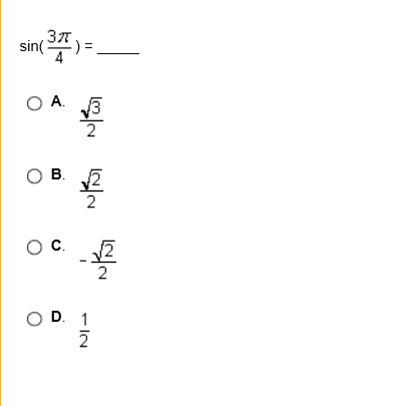 zarkam21:
B
Vocaloid:
good
 zarkam21:
B
Vocaloid:
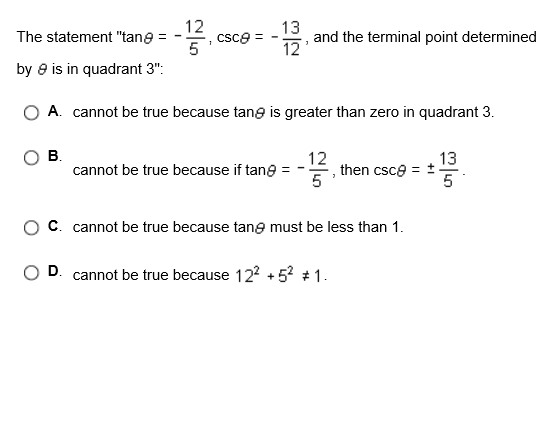
not quite, as a hint try sketching the triangle and calculating tan
Vocaloid:
|dw:1519956392178:dw|
Vocaloid:
opposite/adjacent = ? *** make sure to consider negative signs
zarkam21:
oh c
Vocaloid:
if opposite = -12 and adjacent = -5 what must tan be?
Vocaloid:
tan(theta) = opposite/adjacent = (-12/-5 ) = 12/5 making which answer choice the best possibility?
zarkam21:
A
Vocaloid:
good
 Vocaloid:
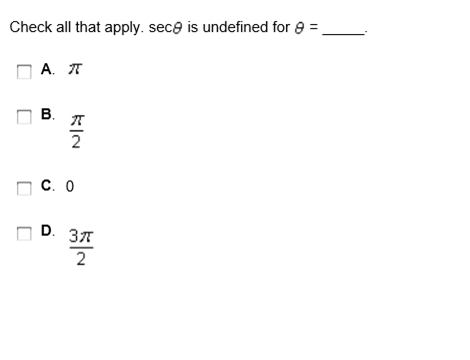
as a hint, sec(theta) = 1/cos(theta) so sec theta will be undefined whenever cos(theta) = 0
zarkam21:
so a and c
Vocaloid:
you might be thinking of sin(theta) not cos(theta), cos(theta) is 0 on integer multiplies of (pi/2)
zarkam21:
B
Vocaloid:
good, what else?
zarkam21:
D
Vocaloid:
good so B + D = your ans
 Vocaloid:
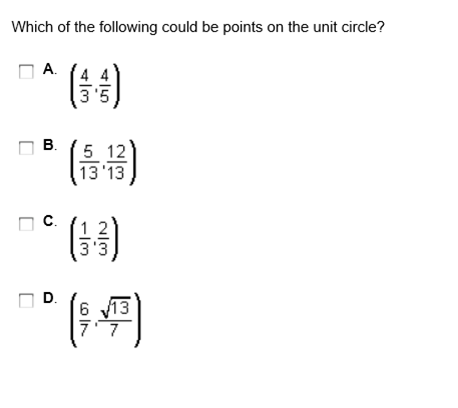
unit circle has radius 1 treat every coordinate as a set of x and y values and see whether x^2 + y^2 = 1 or not
zarkam21:
D
Vocaloid:
good but there's one more
zarkam21:
C
Vocaloid:
is (1/3)^2 + (2/3)^2 equal to 1?
zarkam21:
no hold on
zarkam21:
Ugh um a
zarkam21:
actually no b
Vocaloid:
good, B + D
 zarkam21:
stuck ugh between b and d
Vocaloid:
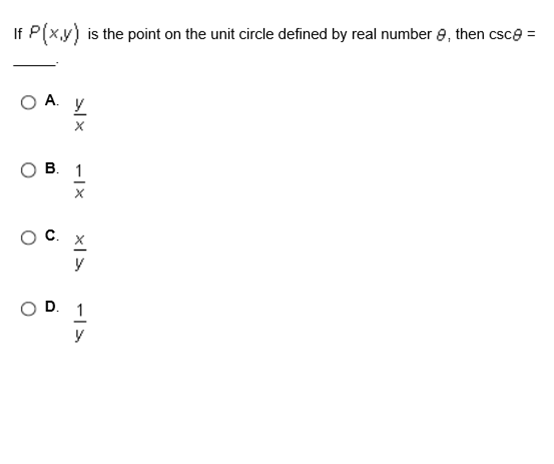
|dw:1519958029794:dw|
Vocaloid:
try determining csc (theta) from this diagram as a hint csc(theta) = 1/sin(theta)
zarkam21:
so definitely b or d
Vocaloid:
sin(theta) = ? based on the diagram
Vocaloid:
as a reminder sin(theta) = opposite/hypotenuse = ?
zarkam21:
D
Vocaloid:
good, D
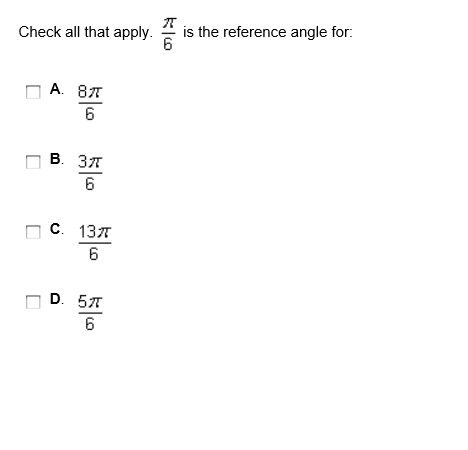 zarkam21:
A and d
Vocaloid:
not quite as a hint, you can generate new reference angles by adding or subtracting 2pi for a reference angle and all of its related angles, the trigonometric ratios should be the same for example, A does not work because cos(pi/6) does not equal cos(8pi/6)
zarkam21:
c and D :)
Vocaloid:
nvm yeah C + D is right
zarkam21:
Yay thanks
Join our real-time social learning platform and learn together with your friends!
 KBaby:
Verse 1 We left our names in the dust of the driveway Watched the old town shrink
KBaby:
Lyrics Generator Use AI to write the lyrics for a song. Suggested Genres: Pop Hip
KBaby:
Verse 1 We left our names in the dust of the driveway Watched the old town shrink
KBaby:
Lyrics Generator Use AI to write the lyrics for a song. Suggested Genres: Pop Hip

 aitexturegenerator:
How are you all handling AI-generated textures for 3D models and game assets without losing the hand-made feel? I've been doing a small stylized environment
aitexturegenerator:
How are you all handling AI-generated textures for 3D models and game assets without losing the hand-made feel? I've been doing a small stylized environment

 Demon25:
Woke up feeling like that girl and that dude well he still aint crap pluse the du
Demon25:
Woke up feeling like that girl and that dude well he still aint crap pluse the du
 playtsec:
how do I get rid of stress from teachers... I just feel like running out the classroom and leaving on my own.
playtsec:
how do I get rid of stress from teachers... I just feel like running out the classroom and leaving on my own.
 JohnnyLFowler0812:
What type of gamer would play something and then get off for a while. Why not sta
JohnnyLFowler0812:
Which is better? Metallica Rap Country R&B hiphop Medal Gospel Chill Which 3 opti
JohnnyLFowler0812:
What type of gamer would play something and then get off for a while. Why not sta
JohnnyLFowler0812:
Which is better? Metallica Rap Country R&B hiphop Medal Gospel Chill Which 3 opti