
 GlockParrot69:
A o.400 Kg object is attached to a spring with a spring constant of 117N/m. The other end of the spring is attached to a wall.The spring rests on a frictionless horizontal surface. A force is exerted on the spring, causing it to compress by a distance of 7.0 cm. b) Explain where the maximum speed occurs and why. Determine the value of this maximum speed.
 random231:
what do you think? (hint:just imagine about the motion of the mass)
GlockParrot69:
i think since the spring compression is completely elastic, every bit of energy is conserved and the system retains 100% efficient. meaning hte energy is not being wasted in the form of heat, friction, or air resistance. The spring will compress and uncompress over and over again without ever slowing down.
GlockParrot69:
i mean the system is 100% efficient.
GlockParrot69:
meant*
GlockParrot69:
the max energy will be just as the object is about to hit the spring at equilibrium state (resting state)
GlockParrot69:
it goes both ways when the spring is about to be compressed and when the spring turned all of the stored elastic potential energy into kinetic energy
GlockParrot69:
how wrong am i ?
GlockParrot69:
i need to go blow my nose....1 sec plz :)
random231:
youre almost right.
GlockParrot69:
noice :)
random231:
see, the body goes both ways. But once when the spring is compressed and the other time its elongated.
random231:
let me draw it for you
random231:
|dw:1520356658978:dw|
GlockParrot69:
yes thats what i meant. when the spring basically in resting position....both when the object is about to compress the spring and when the object is about to stretch the spring.
random231:
|dw:1520356710253:dw|
random231:
|dw:1520356816196:dw|
random231:
so when do you think the body will be moving fastest?
GlockParrot69:
when it's about to compress the spring. and when the spring is about to stretch the spring.
random231:
exactly. When Kinetic energy is maximum. that is the exact starting point.
GlockParrot69:
because at that point almost all of the PE is converted into KE before they start to do work against the spring and compress it.
random231:
not almost but all. yes youre right.
random231:
:)
GlockParrot69:
ok yes. :)
random231:
|dw:1520357041495:dw|
random231:
x'D
GlockParrot69:
so how do i go about calculating the exact value of the force?
GlockParrot69:
Eats Cookie* nom nom nom nom
random231:
i think we did calculate the force in section a. we have to find the speed of the body.
GlockParrot69:
btw just a side question....how device are you on? i can't draw on wc for some odd reason.
GlockParrot69:
i've tried both the surface and the ipad. none works.
random231:
I'm on my laptop
GlockParrot69:
and do u draw with your finger? or a pen?
random231:
Should work on ipad
GlockParrot69:
nope. i have a 1500 dollar ipad pro 2. It doesn't work :/
random231:
whats that? is that a finger? a pen?........No its my mouse :P
random231:
CS GO skills in use.
GlockParrot69:
oh X'D
GlockParrot69:
no wonder.
GlockParrot69:
so how do we calculate the maximum speed?
GlockParrot69:
gimme a hint plz :)
random231:
use energy conservation?
GlockParrot69:
is it W = F change in displacement
random231:
PE=KE
GlockParrot69:
oh...E_T = E_P + E_K ?
GlockParrot69:
oh. so PE = PK 1/2 mv^2 = something....
random231:
1/2 k x^2
GlockParrot69:
oh yes...uhg
GlockParrot69:
PE = PK 1/2kx^2 = ?1/2 mv^2 ? like this ?
random231:
yes. you need to find you v
GlockParrot69:
uhg i cant believe i got that equation right... juhahaha
GlockParrot69:
ok wait ok
random231:
lol
GlockParrot69:
PE = PK 1/2 kx^2 = 1/2 mv^2 kx^2/m = v^2 under-root(kx^2/m = v
GlockParrot69:
like this
random231:
yes! :)
GlockParrot69:
|dw:1520357756722:dw|
GlockParrot69:
ok so all i have to do from here is just plugin the numbers and chug?
random231:
|dw:1520357802759:dw|
random231:
yes
GlockParrot69:
k gimme my cookie!!
random231:
|dw:1520357833635:dw| i couldnt resist from taking a bite
random231:
the rest is yours tho
GlockParrot69:
WHAT?!?!?!!
GlockParrot69:
where is the rest at?
GlockParrot69:
how could you?
random231:
mah belly
random231:
sorreh ;-;
random231:
i thot we cud share
GlockParrot69:
its k. i think sharing is caring!! :)
random231:
:)
GlockParrot69:
keep your thots clean!
GlockParrot69:
anyway...gimme two seconds ineed to copy all that down and i'll be back in 2 seconds. :)
GlockParrot69:
thanks lovely. plz dont go. :)
random231:
lol dw
random231:
just tag me when you need me
GlockParrot69:
@Sam
GlockParrot69:
my question is since the max speed of the spring is at the equilibrium point which is rest phase of the spring. What do i plugin for the "x" value in the equation? here let me draw for you.
 Sam:
Sam:
Sorry my phone died
GlockParrot69:
uhg... and i almost died too
GlockParrot69:
plz help me :)
Sam:
Maximum speed is at equilibrium of the system, that is at its current resting state
GlockParrot69:
yeah what do i plugin for the distance since the spring is not compressed at that point.
GlockParrot69:
|dw:1520557771838:dw|
Sam:
|dw:1520557702389:dw|
GlockParrot69:
true i've already discussed that with random
Sam:
Yep
GlockParrot69:
so what do i plugin for the "x"?
Sam:
Delta x
Sam:
0.07m
GlockParrot69:
oh ok. so basically we are measuring the speed of the object once the spring is compressed and is about to uncompress again right.
GlockParrot69:
because when the spring was being compressed , the speed of the object was slowing down
GlockParrot69:
i think the only way to calculate the speed of the object is once the spring is fully compressed and all the kinetic energy has done its work. when the spring uncompresses, it gains speed to the point where all of the potential elastic energy is turned into kinetic energy.
GlockParrot69:
so by the time, the object reaches the equilibrium. at that point the sped of the object is at max right?
Sam:
No, when the spring is being compressed (thats the left most box on the diagram) its acceleration is at its maximum, velocity is zero, elastic potential energy is maximum, kinetic energy is 0. When the box or object is at the middle, that's the equilibrium point where acceleration is zero, velocity is at maximum. The object then starts decelerating after reaching equilibrium point and it's velocity starts decreasing, the object stops at the third box that's when velocity is at zero again, but different position, that's when spring is extended to its maximum length
GlockParrot69:
ok thanks.. really appreciated your help. :) <3
Sam:
Are you sure? You really have to understand this to do other more complex spring problems, like a spring hanging an object and such
GlockParrot69:
yeah trust me i've understood this problem now. wait what was that equation you gave me earlier???
 Sam:
Sam:
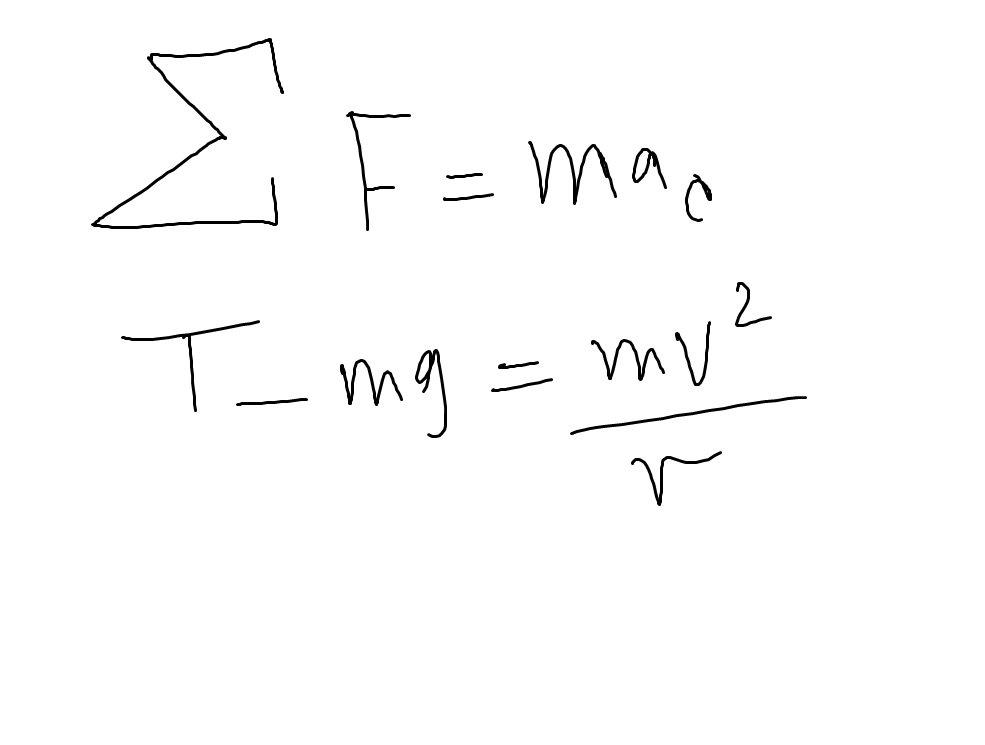
That's the sum of forces acted on the object equals to the mass times the centripetal acceleration. Since the summation of F is the tension minus mg, we get T-mg=mv^2/r
GlockParrot69:
Aah got it. ok thank so much :) GOD BLESS!!
Sam:
No problem :)
Join our real-time social learning platform and learn together with your friends!
 KBaby:
Verse 1 We left our names in the dust of the driveway Watched the old town shrink
KBaby:
Lyrics Generator Use AI to write the lyrics for a song. Suggested Genres: Pop Hip
KBaby:
Verse 1 We left our names in the dust of the driveway Watched the old town shrink
KBaby:
Lyrics Generator Use AI to write the lyrics for a song. Suggested Genres: Pop Hip

 aitexturegenerator:
How are you all handling AI-generated textures for 3D models and game assets without losing the hand-made feel? I've been doing a small stylized environment
aitexturegenerator:
How are you all handling AI-generated textures for 3D models and game assets without losing the hand-made feel? I've been doing a small stylized environment

 Demon25:
Woke up feeling like that girl and that dude well he still aint crap pluse the du
Demon25:
Woke up feeling like that girl and that dude well he still aint crap pluse the du
 playtsec:
how do I get rid of stress from teachers... I just feel like running out the classroom and leaving on my own.
playtsec:
how do I get rid of stress from teachers... I just feel like running out the classroom and leaving on my own.
 JohnnyLFowler0812:
What type of gamer would play something and then get off for a while. Why not sta
JohnnyLFowler0812:
Which is better? Metallica Rap Country R&B hiphop Medal Gospel Chill Which 3 opti
JohnnyLFowler0812:
What type of gamer would play something and then get off for a while. Why not sta
JohnnyLFowler0812:
Which is better? Metallica Rap Country R&B hiphop Medal Gospel Chill Which 3 opti