
 AnimeGhoul8863:
Classification of Living Organisms Bacteria Protists Fungus Plants Plant Cells and Tissues Plant Reproduction and Development Animals
AnimeGhoul8863:
@BenLindquist @EndersWorld
 EndersWorld:
Post
AnimeGhoul8863:
huh?
EndersWorld:
Going to AP Biology, gimme 5 minutes to switch classes
AnimeGhoul8863:
k
EndersWorld:
Back, tell me what you need
AnimeGhoul8863:
ok so what i see is that i need to answer the questions in the work sheet he gives us i still dont exactly know
AnimeGhoul8863:
they give us a big packet with stuff to fill in and all but i dont think u guys wanna fill it out
EndersWorld:
Post the questions.
EndersWorld:
Post de qeuestion
 AnimeGhoul8863:
he wants us to fill this out
EndersWorld:
Post it one question at a time and I got you XD
AnimeGhoul8863:
Classification of Living Things: What did Aristotle do to contribute to classifying living things? __________________________ ____________________________________________________________________________________________________________________________________________________________ What did Linnaeus do to contribute to classifying living things? __________________________ ____________________________________________________________________________________________________________________________________________________________ Linnean Classification: Linnaeus divided nature into three kingdoms: ______________, _________________________, and ___________________. Minerals were defined as nonliving things, like rocks and soil. The animal and plant kingdoms were further divided into smaller, more inclusive categories based on _______________________ characteristics, which at the time were thought to be unchanging. Linnaeus considered any organism that deviated from the norm an imperfect version of the original and did not classify it. Taxa: ________________________________________________________________________ 7 Taxas of the Linnean Classification System from most broad to most specific: 1. _____________________ 2. ____________________ 3. _______________________ 4. _____________________ 5. ___________________ 6. ________________________ 7. ______________________ Kingdoms of Life: What are the 5 Kingdoms of Life? 1. ______________________ 2. _______________________ 3.__________________________ 4. ______________________ 5. ______________________ Binomial Nomenclature: Binomial nomenclature gives a ___________________ to organisms based on the Latin language, such as the use of Felis catus to to describe a common _____________________. It is rooted in Linnaean taxonomy since it simply uses the genus and species names derived from that classification system. The use of Latin in scientific naming is purposeful. It is a dead language and is no longer spoken fluently. Therefore, it works well for universal naming for species throughout the world. What is the scientific name for the polar bear? ____________ _____________ What is the scientific name for the tiger? _______________ _______________ Domain System: In the 1970s, a scientist named Carl Woese began to use nucleic acid sequences and ribosomal RNA to determine links between organisms. These links revealed that organisms with similar ___________________________________ were not necessarily related to one another. In the case of the Bacteria kingdom, ribosomal RNA uncovered the existence of two separate groups of bacteria, _______________________ and _________________________________. Although they looked similar on the outside, these two bacteria groups were very different on the inside. Archeabacteria differ from bacteria in ___________________________ composition, _____________________________, and resistance to extreme _________________________. In 1990, Woese and his colleagues proposed a new three-domain classification system that includes _________________, _______________, and ___________________. It did not end Linnaean taxonomy; it simply added a new grouping (taxa) to express new scientific knowledge. Alternative Classification Systems: Phylogeny and Cladistics: Phylogeny: ____________________________________________________________________ This evolution of species is represented by a phylogenetic tree of ancestors and descendants, linking one species to another in a ______________ starting from the _______________ of the tree to the _______. Each new branch of the tree represents a change in the line of shared traits. Cladistics: ____________________________________________________________________________ Cladogram: ___________________________________________________________________________ Clades: _______________________________________________________________________________ Ancestral Trait: ________________________________________________________________________ Derived Trait: _________________________________________________________________________ Use the following vocabulary terms in your own words to explain how a cladogram works. (cladogram, clade, ancestral trait, derived trait) ________________________________________________________ ____________________________________________________________________________________________________________________________________________________________________________________________________________________________________________________________________________________________________________________________________________________ Alternative Classification Systems: Genetic Connections: _______________________________ help organize species. The ability to see the genetic code that connects all species has defined evolutionary relationships more clearly and provided evidence to support species placement within phylogenetic trees and cladograms. In the case of Woese’s domain system, genetic differences between species led scientists to make changes to the way we classify bacteria. What is a disadvantage of classifying organisms based off of genetics for categorization? __________________________________________________________________________________________________________________________________________________________________________________________________________________________________________ What is the main difference between classifying organisms using the Linnean Taxonomy and the Claogram methods? _____________________________________________________________ __________________________________________________________________________________________________________________________________________________________________________________________________________________________________________ Classification of Nonliving Things: There are biological agents in our midst that contain _________________________________________, but are not ________________. These are the _______________ and ___________________, and they need to be classified, too. Although they are made of DNA or RNA and contain an outer protein coat, they are not living organisms and cannot be classified into a kingdom by Linnaean taxonomy. Instead, viruses are categorized by _______________, _____________, _________________, and _________________________________________. Basic Virus Shapes: Viruses come in all shapes and microscopic sizes. Some have ___________________________________ and some do not. Some have ______________________________, while others have _______________________________. If we consider the organisms they infect, the classification can get complex. However, there are some basic shapes for the protein coats of viruses. Let’s review these shapes below. Virus Shape Description Disease/Symptoms Viral Infections: What is the difference between a lytic and lysogenic infection? __________________________ ______________________________________________________________________________ ____________________________________________________________________________________________________________________________________________________________ Did you know? How are viruses used for beneficial reasons? ____________________________ ____________________________________________________________________________________________________________________________________________________________ Advantages and Disadvantages of Classification Methods: Cladistics: • Advantage: _____________________________________________________________________ • Disadvantage: __________________________________________________________________ Linnaean Taxonomy • Advantage: ______________________________________________________________________________, ______________________________________________________________________________ • Disadvantage: __________________________________________________________________, ______________________________________________________________________________ Genetic Connections • Advantage: _____________________________________________________________________ • Disadvantage: __________________________________________________________________
EndersWorld:
I said one at a time XD or else ima get hella lost trying to answer this
AnimeGhoul8863:
fine but my dba is at 11 so we gotta be fast
AnimeGhoul8863:
What did Aristotle do to contribute to classifying living things?
EndersWorld:
Mmm, can I give you information and you write it down in your own words?
AnimeGhoul8863:
yes? if this is to hard ill just go in my self
EndersWorld:
Not to hard, just don’t have time to decipher
EndersWorld:
Aristotle developed the first classification system, which divided all known organisms into two groups: PLANTS and ANIMALS Aristotle then divided each of these main groups into three smaller groups. Animal Subgroups: Land, Water, Air Plant Subgroups: Small, Medium, Large Aristotle’s classification system was not very good. There were too many organisms that didn’t fit. For example, frogs are born in water and have gills like fish, but when they grow up they have lungs and can live on land. So how would Aristotle classify frogs? In Aristotle’s classification system, birds, bats, and flying insects were grouped together even though they have little in common except they can fly. But the penguin is a bird that cannot fly. So Aristotle would not have classified them as birds.
EndersWorld:
Is this making sense
AnimeGhoul8863:
yes
EndersWorld:
Need more?
AnimeGhoul8863:
What did Linnaeus do to contribute to classifying living things?
EndersWorld:
Taxonomy is the part of science that focuses on naming and classifying or grouping organisms. A Swedish naturalist named Carolus Linnaeus is considered the 'Father of Taxonomy' because, in the 1700s, he developed a way to name and organize species that we still use today. His two most important contributions to taxonomy were: A hierarchical classification system The system of binomial nomenclature (a 2-part naming method) Carolus Linnaeus lived from 1707 to 1778. Carolus Linnaeus During his lifetime, Linnaeus collected around 40,000 specimens of plants, animals, and shells. He believed it was important to have a standard way of grouping and naming species. So in 1735, he published his first edition of Systema Naturae (The System of Nature), which was a small pamphlet explaining his new system of the classification of nature.
AnimeGhoul8863:
Linnaeus divided nature into three kingdoms: 1
2
3
EndersWorld:
Hmmm...
AnimeGhoul8863:
found it animals, vegetable (or plant), and minerals.
EndersWorld:
I couldn’t find it, sorry :(
AnimeGhoul8863:
7 Taxas of the Linnean Classification System from most broad to most specific: 1. _____________________ 2. ____________________ 3. _______________________ 4. _____________________ 5. ___________________ 6. ________________________ 7. ______________________
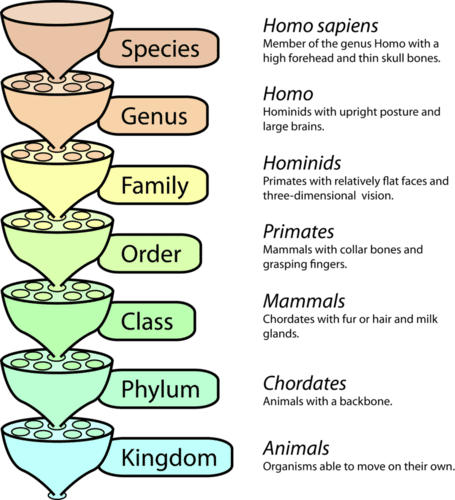 EndersWorld:
Species is most specific, Kingdom is most broad
AnimeGhoul8863:
ok Phylogeny: ____________________________________________________________________
EndersWorld:
Am I defining it?
AnimeGhoul8863:
just like a definition
EndersWorld:
the branch of biology that deals with phylogenesis.
AnimeGhoul8863:
i found it Phylogeny is the evolutionary history of a group of genetically related species.
AnimeGhoul8863:
What is the main difference between classifying organisms using the Linnean Taxonomy and the Claogram methods?
EndersWorld:
the particular form of biological classification (taxonomy) set up by Carl Linnaeus, as set forth in his Systema Naturae (1735) and subsequent works. In the taxonomy of Linnaeus there are three kingdoms, divided into classes, and they, in turn, into orders, genera (singular: genus), and species (singular: species), with an additional rank lower than species. a term for rank-based classification of organisms, in general. That is, taxonomy in the traditional sense of the word: rank-based scientific classification. This term is especially used as opposed to cladistic systematics, which groups organisms into clades. It is attributed to Linnaeus, although he neither invented the concept of ranked classification (it goes back to Plato and Aristotle) nor gave it its present form. In fact, it does not have an exact present form, as "Linnaean taxonomy" as such does not really exist: it is a collective (abstracting) term for what actually are several separate fields, which use similar approaches.<— Linnean
EndersWorld:
The characteristics used to create a cladogram can be roughly categorized as either morphological (synapsid skull, warm blooded, notochord, unicellular, etc.) or molecular (DNA, RNA, or other genetic information).[7] Prior to the advent of DNA sequencing, cladistic analysis primarily used morphological data. Behavioral data (for animals) may also be used.[8] As DNA sequencing has become cheaper and easier, molecular systematics has become a more and more popular way to infer phylogenetic hypotheses.[9] Using a parsimony criterion is only one of several methods to infer a phylogeny from molecular data. Approaches such as maximum likelihood, which incorporate explicit models of sequence evolution, are non-Hennigian ways to evaluate sequence data. Another powerful method of reconstructing phylogenies is the use of genomic retrotransposon markers, which are thought to be less prone to the problem of reversion that plagues sequence data. They are also generally assumed to have a low incidence of homoplasies because it was once thought that their integration into the genome was entirely random; this seems at least sometimes not to be the case, however.<—- Claogram
AnimeGhoul8863:
ok thx ill be back at 11:30 ish so wish me luck
EndersWorld:
Good luck. I feel like I’m not really helping lol
 Eiwoh2:
And this is a long thread. Not closed yet, though? XD
Join our real-time social learning platform and learn together with your friends!
 KBaby:
Verse 1 We left our names in the dust of the driveway Watched the old town shrink
KBaby:
Lyrics Generator Use AI to write the lyrics for a song. Suggested Genres: Pop Hip
KBaby:
Verse 1 We left our names in the dust of the driveway Watched the old town shrink
KBaby:
Lyrics Generator Use AI to write the lyrics for a song. Suggested Genres: Pop Hip

 aitexturegenerator:
How are you all handling AI-generated textures for 3D models and game assets without losing the hand-made feel? I've been doing a small stylized environment
aitexturegenerator:
How are you all handling AI-generated textures for 3D models and game assets without losing the hand-made feel? I've been doing a small stylized environment

 Demon25:
Woke up feeling like that girl and that dude well he still aint crap pluse the du
Demon25:
Woke up feeling like that girl and that dude well he still aint crap pluse the du
 playtsec:
how do I get rid of stress from teachers... I just feel like running out the classroom and leaving on my own.
playtsec:
how do I get rid of stress from teachers... I just feel like running out the classroom and leaving on my own.
 JohnnyLFowler0812:
What type of gamer would play something and then get off for a while. Why not sta
JohnnyLFowler0812:
Which is better? Metallica Rap Country R&B hiphop Medal Gospel Chill Which 3 opti
JohnnyLFowler0812:
What type of gamer would play something and then get off for a while. Why not sta
JohnnyLFowler0812:
Which is better? Metallica Rap Country R&B hiphop Medal Gospel Chill Which 3 opti