
 zarkam21:
What is the mathematical equation for capacitance? Identify each variable.
 Vocaloid:
|dw:1523580016092:dw|
zarkam21:
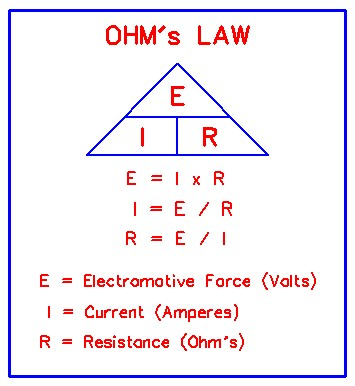
What is the mathematical equation for Ohm’s law? Identify each variable.
 zarkam21:
This would be it right?
zarkam21:
@Vocaloid
Vocaloid:
yes
 Vocaloid:
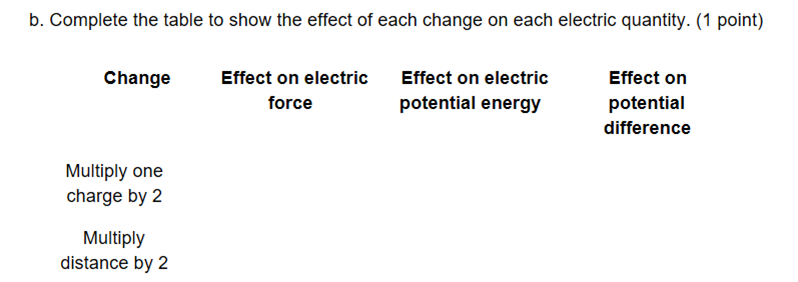
|dw:1523590469037:dw| well let's start with the force equation, what would multiplying the charge by 2 do and what would multiplying the distance by 2 do?
zarkam21:
well distance is inverse
zarkam21:
anf force is just parallel i think :/
Vocaloid:
good, so numerically, how would the force change if one charge is doubled?
zarkam21:
4 and then one would reduce by 2?
Vocaloid:
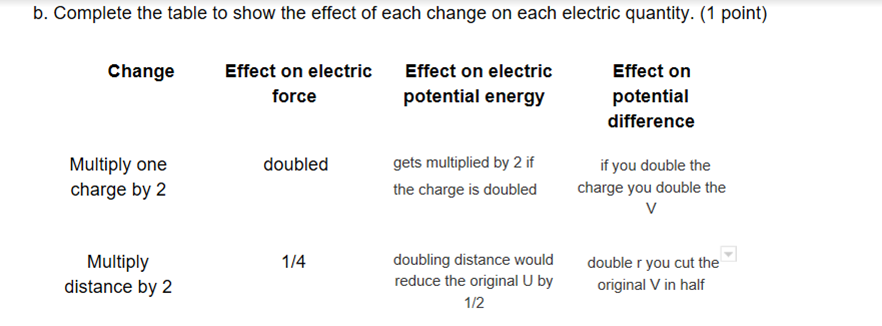
hm if one charge is doubled the equation just becomes F = 2q * q / r^2 so the force is just doubled from before if the distance doubles then the equation becomes F = q * q / (2r)^2 so qq/4r^2 so it gets scaled down to 1/4 of the original force
Vocaloid:
|dw:1523590677166:dw|
Vocaloid:
what about the electric potential U? doubling a charge vs doubling the distance?
zarkam21:
um not sure about this one
Vocaloid:
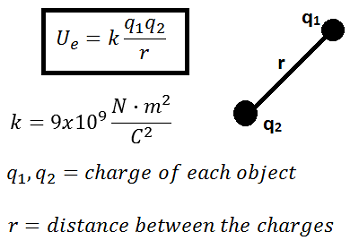
well, take the equation for U and multiply one of the charges by 2 what happens to the overall equation?
 zarkam21:
This equation right
Vocaloid:
yes
zarkam21:
It would decrease
zarkam21:
:/
zarkam21:
Still not sure about this one
Vocaloid:
|dw:1523590926422:dw|
Vocaloid:
let's take q1 and multiply it by 2
Vocaloid:
|dw:1523590938080:dw|
Vocaloid:
what happens to the overall equation for U?
zarkam21:
well its multilpied by two
Vocaloid:
good, so we would say the potential energy equation gets multiplied by 2 if the charge is doubled now repeat the same thing except multiply the distance r by 2
zarkam21:
SO the charge increase
zarkam21:
well distance is inverse so the opposite?
Vocaloid:
good, doubling distance would reduce the original U by 1/2
Vocaloid:
|dw:1523591144967:dw|
Vocaloid:
what about the potential difference V?
Vocaloid:
it pretty much follows the same rule as U, if you double the charge you double the V, if you double r you cut the original V in half
 Vocaloid:
good but instead of just saying "1/4" in the lower left corner it needs to be something like "reduces the force by a factor of 1/4"
zarkam21:
Okay got it and for the top part where I wrote doubled it would be doubled by 2?
Vocaloid:
"doubled" already means increased by 2 so "doubled by 2" is redundant
zarkam21:
What is the potential difference across a 15 Ω resistor that has a current of 3.0 A?
Vocaloid:
potential difference = V = IR you're given current and resistance, find V
zarkam21:
V=IR V=3.0*15=45
Vocaloid:
awesome units on potential difference are volts (V)
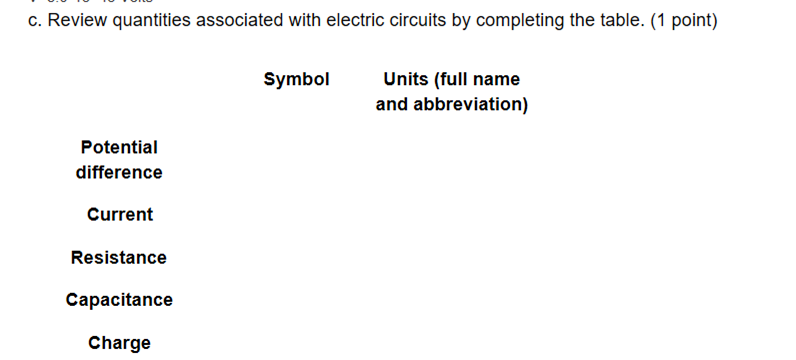 zarkam21:
symbol is U
Vocaloid:
U is potential energy not potential difference (yeah the names are a bit confusing) so potential difference has the symbol V and the name volts (i can't find an abbreviation for volts, so just "v"??)
Vocaloid:
*i guess it should be a capital V for the abbreviation too
zarkam21:
Yeah thats what I pur ^~^
zarkam21:
Okay for current I resistance it would be R
Vocaloid:
yes, and the full names for those would be amperes (amps) for current and ohms (idk how to abbreviate ohms)
Vocaloid:
oh wait duh the abbreviation would be the omega symbol (Ω)
Vocaloid:
anyway what about charge?
zarkam21:
capacitance would be Um :/
Vocaloid:
capacitance has the symbol C, units of farads, abbreviation (F)
zarkam21:
charge would be neg or pos
Vocaloid:
that's a good guess but those are types of charge, not necessarily the symbol we use to represent charge if you look at the equations for force/potential energy/, etc. from before notice how we used "q" for charge, that would be your symbol the units of charge are Coloumbs, usually abbreviated as C (to distinguisth between coloumbs and capacitance you have to pay attention to the context of the problem)
zarkam21:
Going to bed? [=)
Vocaloid:
nah I'll be up for a while, I'm caught up on sleep
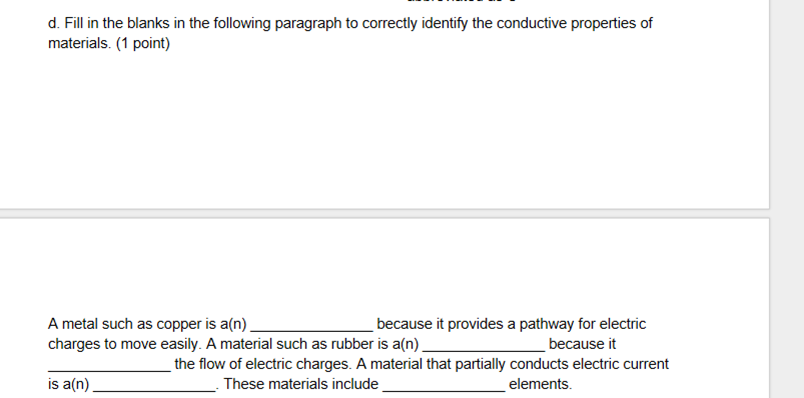 zarkam21:
insulator for the first blank
Vocaloid:
copper is a conductor not an insulator (it allows for the flow of electrons)
Vocaloid:
insulator would be rubber
zarkam21:
because it allows?
Vocaloid:
the third blank is talking about an insulator so it would *"prevent"* the flow of charges
Vocaloid:
material that partially conducts electricity is a semiconductor and I'm 80% sure the elements would be "metalloids"
Vocaloid:
good
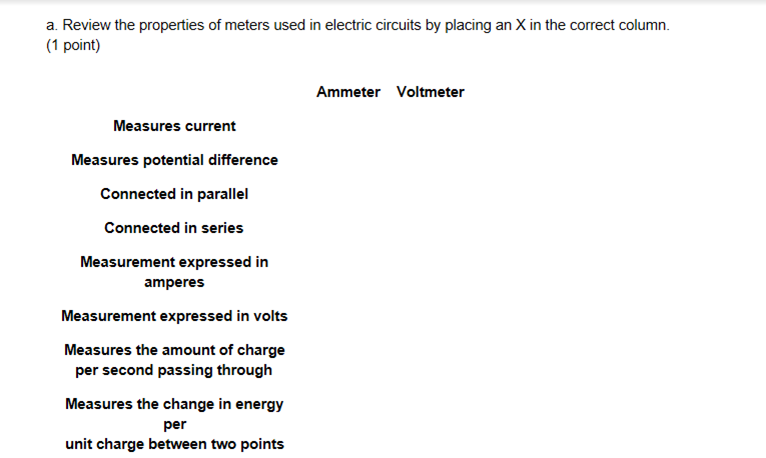 Vocaloid:
well let's take the rows two at a time between voltmeter and ammeter which one measures current and which one measures voltage?
zarkam21:
voltmeter = voltage ammeter = current
Vocaloid:
good which one is in series and which one is in parallel?
zarkam21:
current is parallel and the other is series
Vocaloid:
other way around, since resistors in parallel have the same voltage so the voltmeter needs to be in parallel and the ammeter in series
Vocaloid:
so moving on, which one's in amperes and which one's in volts?
zarkam21:
amperes is obviously PD and the other is current
Vocaloid:
amperes is current, voltage is potential difference
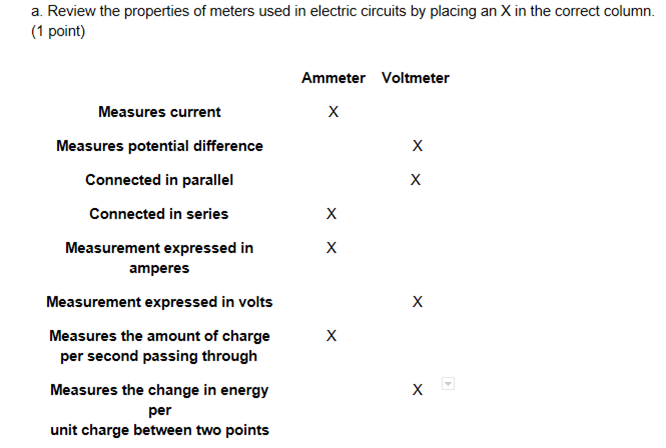 Vocaloid:
good, all the x's are in the right spots
zarkam21:
Write a few sentences comparing three different kinds of circuits: complete, open, and short circuits.
zarkam21:
Open: allows matter to enter and exit
Vocaloid:
that's an open system not an open circuit|dw:1523593918246:dw|
zarkam21:
open circuit is light right?
Vocaloid:
open circuit = a circuit in which the flow of electrons has been interrupted by a break in the pathway closed circuit = a circuit in which the flow of electrons has not been interrupted
zarkam21:
Okay so the question is asking for complete, short, and open
zarkam21:
complete would be where it is a completed circuit
Vocaloid:
yes
Vocaloid:
a short circuit is a circuit with too low resistance which causes the circuit elements to overheat, causing damage; this happens because electrons will naturally seek the path of lowest resistance
zarkam21:
got it and my definiton for completed is correct right?
Vocaloid:
yes
zarkam21:
Describe how fuses and circuit breakers protect against electrocution and household fires. How do you restore a broken circuit after the problem has been corrected?
zarkam21:
Not sure about this
Vocaloid:
fuses are thin pieces of wire that will melt when overheated, interrupting excess current and opening the circuit circuit breakers are switches that turn off and interrupt the flow of current when too much current is detected I'm not 100% sure on how to restore a circuit, but apparently you just have to turn the circuit breaker to the off position and then on again, or, if you're using a fuse, replace the broken fuse with a new one
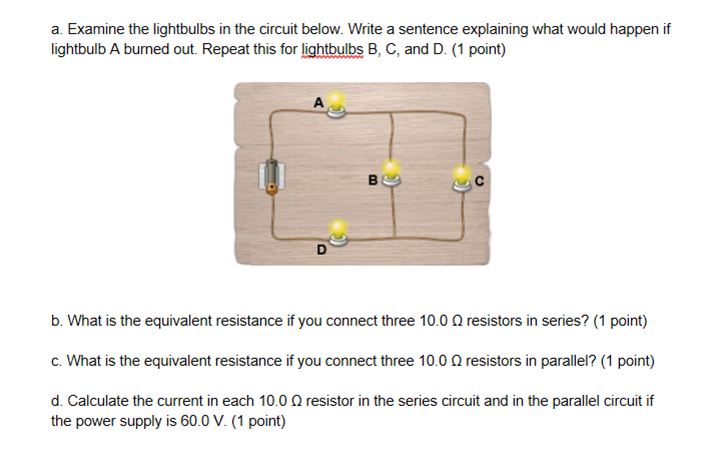 Vocaloid:
well let's start with A, do any of the bulbs still work if A is broken? (are there any loops that still work without bulb A?)
zarkam21:
It would still work I think
Vocaloid:
|dw:1523594652360:dw|
Vocaloid:
|dw:1523594657327:dw|
Vocaloid:
|dw:1523594676034:dw|
Vocaloid:
so none of the bulbs work if A is out what about bulb B?
zarkam21:
b would work
Vocaloid:
good, if bulb B goes out, then A C and D are still in a loop what about bulb C?
zarkam21:
will not work
Vocaloid:
hm, if we burn out bulb C we still have a loop with A, B D|dw:1523594812435:dw|
Vocaloid:
bulb D?
zarkam21:
Its in the loop
Vocaloid:
good so if bulb D goes out they all go out
Vocaloid:
alright for part b, if you have three 10 ohm resistors in series what's the total resistance?
zarkam21:
30 right because I would do 10*3
Vocaloid:
awesome what about part c) if three 10 ohms are in parallel?
zarkam21:
um 10+10+10 ? :/
Vocaloid:
remember the rule for parallel resistance 1/T = sum of 1/resistance for all resistors
Vocaloid:
1/T = 1/10 + 1/10 + 1/10 T = ?
zarkam21:
oh okay so 1/10+1/10+1/10
zarkam21:
3/10
Vocaloid:
be careful 1/T = 3/10 yes, but we still need to solve for T
zarkam21:
10/3
zarkam21:
for this would it just be 60/10
Vocaloid:
good, T = 10/3 which rounds to about 3.33 ohms for c)
Vocaloid:
alright for d) use the formula V = IR to find the current for the 30 ohm series resistors , and then for the 3.33 ohm parallel resistors (you are given V = 60 volts)
zarkam21:
V=IR 60=I(30) I=2 V=IR 60=I(3.33) I=18
Vocaloid:
good units of current are amps as usual
zarkam21:
Going to bed now?? =)
Vocaloid:
nah I'll be up for an hour or so, I'm working on some notes for class
zarkam21:
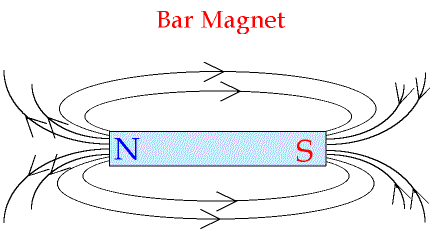
a. What are the ends of a magnet called? Describe the forces that occur when two magnets are brought close together. (1 point) b. Draw a bar magnet, label its poles, and draw the magnetic field lines around it. (1 point) c. Explain what happens when you cut a magnet in half. (1 point)
zarkam21:
A. the ends of the magnet are called the north and south pole. When these are brought together, they repel against each other. B.
 zarkam21:
I am not sure about part C
Vocaloid:
just be careful with part A, you must specify that they will repel each other if *like* ends (so north-north or south-south) are brought together, and will attract if opposite ends are brought together
Vocaloid:
for C, if a magnet is cut in half, each segment will form its own north and south pole
zarkam21:
Compare permanent magnetism, induced magnetism, and electromagnetism.
zarkam21:
Not sure about this. electromagnetism well has to do with electricity and magnets.>
Vocaloid:
permanent magnetism = type of magnetism in which magnet that still retains its properties even w/o an applied field induced magnetism = type of magnetism in which a substance is induced to have a magnetic field after being exposed to an applied field, but the alignment of their atoms is not permanent and thus is not a permanent magnet
Vocaloid:
electromagnetism: magnetism that is induced by an applied electric current
 Vocaloid:
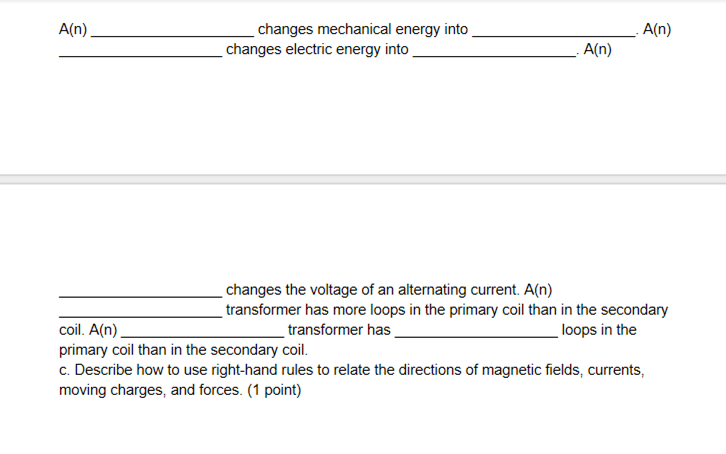
generator: mechanical --> electrical motor: electrical --> mechanical
Vocaloid:
third blank is transformer, if primary coil # is > than secondary coil # it's a step-down transformer, if primary < secondary it's a step-up
 Vocaloid:
can we close this and re-post this question in either the finance or the math section?
zarkam21:
Not the phhysics section?
Vocaloid:
yeah this is an economics question so physics wouldn't be the right place, plus this question is already very long (130+ replies)
zarkam21:
OH shoot , i posted the wrong thing. I have a physics question. I will repost it in physics
Join our real-time social learning platform and learn together with your friends!
 KBaby:
Verse 1 We left our names in the dust of the driveway Watched the old town shrink
KBaby:
Lyrics Generator Use AI to write the lyrics for a song. Suggested Genres: Pop Hip
KBaby:
Verse 1 We left our names in the dust of the driveway Watched the old town shrink
KBaby:
Lyrics Generator Use AI to write the lyrics for a song. Suggested Genres: Pop Hip

 aitexturegenerator:
How are you all handling AI-generated textures for 3D models and game assets without losing the hand-made feel? I've been doing a small stylized environment
aitexturegenerator:
How are you all handling AI-generated textures for 3D models and game assets without losing the hand-made feel? I've been doing a small stylized environment

 Demon25:
Woke up feeling like that girl and that dude well he still aint crap pluse the du
Demon25:
Woke up feeling like that girl and that dude well he still aint crap pluse the du
 playtsec:
how do I get rid of stress from teachers... I just feel like running out the classroom and leaving on my own.
playtsec:
how do I get rid of stress from teachers... I just feel like running out the classroom and leaving on my own.
 JohnnyLFowler0812:
What type of gamer would play something and then get off for a while. Why not sta
JohnnyLFowler0812:
Which is better? Metallica Rap Country R&B hiphop Medal Gospel Chill Which 3 opti
JohnnyLFowler0812:
What type of gamer would play something and then get off for a while. Why not sta
JohnnyLFowler0812:
Which is better? Metallica Rap Country R&B hiphop Medal Gospel Chill Which 3 opti