
 zarkam21:
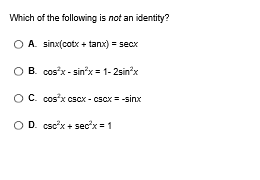
A?
 Vocaloid:
so here's why it's not A |dw:1523656721695:dw|
Vocaloid:
|dw:1523656775680:dw|
Vocaloid:
or |dw:1523656822922:dw|
Vocaloid:
cos^2(x) + sin^2(x) = 1 so...
Vocaloid:
|dw:1523656876750:dw|
Vocaloid:
1/cosx = secx so A is actually True
Vocaloid:
alright, any thoughts on B? as a hint cos^2(x) + sin^2(x) = 1 as we stated before
zarkam21:
So D/
Vocaloid:
good, D is the false one
 zarkam21:
A
Vocaloid:
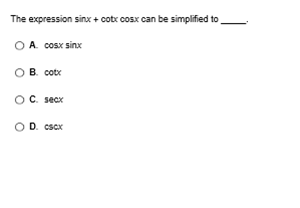
hm well you can split cot into cos/sin giving us: sin(x) + cos(x) * cos(x) / sin(x) any ideas what you can do from there?
zarkam21:
Oh B
Vocaloid:
nope not quite
zarkam21:
Actually I do not want toguess. No, I am not sure what to do from here
Vocaloid:
we can re-write sin(x) as sin^2(x)/sin(x) to get sin^2(x)/sin(x) + cos^2(x)/sin(x) now, since sin^2(x) + cos^2(x) equals 1 what do you think the final result might be?
zarkam21:
D
zarkam21:
nopr its c
Vocaloid:
sin^2(x)/sin(x) + cos^2(x)/sin(x) = 1/sin(x) = csc(x)
 zarkam21:
I apologize I'm not too well aware on these concepts
zarkam21:
C
Vocaloid:
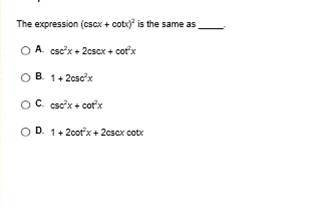
ok I finally figured it out first you have to expand (csc(x) + cot(x))^2 using foil it ends up being csc^(x) + 2csc(x)cot(x) + cot^2(x) now, we know that csc^(x) = 1 + cot^(x) so if you substitute csc^(x) = 1 + cot^(x) into the equation csc^(x) + 2csc(x)cot(x) + cot^2(x) what do you get?
zarkam21:
Um D?
Vocaloid:
good
 zarkam21:
B
Vocaloid:
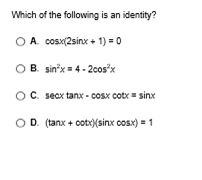
well it's kind of hard to do this one w/o giving it away, but if you start with the last identity and convert the cot and tan expressions to sin and cos you will see that you end up with sin^2(x) + cos^2(x) = 1 cross out like terms, making D the best possibility
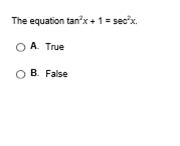 zarkam21:
true
Vocaloid:
yup good
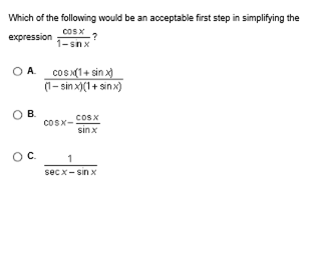 zarkam21:
B
Vocaloid:
weeel this one is also a little hard to do w/o giving it away but B is wrong b/c that's not a mathematically valid step, C is a bit too far to be a first step the reason we multiply the denominator and numerator by 1 + sin(x) in answer choice A is to convert the denominator to 1 - sin^2(x) which = cos^2(x)
Vocaloid:
so A is your best possibility
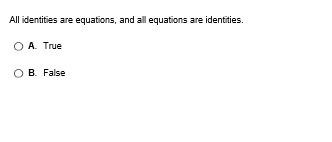 zarkam21:
f?
Vocaloid:
good
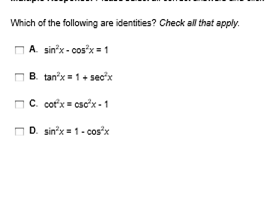 zarkam21:
C
Vocaloid:
good but there's one more, you may need to re-arrange the equations to see it clearly
zarkam21:
A
Vocaloid:
that's close but keep in mind sin^2(x) + cos^2(x) = 1 is the identity not a minus sign
zarkam21:
D
Vocaloid:
good so C+ D
 zarkam21:
A
Vocaloid:
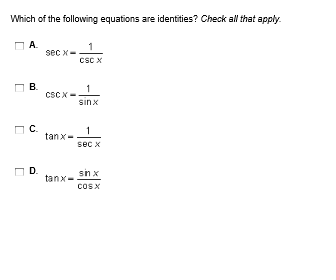
A is actually not an identity sec(x) = 1/cos csc(x) = 1/sin
Vocaloid:
there are two correct choices, try looking at B C and D to see which one is false
zarkam21:
B is right
Vocaloid:
good, keep going
zarkam21:
and so is C
zarkam21:
D*
Vocaloid:
hm remember that sec(x) = 1/cos(x) that means 1/sec(x) = cos not tan so the correct sol'ns are B +D
 zarkam21:
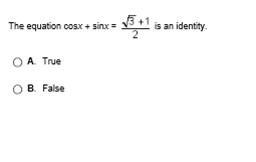
True
Vocaloid:
I'm going to say false on this one, if you try plugging in various x-values you won't get (sqrt(3) + 1) / 2 every single time
Join our real-time social learning platform and learn together with your friends!
 KBaby:
Verse 1 We left our names in the dust of the driveway Watched the old town shrink
KBaby:
Lyrics Generator Use AI to write the lyrics for a song. Suggested Genres: Pop Hip
KBaby:
Verse 1 We left our names in the dust of the driveway Watched the old town shrink
KBaby:
Lyrics Generator Use AI to write the lyrics for a song. Suggested Genres: Pop Hip

 aitexturegenerator:
How are you all handling AI-generated textures for 3D models and game assets without losing the hand-made feel? I've been doing a small stylized environment
aitexturegenerator:
How are you all handling AI-generated textures for 3D models and game assets without losing the hand-made feel? I've been doing a small stylized environment

 Demon25:
Woke up feeling like that girl and that dude well he still aint crap pluse the du
Demon25:
Woke up feeling like that girl and that dude well he still aint crap pluse the du
 playtsec:
how do I get rid of stress from teachers... I just feel like running out the classroom and leaving on my own.
playtsec:
how do I get rid of stress from teachers... I just feel like running out the classroom and leaving on my own.
 JohnnyLFowler0812:
What type of gamer would play something and then get off for a while. Why not sta
JohnnyLFowler0812:
Which is better? Metallica Rap Country R&B hiphop Medal Gospel Chill Which 3 opti
JohnnyLFowler0812:
What type of gamer would play something and then get off for a while. Why not sta
JohnnyLFowler0812:
Which is better? Metallica Rap Country R&B hiphop Medal Gospel Chill Which 3 opti