
 Shadow:
Ohm's Law Master Page: https://questioncove.com/study#/updates/5ae2c3a7293a9d6f092ba200
Shadow:
Ohm's Law Formula: \[(I) = \frac{ V }{ R }\] Where, I = the current (in amps) V = the voltage (in volts R = the resistance (in ohms) The current is directly proportional to the voltage and inversely proportional to the resistance. If voltage increases, so does the current. If the resistance increases, the current decreases. Note: I is only in parentheses due to a visual glitch. Disregard it.
Shadow:
Ohm's Law Formula: \[(I) = \frac{ V }{ R }\] Where, I = the current (in amps, A) V = the voltage (in volts, v) R = the resistance (in ohms) \[ohms = \Omega\] The current is directly proportional to the voltage and inversely proportional to the resistance. If voltage increases, so does the current. If the resistance increases, the current decreases. Note: I is only in parentheses due to a visual glitch. Disregard it.
Shadow:
Ohm's Law - Practice 1 1. How much current is in a circuit that includes a 9-volt battery and a bulb with a resistance of 3 ohms? \[(I) = \frac{ 9 }{ 3 } = 3 \Omega \] 2. How much current is in a circuit that includes a 9-volt battery and a bulb with a resistance of 12 ohms? \[(I) = \frac{ 9 }{ 12 } = 0.75 A\] 3. A circuit contains a 1.5 volt battery and a bulb with a resistance of 3 ohms. Calculate the current. \[(I) = \frac{ 1.5 }{ 3 } = 0.5 A\] 4. A circuit contains two 1.5 volt batteries with a resistance of 3 ohms. Calculate the current. \[V _{total} = 1.5 + 1.5 = 3 V \] \[(I) = \frac{ 3 }{ 3 } = 1 A\] 5. What is the voltage of a circuit with 15 amps of current and toaster with 8 ohms of resistance? \[V = RI\] \[V = (8)(15) = 120 V\] 6. A light bulb has a resistance of 4 ohms and a current of 2A. What is the voltage across the bulb? \[V = (4)(2) = 8 V\] 7. How much voltage would be necessary to generate 10 amps of current in a circuit that has 5 ohms of resistance? \[V = (5)(10) = 50 V\] 8. How many ohms of resistance must be present in a circuit that has 120 volts and a current of 10 amps? \[R = \frac{ V }{ I }\] \[R = \frac{ 120 }{ 10 } = 12 \Omega\] 9. An alarm clock draws 0.5 A of current when connected to a 120 volt circuit. Calculate it's resistance. \[R = 120(0.5) = 240 \Omega\] 10. A portable CD player uses two 1.5 V batteries. If the current in the CD player is 2A, what is the resistance \[V_{total} = 1.5 + 1.5 = 3 V\] \[R = \frac{ 3 }{ 2 } = 1.5 \Omega\] 11. You have a large flashlight that takes 4 D-cell batteries. If the current in the flashlight is 2 amps, what is the resistance of the light bulb? (Hint: A D-cell battery has 1.5 volts) \[V_{total} = 4(1.5) = 6 V\] \[R = \frac{ 6 }{ 2 } = 3 \Omega\]
 Shadow:
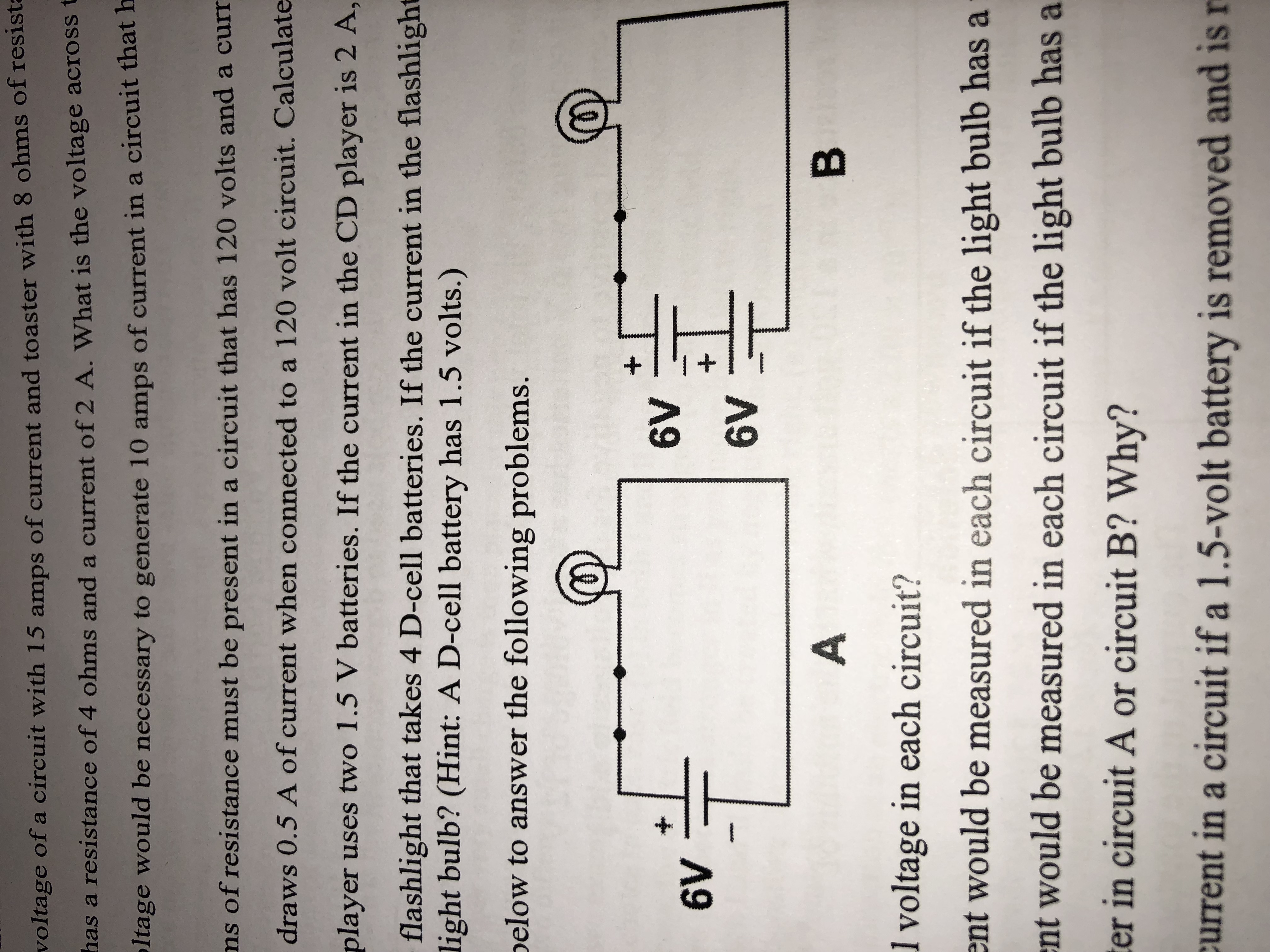
12. Use the diagram above to answer the following problems a. What is the total voltage in each circuit? First one: \[V_{total} = 6\] Second one: \[V_{total} = 6 + 6 = 12 V\] b. How much current would be measured in each circuit if the light bulb has a resistance of 6 ohms? First one: \[(I) = \frac{ 6 }{ 6 } = 1 A\] Second one: \[(I) = \frac{ 12 }{ 6 } = 2 A\] c. How much current would be measured in each circuit if the light bulb has a resistance of 12 ohms? First one: \[(I) = \frac{ 6 }{ 12} = 0.5 A\] Second one: \[(I) = \frac{ 12 }{ 12 } = 1A\] d. Is the bulb brighter in circuit A or circuit B? Why? The bulb is brighter in circuit B because more voltage means more current, and more current means more power. More power means more brightness.
Shadow:
13. What happens to the current in a circuit if a 1.5-volt battery is removed and is replaced by a 9-volt battery? \[1.5x = 9\] \[x = 6\] The current would increase by a factor of 6.
Shadow:
14. In your own words, state the relationship between resistance and current in a circuit. "The current is inversely proportional to the resistance. If the resistance increases, the current decreases." 15. In your own words, state the relationship between voltage and current in a circuit. "The current is directly proportional to the voltage. If voltage increases, so does the current" Note: Basically what I wrote in the first post on this question.
Shadow:
16. What could you do to a closed circuit consisting of 2 batteries, 2 light bulbs, and a switch to increase the current? Explain your answer. Make a parallel circuit. They have a lower total resistance in comparison to a series circuit. Due to the inverse proportional relationship to current, this will result in a higher total current than a series circuit. 17. What could you do to a closet circuit consisting of 2 batteries, 2 light bulbs, and a switch to decrease the current? Explain your answer. Make the series circuit. They have a higher total resistance than parallel circuits. Due to the inverse proportional relationship to current, this will result in a lower total current than a parallel circuit. @nuts good?
Shadow:
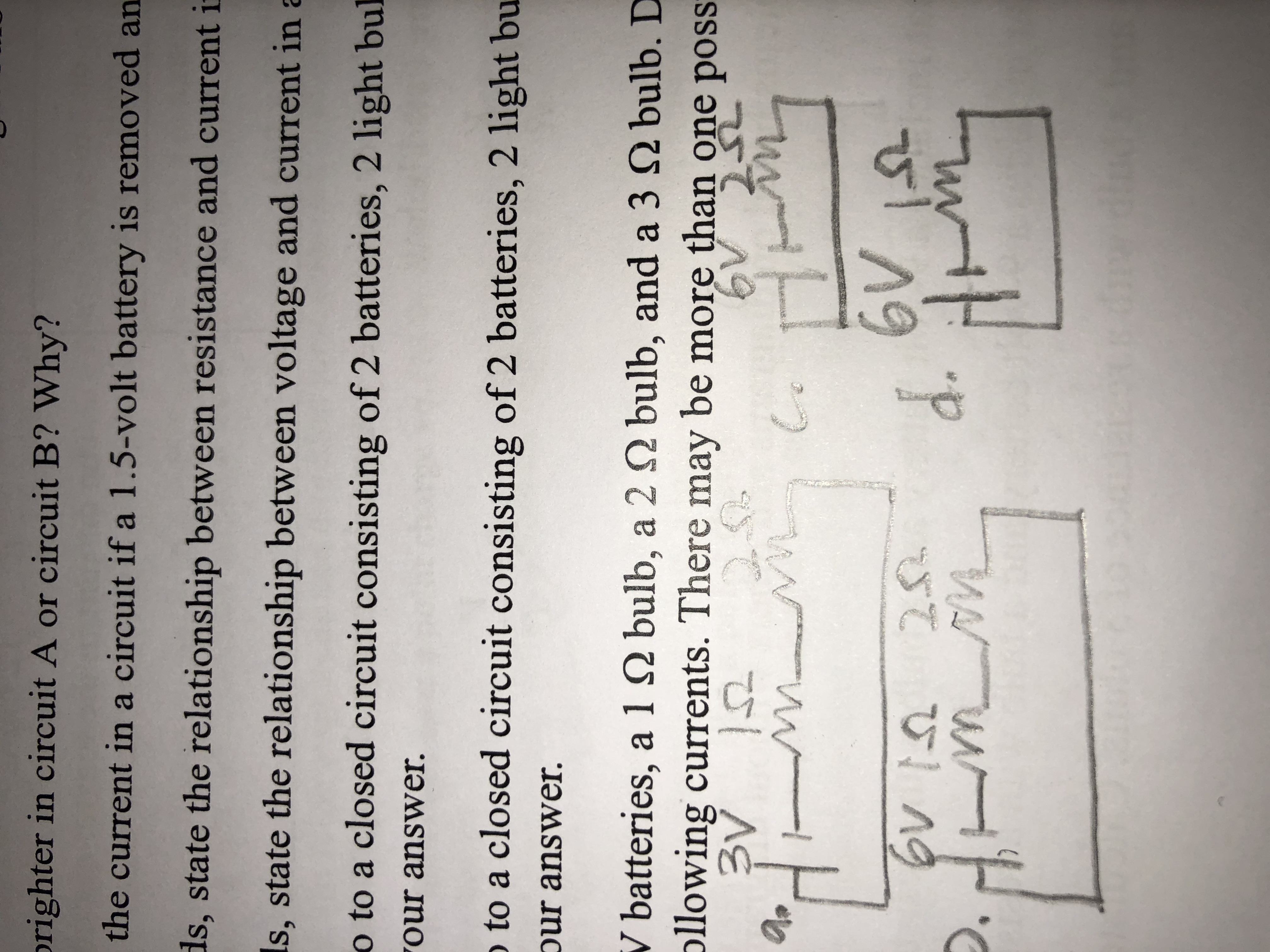
18. You have four 1.5 V batteries, a 1 ohm bulb, a 2 ohm bulb, and a 3 ohm bulb. Draw a circuit you could build to create each of the following currents. There may be more than one possible answer for each. a. 1 ampere b. 2 amperes c. 3 amperes. d. 6 amperes
Join our real-time social learning platform and learn together with your friends!
 KBaby:
Verse 1 We left our names in the dust of the driveway Watched the old town shrink
KBaby:
Lyrics Generator Use AI to write the lyrics for a song. Suggested Genres: Pop Hip
KBaby:
Verse 1 We left our names in the dust of the driveway Watched the old town shrink
KBaby:
Lyrics Generator Use AI to write the lyrics for a song. Suggested Genres: Pop Hip

 aitexturegenerator:
How are you all handling AI-generated textures for 3D models and game assets without losing the hand-made feel? I've been doing a small stylized environment
aitexturegenerator:
How are you all handling AI-generated textures for 3D models and game assets without losing the hand-made feel? I've been doing a small stylized environment

 Demon25:
Woke up feeling like that girl and that dude well he still aint crap pluse the du
Demon25:
Woke up feeling like that girl and that dude well he still aint crap pluse the du
 playtsec:
how do I get rid of stress from teachers... I just feel like running out the classroom and leaving on my own.
playtsec:
how do I get rid of stress from teachers... I just feel like running out the classroom and leaving on my own.
 JohnnyLFowler0812:
What type of gamer would play something and then get off for a while. Why not sta
JohnnyLFowler0812:
Which is better? Metallica Rap Country R&B hiphop Medal Gospel Chill Which 3 opti
JohnnyLFowler0812:
What type of gamer would play something and then get off for a while. Why not sta
JohnnyLFowler0812:
Which is better? Metallica Rap Country R&B hiphop Medal Gospel Chill Which 3 opti