
 Shadow:
Electrical Power Master Page: https://questioncove.com/study#/updates/5ae2c3a7293a9d6f092ba200
Shadow:
This section talks about the relationship between electrical power and Ohm's Law. The following formula will be used: \[P = IV\] Where, P = Power (measured in watts, also known as J/s) I = the current (measured in amperes) V = the voltage (measured in volts) Note: A kilowatt is 1,000 watts. If you see kilowatts on the test, just multiply them by 1000 to convert to watts. \[1 kW \times \frac{ 1000 watts }{ 1 kW}\] If you need to determine kWh (kilowatts used in an hour) simply do: \[kW \times hours = kWh\]
Shadow:
Electrical Power - Practice 1. Your oven has a power rating of 5000 watts. a. How many kilowatts is this? \[5000 watts \times \frac{ 1 kW }{ 1000watts } = 5 kW\] b. If the oven is used for 2 hours to bake cookies, how many kilowatt hours (kWh are used?) \[5 kW \times 2 hours = 10 kWh\] c. If you town charges $0.15/kWh, what is the cost to use the oven to bake cookies? \[10 \times 0.15 = $1.5\] Note: They are asking for kWh not per hour. Easy money
Shadow:
2. You use a 1200-watt hair dryer for 10 minutes each day. a. How many minutes do you use the hair dryer in a month? \[10minutes \times 30 days = 300\] 300 minutes per month b. How many hours do you use the hair dryer in a month? \[300 \div 60 = 5 hours\] c. What is the power of the hair dryer in kilowatts? \[1200watts \times \frac{ 1kW }{ 1000watts } = 1.2 kW\] d. How many kilowatts-hours of electricity does the hair dryer use in a month? \[1.2 kWh \times 5 hours = 6 kWh \] e. If your town charges $0.15/kWh, what is the cost to use the hair dryer for a month \[6 \times 0.15 = $0.90\]
Shadow:
3. Calculate the power rating of a home appliance (in kilowatts) that uses 8 amps of current when plugged into a 120-volt outlet. \[P = IV\] \[P = (8)(120) = 960 watts\] 4. Calculate the power of a motor that draws a current of 2 A when connected to a 12 volt battery. \[P = (2)(12) = 24 watts\] 5. Your alarm clock is connected to a 120 volt circuit that draws 0.5 A of current. a. Calculate the power of the alarm clock in watts. \[P = (0.5)(120) = 60 watts\] b. Convert the power to kilowatts \[60 watts = \frac{ 1kW }{ 1000 watts } = 0.06 kW\] c. Calculate the number of kilowatt-hours of electricity used by the alarm clock if it is left on for one year 1 year = 8760 hours \[0.06 \times 8760 = 526.6 kWh\] d. Calculate the cost of using the alarm clock for one year if your town charges $0.15/kWh \[526.6 \times 0.15 = $78.84\]
Shadow:
6. Using the formula for power, calculate the amount of current through a 75-watt light bulb that is connected to a 120-volt circuit in your home. \[P = IV\] \[\frac{ P }{ V } = I\] \[(I) = \frac{ 75 }{ 120 } = 0.625 A\]
 Shadow:
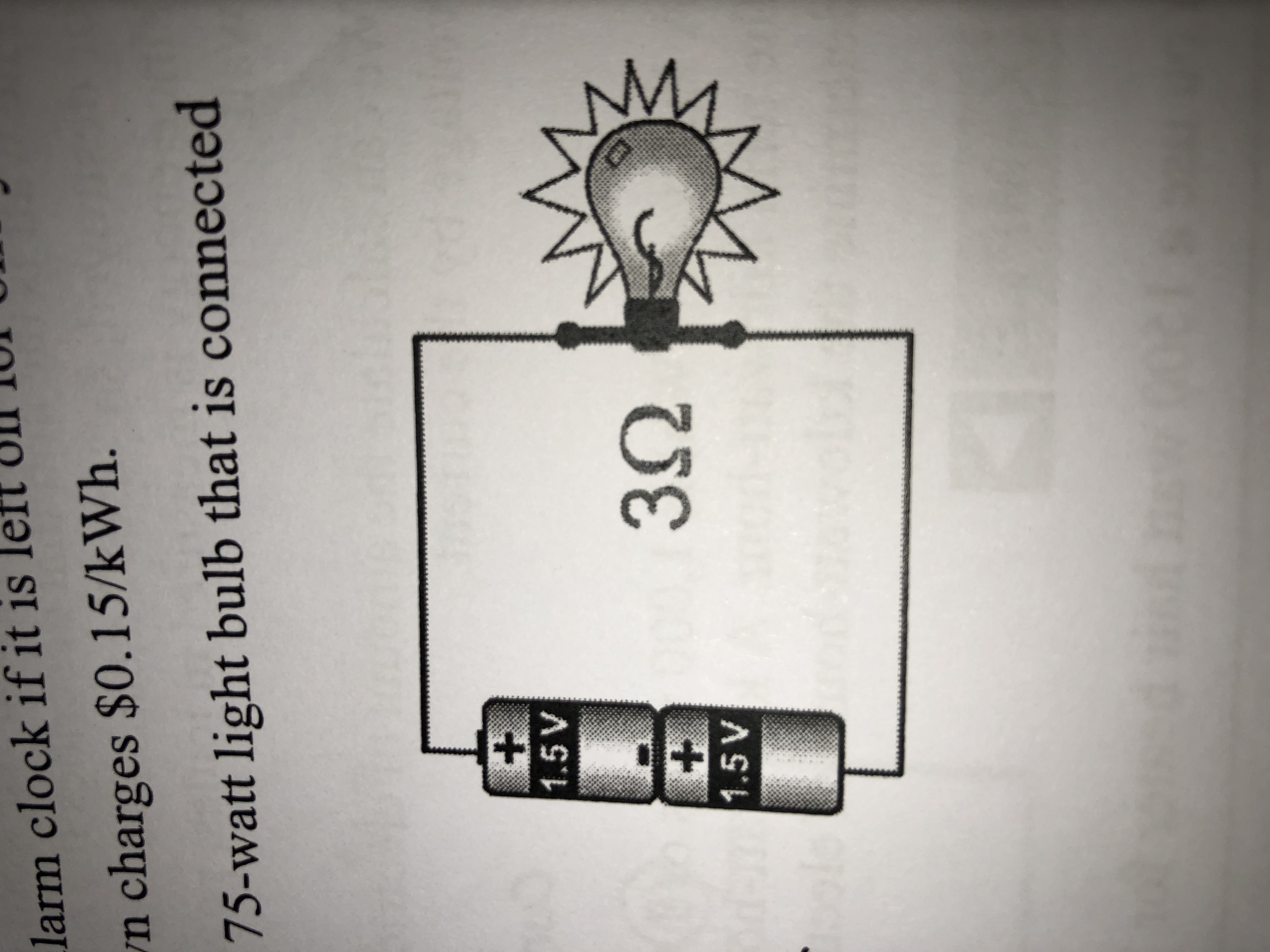
7. The following questions refer to the above diagram a. What is the total voltage of the circuit? \[V_{total} = 1.5 + 1.5 = 3 V\] b. What is the current in the circuit? \[(I) = \frac{ 3 }{ 3 } = 1 A\] c. What is the power of the light bulb? \[P = (1)(3) = 1 watt\] 8. A toaster is plugged into a 120-volt housed circuit. It draws 5 amps of current. a. What is the resistance of the toaster? \[R = \frac{ V }{ I }\] \[R = \frac{ 120 }{ 5 } = 24 \Omega\] b. What is the power of the toaster in watts? \[P = IV\] \[P = (5)(120) = 600 watts\] c. What is the power in kilowatts? \[600 watts \times \frac{ 1kW }{ 1000 watts } = 0.6 kW\] 9. A clothes dryer in a home has a power of 4,500 watts and runs on a special 220-volt household circuit. a. What is the current through the dryer? \[(I) = \frac{ P }{ V }\] \[(I) = \frac{ 4,500 watts }{ 220 V } = 20.5 A\] b. What is the resistance of the dryer? \[R = \frac{ V }{ I }\] \[R = \frac{ 220 }{ 20.5 } = 10.8 \Omega\] c. How many kilowatt-hours of electricity are used by the dryer if it is used for 4 hours in one week? \[4,500 watts \times \frac{ 1 kW }{ 1000watts} = 4.5 kW\] \[4.5 kW \times 4 hours = 18 kWh\] d. How much does it cost to run the dryer for one year if it is used for 4 hours each week at a cost of $0.15/kWh? \[18 \times 0.15 = $2.7\]
 Shadow:
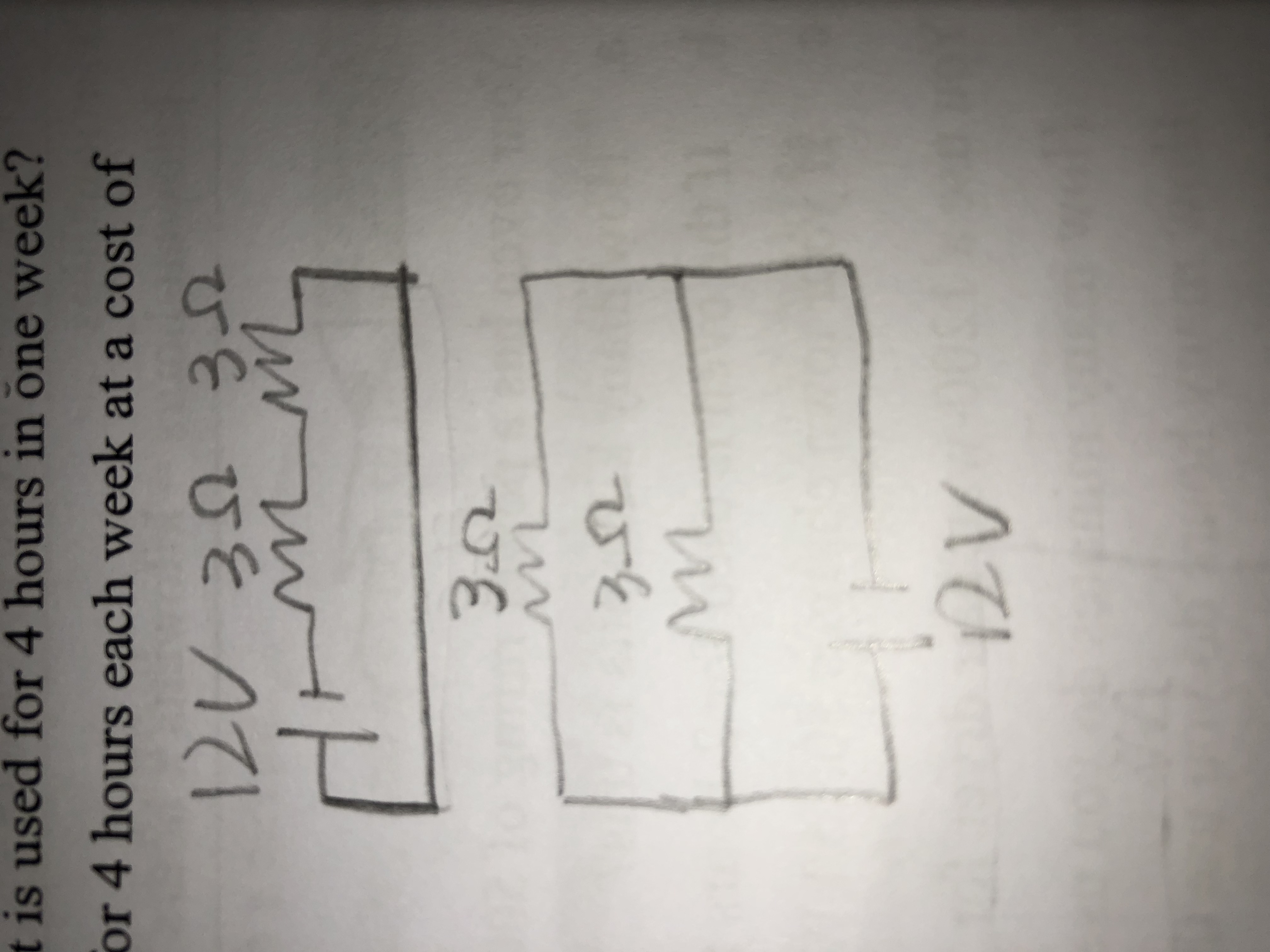
10. A circuit contains a 12-volt battery and two 3-ohms bulbs in series. a. Calculate the total resistance of the circuit \[R_{total} = 3 + 3 = 6 \Omega\] b. Calculate the total current of the circuit. \[(I) = \frac{ 12 }{ 6 } = 2A\] c. Calculate the power of each bulb \[V = (2)(3) = 6 V\] \[P = (2)(6) = 12 watts\] d. Calculate the power supplied by the battery \[P = (2)(12) = 24 watts\]
Shadow:
11. A circuit contains a 12-volt battery and two 3-ohm bulbs in parallel. a. What is the voltage across each branch \[V_{3} = V_{3} = V_{batt} = 12 V\] Voltage same across all branches in a parallel circuit. b. Calculate the current in each branch \[I_{3} = \frac{ 12 }{ 3 } = 4 A\] Answer for both since they both have a resistance of three. c. Calculate the power of each bulb. \[P = (4)(12) = 48 watts\] d. Calculate the total current in the circuit. \[I_{total} = 4 + 4 = 8A\] e. Calculate the power supplied by the battery. \[P = (8)(12) = 96 watts\]
Join our real-time social learning platform and learn together with your friends!
 KBaby:
Verse 1 We left our names in the dust of the driveway Watched the old town shrink
KBaby:
Lyrics Generator Use AI to write the lyrics for a song. Suggested Genres: Pop Hip
KBaby:
Verse 1 We left our names in the dust of the driveway Watched the old town shrink
KBaby:
Lyrics Generator Use AI to write the lyrics for a song. Suggested Genres: Pop Hip

 aitexturegenerator:
How are you all handling AI-generated textures for 3D models and game assets without losing the hand-made feel? I've been doing a small stylized environment
aitexturegenerator:
How are you all handling AI-generated textures for 3D models and game assets without losing the hand-made feel? I've been doing a small stylized environment

 Demon25:
Woke up feeling like that girl and that dude well he still aint crap pluse the du
Demon25:
Woke up feeling like that girl and that dude well he still aint crap pluse the du
 playtsec:
how do I get rid of stress from teachers... I just feel like running out the classroom and leaving on my own.
playtsec:
how do I get rid of stress from teachers... I just feel like running out the classroom and leaving on my own.
 JohnnyLFowler0812:
What type of gamer would play something and then get off for a while. Why not sta
JohnnyLFowler0812:
Which is better? Metallica Rap Country R&B hiphop Medal Gospel Chill Which 3 opti
JohnnyLFowler0812:
What type of gamer would play something and then get off for a while. Why not sta
JohnnyLFowler0812:
Which is better? Metallica Rap Country R&B hiphop Medal Gospel Chill Which 3 opti