
 zarkam21:
When a certain amount of violet light and yellow light shine on a metal surface, only violet light produces an electric current. Write 3 - 4 sentences describing how an increase in the intensity of each type of light will affect the amount of current produced. How does quantization help to explain these observations?
 Vocaloid:
this phenomenon is called the photoelectric effect so there are two factors of light that affect the ejection of electrons from the metal: intensity and frequency frequency determines whether electrons will be ejected or not (only high enough frequency light ejects electrons; if the frequency is too low, then no electrons are ejected regardless of intensity) intensity determines the rate at which electrons will be ejected
Vocaloid:
with that being said: - how does changing the intensity of violet light change the current? - how does changing the intensity of yellow light change the current?
Vocaloid:
|dw:1528167662268:dw| notice how current increases as intensity increases, but only if the frequency is high enough
zarkam21:
- how does changing the intensity of violet light change the current? increases - how does changing the intensity of yellow light change the current? increses
Vocaloid:
hint: going back to the original problem "only violet light produces an electric current. "
zarkam21:
- how does changing the intensity of violet light change the current? increases - how does changing the intensity of yellow light change the current? Does not
Vocaloid:
good and as for the quantization part, the reason why only violet light produces current is that light is quantized, and only photons with the right amount of energy (the right quanta) can eject a particle
 Vocaloid:
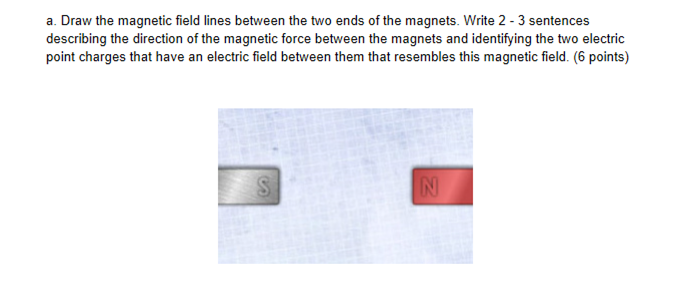
uh it's kinda hard to describe the shape but you gotta draw the field lines pointing north to south like this |dw:1528168903368:dw|
zarkam21:
so all these lines?
Vocaloid:
yeah something like that, make sure the arrows are pointing in the right direction (north to south) then for the force, I guess you could say the force at any location between the two magnets follows the direction of the field line, north to south
Vocaloid:
anyway for the last part of the question you just need to decide which two electric charges produce similar field lines, ex. two positives or two negatives or one positive one negative
zarkam21:
one positive and one negative?
Vocaloid:
good, or to be more specific, one proton one electron; electron has to be on the left and proton on the right to produce the same field lines in the same direction
 Vocaloid:
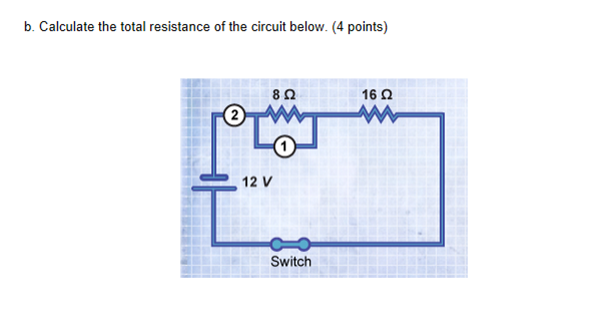
huh. what exactly are 1 and 2 representing? I think(?) the resistors are still in series so total resistance is just the sum
zarkam21:
36
Vocaloid:
12 is the voltage so it cannot be added to the resistors
zarkam21:
24
Vocaloid:
good, that's it I believe (units are ohms)
zarkam21:
okay so using this same diagram : c. In the circuit diagram above, meters 1 and 2 are connected as shown. Write 2 - 3 sentences identifying each type of meter and how it is connected with the 8 Ω resistor. d. In the circuit diagram above, predict which resistors will stop working (if any) when the switch is opened. Write 2 - 3 sentences explaining your reasoning.
Vocaloid:
c: well there are two types of meters, an ammeter and voltmeter, any ideas which is which? as a hint the ammeter must be in series with the resistors and the voltmeter must be in parallel
zarkam21:
series so ammeter
Vocaloid:
is the ammeter meter 1 or meter 2?
zarkam21:
1
 nuts:
nuts:
meter 1 is in parallel with the resistor :(
zarkam21:
2?
Vocaloid:
yeah, the ammeter must be meter 2 meaning the voltmeter is meter 1
zarkam21:
okay so for part d
zarkam21:
no
zarkam21:
I Have @Vocaloid
Vocaloid:
uh so have you given any thought to it yet? there are only a few possibilities, either they both keep working, they both stop working, or only one keeps working
zarkam21:
one stops working?
nuts:
why do you say that?
zarkam21:
actually all of them
zarkam21:
they all stop working because they are in a series?
nuts:
that's correct. Because the resistors are in series if either one of them fails, there is no closed path for current to go through any of them, so both stop working.
zarkam21:
A light wave moves through glass (n = 1.5) at an angle of 15°. What angle will it have when it moves from the glass into air (n = 1)?
nuts:
Do you remember snell's law?
zarkam21:
No
zarkam21:
is it the n1 equation. I think ?
nuts:
yeah. so \(\Huge \frac{\sin \theta_1}{\sin \theta_2}=\frac{n_2}{n_1}\). Well actually i don't know the critical angle but i'm pretty sure we use snell's law cause pretty sure refraction and not reflection occur.
zarkam21:
sin15/sin(theta)=1/1.5 theta=1.03
nuts:
your first equation is correct, but i'm not sure how you're getting theta=1.03
zarkam21:
oh 0.67?
nuts:
could you show your work?
zarkam21:
0.39?
zarkam21:
I think I got it now
Vocaloid:
might be a degrees/radians issue?
nuts:
Yeah it is. You've given the correct number in radians but you need to convert to degrees or use the correct mode on whatever calculator you're using
zarkam21:
22.35
nuts:
yup you're well on your way to design a spectrophotometer, all you need is to learn about dispersion now :)
Join our real-time social learning platform and learn together with your friends!
 KBaby:
Verse 1 We left our names in the dust of the driveway Watched the old town shrink
KBaby:
Lyrics Generator Use AI to write the lyrics for a song. Suggested Genres: Pop Hip
KBaby:
Verse 1 We left our names in the dust of the driveway Watched the old town shrink
KBaby:
Lyrics Generator Use AI to write the lyrics for a song. Suggested Genres: Pop Hip

 aitexturegenerator:
How are you all handling AI-generated textures for 3D models and game assets without losing the hand-made feel? I've been doing a small stylized environment
aitexturegenerator:
How are you all handling AI-generated textures for 3D models and game assets without losing the hand-made feel? I've been doing a small stylized environment

 Demon25:
Woke up feeling like that girl and that dude well he still aint crap pluse the du
Demon25:
Woke up feeling like that girl and that dude well he still aint crap pluse the du
 playtsec:
how do I get rid of stress from teachers... I just feel like running out the classroom and leaving on my own.
playtsec:
how do I get rid of stress from teachers... I just feel like running out the classroom and leaving on my own.
 JohnnyLFowler0812:
What type of gamer would play something and then get off for a while. Why not sta
JohnnyLFowler0812:
Which is better? Metallica Rap Country R&B hiphop Medal Gospel Chill Which 3 opti
JohnnyLFowler0812:
What type of gamer would play something and then get off for a while. Why not sta
JohnnyLFowler0812:
Which is better? Metallica Rap Country R&B hiphop Medal Gospel Chill Which 3 opti