
 roserose:
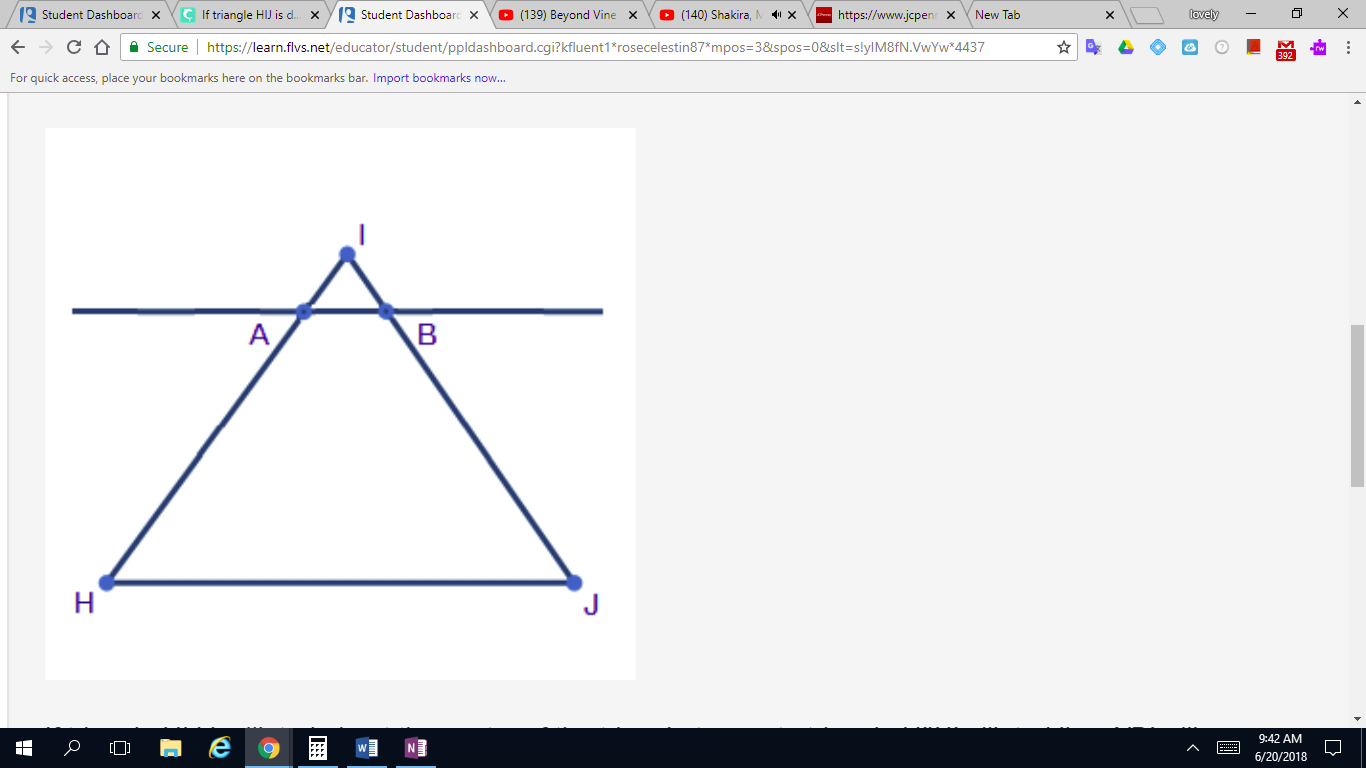
If triangle HIJ is dilated about the center of the triangle to create triangle H′I′J′, dilated line A′B′ will
 Mercury:
welcome to QC~ is there a list of choices or a diagram associated with this problem?
roserose:
a.be perpendicular to AB b. lie on the same line as AB c.shift four units to the left d.be parallel to AB
roserose:
that it the list of the choices.
Mercury:
|dw:1529501913093:dw|
Mercury:
|dw:1529501920756:dw|
Mercury:
if you compare the line AB and the dilated red line A'B' are they parallel? perpendicular? or something else?
 Mercury:
try to look at my diagram notice how the black line AB gets dilated to the red horizontal line are the line AB and the red line parallel or perpendicular?
roserose:
thanks
roserose:
The coordinates of trapezoid ABCD are A(−4, 3), B(2, 3), C(4, −1) and D(−4, −1). A line segment runs through the trapezoid with endpoints Y(−4, 1) and Z(3, 1). If trapezoid ABCD is dilated by a scale factor of 3 creating the new trapezoid of A′B′C′D′, what can you say about the length of line segment Y′Z′?
Mercury:
"dilated by scale factor three" means that Y'Z' is three times as large as YZ
roserose:
The length remains the same as the original line segment. The length increases by a scale factor of 3. The length decreases by a scale factor of 3. The length is not able to be determined by the information given.
Mercury:
\(\color{#0cbb34}{\text{Originally Posted by}}\) @Mercury "dilated by scale factor three" means that Y'Z' is three times as large as YZ \(\color{#0cbb34}{\text{End of Quote}}\) key phrase: "Three times as large"
roserose:
Triangle HAM is translated using the rule (x,y)→(x+6, y) to create triangle H′A′M′. If a line segment is drawn from point H to point H′ and from point A to point A′, which statement would best describe the line segments drawn? a. They share the same midpoints. b. They are parallel and congruent. c.They are diameters of concentric circles. d.They are perpendicular to each other.
Mercury:
any attempts to sketch the problem?
Mercury:
|dw:1529502674423:dw|
Mercury:
|dw:1529502728050:dw|
Mercury:
so which statement out of the choices best describes these those blue lines?
roserose:
those are not helping me
Mercury:
|dw:1529502938021:dw|
Mercury:
are those two lines parallel or perpendicular? are they the same length or different lengths?
roserose:
they are the same length
Mercury:
good but are they parallel or perpendicular?
roserose:
they are parallel
Mercury:
good so they are parallel and the same length making which answer choice the correct one?
roserose:
the correct answer is b. They are parallel and congruent.
Mercury:
well done
roserose:
Triangle CAT is translated using the rule (x,y)→(x−3, y+4) to create triangle C′A′T′. If a line segment is drawn from point C to point C′ and from point A to point A′, which statement would best describe the line segments drawn?
Mercury:
same logic as last time try sketching the two triangles, connecting the segments, and seeing if the two segments are perpendicular/parallel, etc. you may use the previous problem as a reference. let me know if you're getting stuck
roserose:
thanks, I find it
roserose:
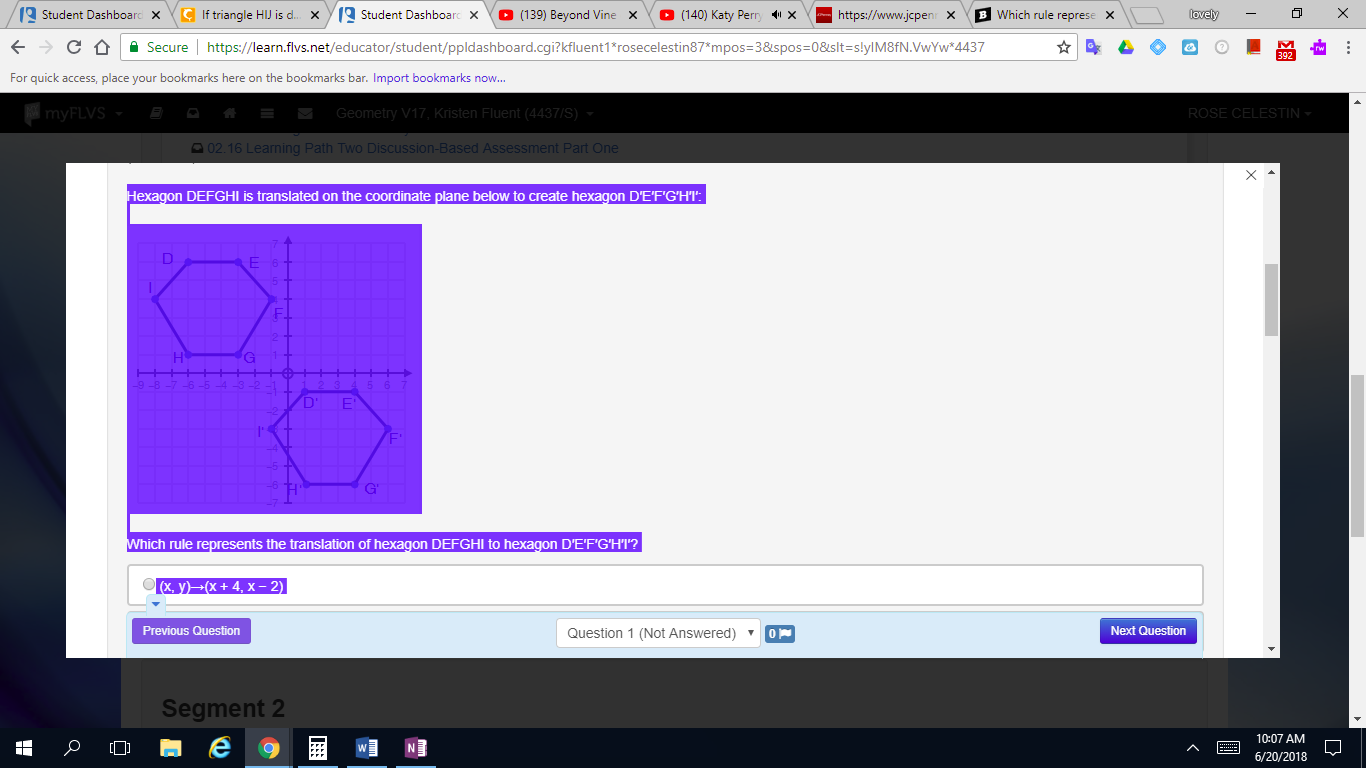
Hexagon DEFGHI is translated on the coordinate plane below to create hexagon D′E′F′G′H′I′: Which rule represents the translation of hexagon DEFGHI to hexagon D′E′F′G′H′I′? a.(x, y)→(x + 4, x − 2) b. (x, y)→(x − 7, y + 7) c. (x, y)→(x + 2, x − 4) d. (x, y)→(x + 7, y − 7)
 Mercury:
so you want to pick two corresponding points and see the horizontal and vertical distance between them so let's use D and D' as an example what is the horizontal distance between D and D'?
roserose:
I don't know
Mercury:
|dw:1529503836091:dw|
Mercury:
|dw:1529503841726:dw|
Mercury:
how many spaces did we go from D to D'?
roserose:
one spaces Dto D
Mercury:
see how many little jumps we made from D to D'? try counting the jumps
roserose:
7
Mercury:
awesome so D --> D' we add 7 units to the x coordinate to get x + 7 so the last choice is the only viable option
roserose:
is going to be the y
Mercury:
notice how the only answer choice with x + 7 is the last choice d. (x, y)→(x + 7, y − 7)
roserose:
thanks
roserose:
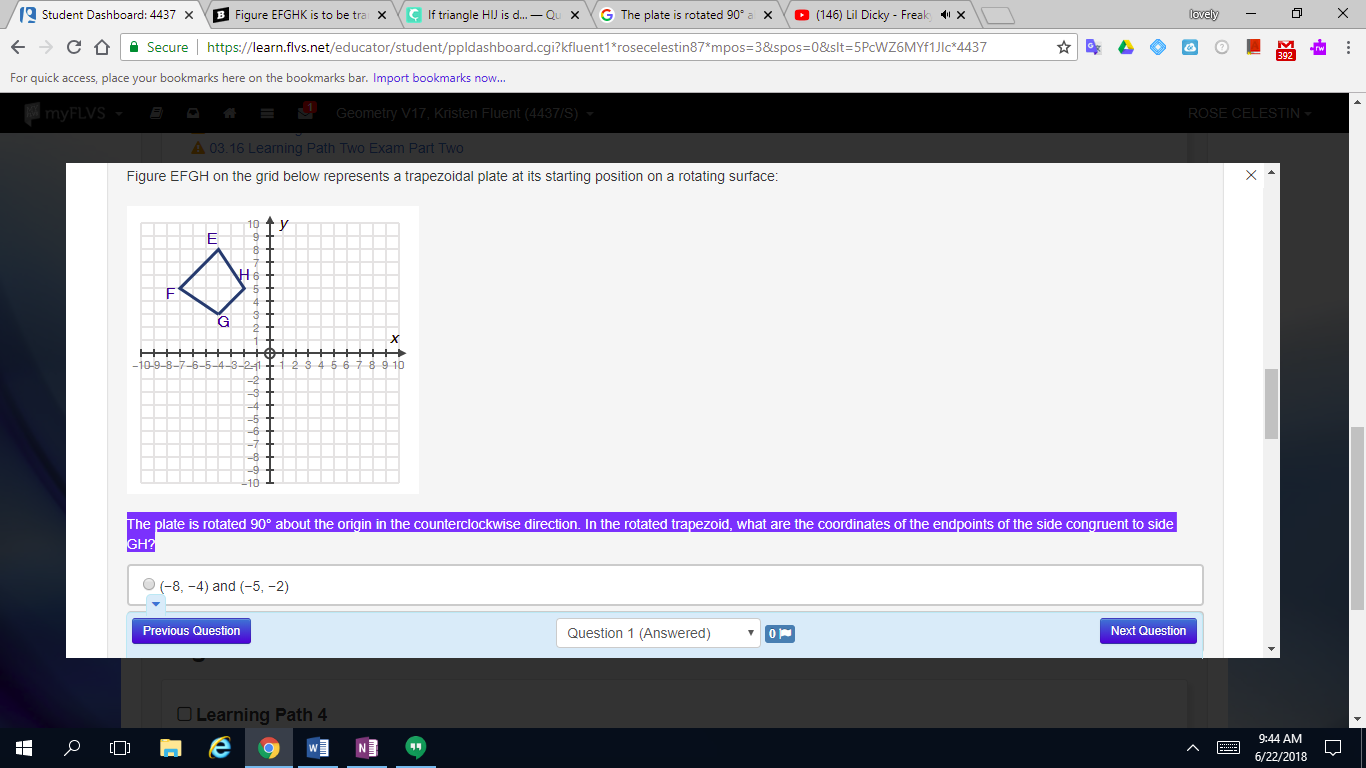
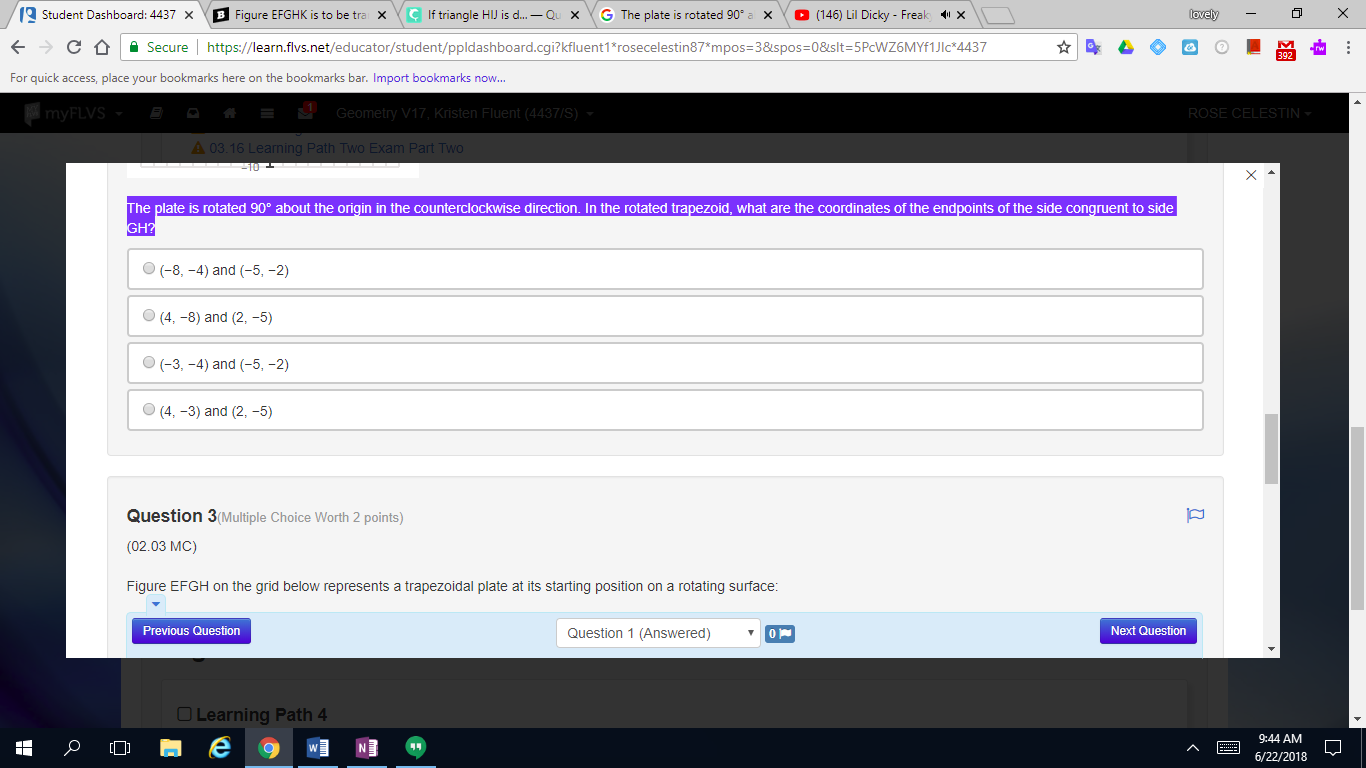
The plate is rotated 90° about the origin in the counterclockwise direction. In the rotated trapezoid, what are the coordinates of the endpoints of the side congruent to side GH?
Mercury:
is there a diagram that goes with this?
 Mercury:
first find the coordinates of G then apply the rule (-y,x) to find the new coordinates of G
Mercury:
the coordinates of G are (-4,3), right? so x = -4 and y = 3 what do you get when you write the coordinates as (-y, x)?
roserose:
I find what it is
 roserose:
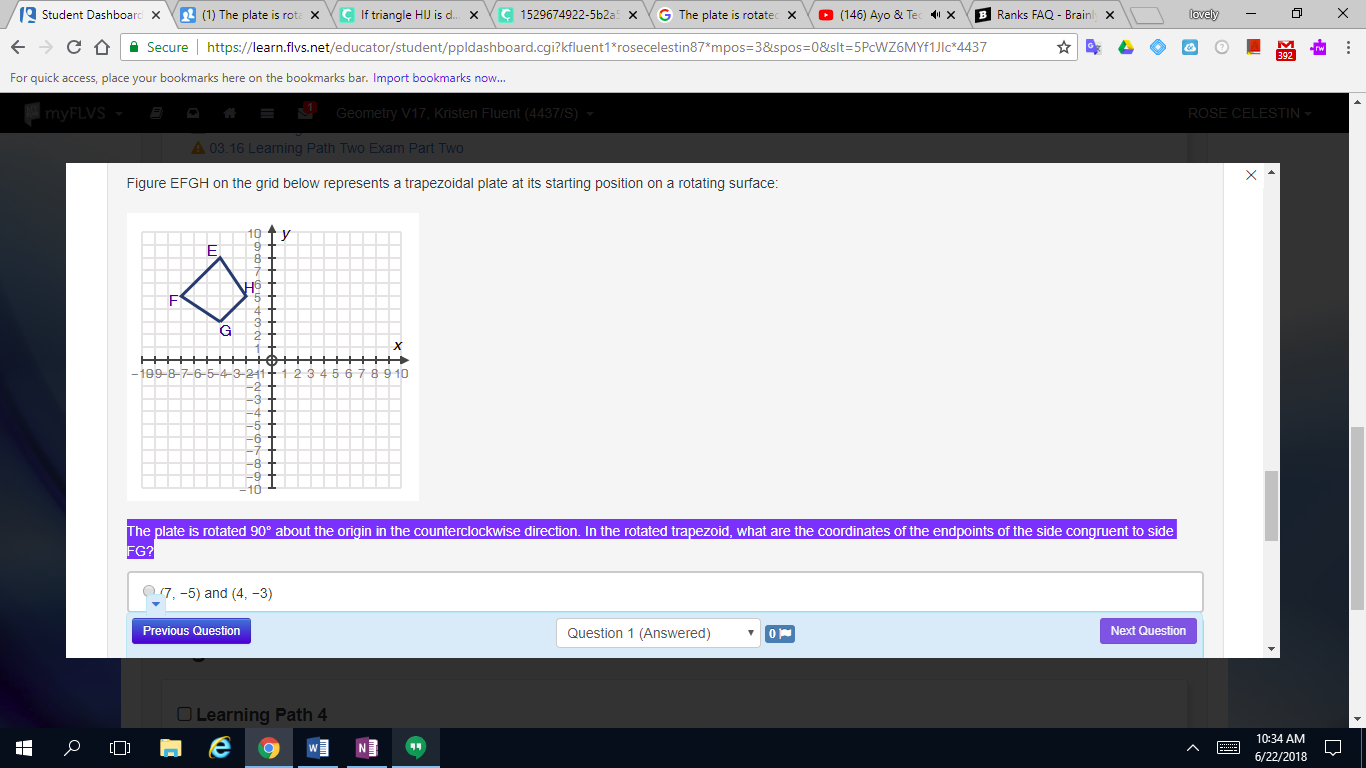
The plate is rotated 90° about the origin in the counterclockwise direction. In the rotated trapezoid, what are the coordinates of the endpoints of the side congruent to side FG? (a.7, −5) and (4, −3) b. (5, 7) and (3, 4) c. (−5, −7) and (−3, −4) d. (−5, −7) and (−8, −4)
Join our real-time social learning platform and learn together with your friends!
 Demon25:
For a hoco proposal with a cheerleader and football player, what else should be a
Demon25:
For a hoco proposal with a cheerleader and football player, what else should be a

 Breathless:
TOC: "MGF any confirmation on the commander? we require confirmation as soon as[radio static].
Breathless:
TOC: "MGF any confirmation on the commander? we require confirmation as soon as[radio static].
 EdwinJsHispanic:
I wrote something that I don't know if I want it as a poem or song, Please let me know on yours thoughts about it, I'm still doing this! "Broken promises an
EdwinJsHispanic:
I wrote something that I don't know if I want it as a poem or song, Please let me know on yours thoughts about it, I'm still doing this! "Broken promises an
 thehearken:
hi um I don't know if this is the right section for this, but can someone go over my poem and tell me if its good enough to give my English professor for a
thehearken:
hi um I don't know if this is the right section for this, but can someone go over my poem and tell me if its good enough to give my English professor for a
 heartlessprophet:
Aye what's 19z%u00f74p=9u03c0 my teacher thinking of impossible questions for us
heartlessprophet:
Aye what's 19z%u00f74p=9u03c0 my teacher thinking of impossible questions for us
 kippppp:
does anyone have any good tips for writing stories? i'm trying to write a dnd campaign but i'm not that great of a writer yet.
kippppp:
does anyone have any good tips for writing stories? i'm trying to write a dnd campaign but i'm not that great of a writer yet.
 GRIZZLEY19:
Y'all let me know what y'all think about this beat I made I took me like a hour maybe rate it 0/10 https://drive.
GRIZZLEY19:
Y'all let me know what y'all think about this beat I made I took me like a hour maybe rate it 0/10 https://drive.
 Ultrilliam:
Welcome to the 10th Anniversary Update! (Part 2) Sorry this one passed the date a
Ultrilliam:
Welcome to the 10th Anniversary Update! (Part 2) Sorry this one passed the date a
 Twaylor:
was walking downtown and my adhd brain wanted to make some (rock?) lyrics: There'
Twaylor:
was walking downtown and my adhd brain wanted to make some (rock?) lyrics: There'