
 mikewwe13:
Which one best fits the answer ?
![IMG_6630[1].JPG](https://assets.questioncove.com/attachments/1536117709-5b8f4b86221c37120cddbe00-IMG_6630[1].JPG)
![IMG_6631[1].JPG](https://assets.questioncove.com/attachments/1536117709-5b8f4b86221c37120cddbe00-IMG_6631[1].JPG)
![IMG_6632[1].JPG](https://assets.questioncove.com/attachments/1536117709-5b8f4b86221c37120cddbe00-IMG_6632[1].JPG) mikewwe13:
mikewwe13:
@Vocaloid
 Vocaloid:
statement 1: AB congruent to BD statement 2 BD congruent to CE using the transitive property we have the general rule A = B B = C therefore A = C try to apply this logic to statements 1 and 2 to get the next blank
mikewwe13:
CE AC
Vocaloid:
|dw:1536118417209:dw|
Vocaloid:
"AB is congruent to BD" that's like saying "A = B" "BD is congruent to CE" that's like saying "B = C" so the conclusion "A = C" must therefore be "AB is congruent to CE"
Vocaloid:
statement 4 says "given" so we go back to the original statements to see what was originally given CE is congruent to AC is the only thing that works for blank 4
Vocaloid:
statement 5: we use the original statements AB congruent to BD BD congruent to CE CE congruent to AC therefore AB congruent to AC do you remember which property this is?
mikewwe13:
transitive
Vocaloid:
good so the remaining blank 6 must be isosceles so to recap: AB is congruent to CE CE is congruent to AC transitive isosceles definition
![IMG_6633[1].JPG](https://assets.questioncove.com/attachments/1536118970-5b8f4b86221c37120cddbe00-IMG_6633[1].JPG)
![IMG_6634[1].JPG](https://assets.questioncove.com/attachments/1536118970-5b8f4b86221c37120cddbe00-IMG_6634[1].JPG) Vocaloid:
Vocaloid:
statement 1 " <1 and <2 are supplementary therefore their angles must add up to 180 so which statement best reflects this idea?
mikewwe13:
m<1 + m<3 = 180
Vocaloid:
awesome statement 4 states that the bisector from step 3 creates two equal angles so which statement would this be?
mikewwe13:
substitution property
Vocaloid:
keyword: bisector
mikewwe13:
bisector i thought at first
Vocaloid:
alright, so the bisector gives us two equal angles <2 and <3 therefore we can ~substitute~ m<3 into m<2 to get m<1 + m<3 = 180 as the statement and "substitution property" as the reason
Vocaloid:
so to recap: m<1 + m<2 = 180 bisector def. m<1 + m<3 = 180 substitution property
mikewwe13:
i thought the 3rd was the first wasn't it ?
Vocaloid:
remember, the first sentence says that <1 and <2 are supplementary therefore the first statement must be m<1 and m<2 add up to 180.
mikewwe13:
oh ok i see
![IMG_6635[1].JPG](https://assets.questioncove.com/attachments/1536119715-5b8f4b86221c37120cddbe00-IMG_6635[1].JPG)
![IMG_6636[1].JPG](https://assets.questioncove.com/attachments/1536119715-5b8f4b86221c37120cddbe00-IMG_6636[1].JPG)
![IMG_6637[1].JPG](https://assets.questioncove.com/attachments/1536119715-5b8f4b86221c37120cddbe00-IMG_6637[1].JPG) Vocaloid:
Vocaloid:
this is from the unit test. I recognize the question + purple border; :/
mikewwe13:
this is a different question
mikewwe13:
it doesn't have the unit test on top
 mikewwe13:
oh i see they might've put this question in this one
mikewwe13:
that test is over and done with, this is a new one
Vocaloid:
I don't feel comfortable answering this
mikewwe13:
i can prove it
mikewwe13:
https://assets.questioncove.com/attachments/1536119925-5b8f4b86221c37120cddbe00-UTquestion.JPG
Vocaloid:
well if you've already taken the test you should be able to re-use your solution then
mikewwe13:
this one has the unit test on top of it
mikewwe13:
and this one doesn't
Vocaloid:
it's not showing up for me
![IMG_6635[2].JPG](https://assets.questioncove.com/attachments/1536120162-5b8f4b86221c37120cddbe00-IMG_6635[2].JPG) mikewwe13:
mikewwe13:
there it doesn't have the unit test on top of it
mikewwe13:
but the other test was wrong
Vocaloid:
can you please show me the entire screen?
mikewwe13:
ok
![IMG_6638[1].JPG](https://assets.questioncove.com/attachments/1536120278-5b8f4b86221c37120cddbe00-IMG_6638[1].JPG) mikewwe13:
mikewwe13:
i hope this is clear for you
Vocaloid:
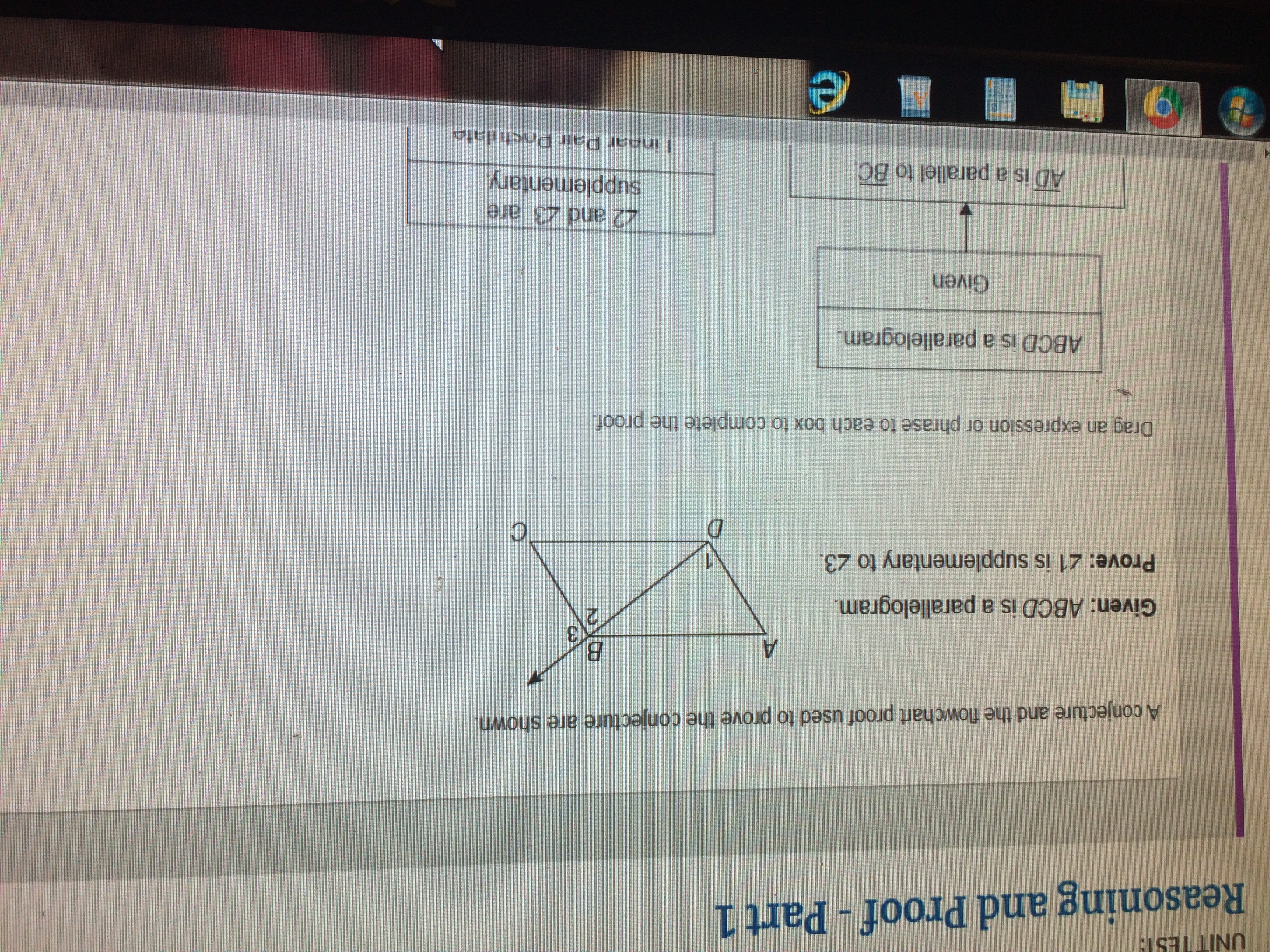
alright :/ for AD being parallel to BC this is because they are opposite sides on a parallelogram therefore what choice would fit best?
mikewwe13:
definition of parallelogram
Vocaloid:
awesome then going from <1 to <2 to m<1 = m<2 this is the angle congruence (if angles are equal their measurements are as well) now let's move to the right column, if <2 and <3 are supplementary they add up to 180, right? so which statement best reflects this idea?
mikewwe13:
definition of supplementary
Vocaloid:
hm not quite notice how the box already has "definition of supplementary" on it we want the statement that says "angle 2 and 3 add up to 180" which one is closest to this idea?
mikewwe13:
m<2 + m<3 = 180
Vocaloid:
good then for the box that says "substitution property" we take the expression m<2 + m<3 = 180 and substitute m<1 instead of m<2, what would be the result of that?
mikewwe13:
angle congruence
Vocaloid:
we already used angle congruence remember, when you ~substitute~ something in for another thing, you replace it so if we "substitute" m<1 for m<2, we replace "m<2" with "m<1" giving us m<1 + m<3 = 180 as the statement
Vocaloid:
for the last blank we just use the one that's left, definition of supplementary
Vocaloid:
so to recap: 1. AD parallel to BC --> definition of parallelogram 2. definition of supplementary --> m<2 + m<3 = 180 3. m<1 + m<2 ---> angle congruence 4. substitution property --> m<1 + m<3 = 180 5. last blank --> definition of supplementary
mikewwe13:
well one was wrong but is 92 good for a score ?
mikewwe13:
that's a B
Vocaloid:
hm :S
Vocaloid:
a little lower than I was expecting but not the end of the world
mikewwe13:
well it ain't bad but it's not the best
mikewwe13:
Thank You Vocaloid for all your help once again
Join our real-time social learning platform and learn together with your friends!
 KBaby:
Verse 1 We left our names in the dust of the driveway Watched the old town shrink
KBaby:
Lyrics Generator Use AI to write the lyrics for a song. Suggested Genres: Pop Hip
KBaby:
Verse 1 We left our names in the dust of the driveway Watched the old town shrink
KBaby:
Lyrics Generator Use AI to write the lyrics for a song. Suggested Genres: Pop Hip

 aitexturegenerator:
How are you all handling AI-generated textures for 3D models and game assets without losing the hand-made feel? I've been doing a small stylized environment
aitexturegenerator:
How are you all handling AI-generated textures for 3D models and game assets without losing the hand-made feel? I've been doing a small stylized environment

 Demon25:
Woke up feeling like that girl and that dude well he still aint crap pluse the du
Demon25:
Woke up feeling like that girl and that dude well he still aint crap pluse the du
 playtsec:
how do I get rid of stress from teachers... I just feel like running out the classroom and leaving on my own.
playtsec:
how do I get rid of stress from teachers... I just feel like running out the classroom and leaving on my own.
 JohnnyLFowler0812:
What type of gamer would play something and then get off for a while. Why not sta
JohnnyLFowler0812:
Which is better? Metallica Rap Country R&B hiphop Medal Gospel Chill Which 3 opti
JohnnyLFowler0812:
What type of gamer would play something and then get off for a while. Why not sta
JohnnyLFowler0812:
Which is better? Metallica Rap Country R&B hiphop Medal Gospel Chill Which 3 opti