
 zarkam21:
Help check
 zarkam21:
@Vocaloid
 Vocaloid:
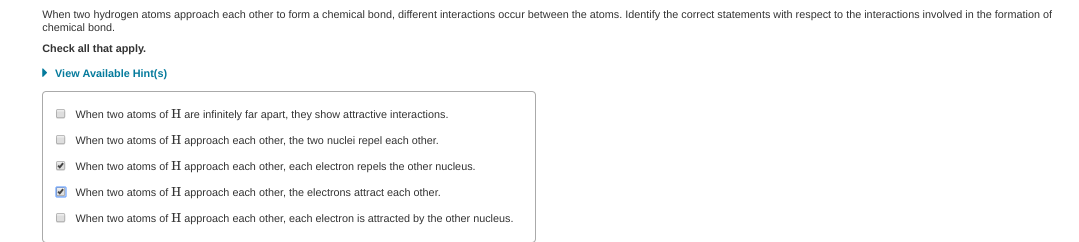
hm, you're on the right track but the nucleus of a hydrogen atom is positively charged and an electron is negatively charged so what sort of repulsion/attraction is going on?
Vocaloid:
well, if the nuclei are both positively charged the nuclei must repel each other (likes repel) there must also be attraction between the nucleus and the electrons (opposites attract) so what two statements look good to you?
Vocaloid:
there's one choice that mentions repulsion btwn nuclei (choice 2) there's also a choice that mentions attraction between electrons and nuclei (choice 5)
zarkam21:
A
Vocaloid:
hm, no, the first statement wouldn't be true, if the nuclei are infinitely apart then there will be no attraction (think about coloumb's law)
zarkam21:
B
zarkam21:
because they would repel
Vocaloid:
good, anything else?
zarkam21:
e?
Vocaloid:
good, B+E
 Vocaloid:
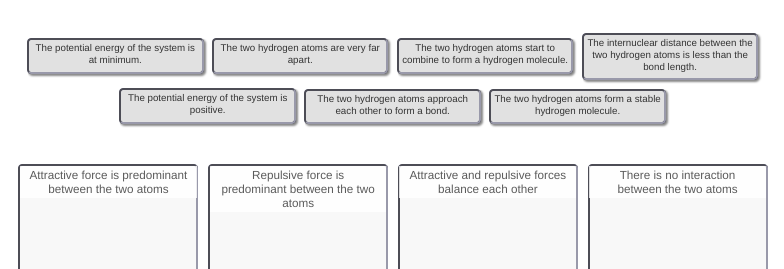
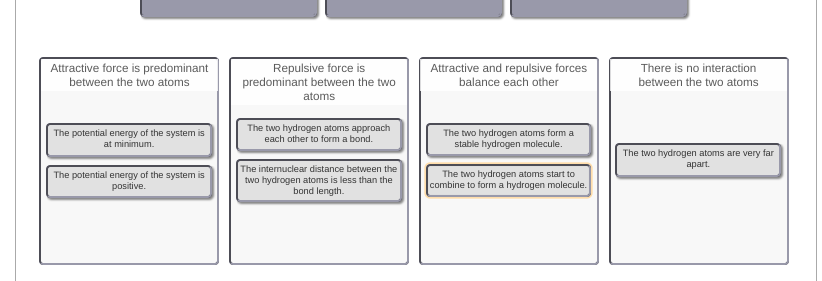
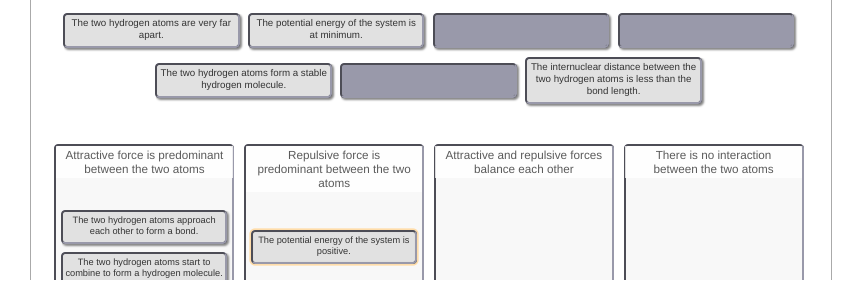
let's go through one box at a time 1. attractive force is predominant between the atoms this happens when the attractive force is just enough to overcome the repulsive force, so that would draw the atoms closer to each other which two statements might this be?
 Vocaloid:
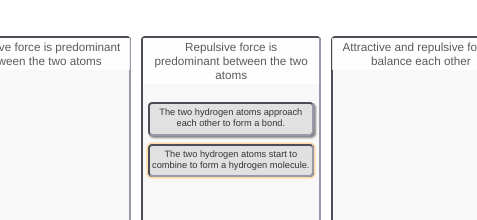
good, but those two should be in the attractive force box not the repulsive box
Vocaloid:
so, moving on to the repulsive box, the repulsive force is strong when the atoms are close to each other and the potential energy is positive
 Vocaloid:
any ideas about the other statements? which remaining statement suggests that the atoms are very close (have a short internuclear distance)?
zarkam21:
internuclear distance between...
Vocaloid:
good
Vocaloid:
so when the forces are balanced (third box) which two statements do you think are true?
zarkam21:
form a stable bond
Vocaloid:
good, that also means the potential energy is minimal
Vocaloid:
then the last statement (the two hydrogen atoms are very far apart) gets the last box
Join our real-time social learning platform and learn together with your friends!
 Demon25:
For a hoco proposal with a cheerleader and football player, what else should be a
Demon25:
For a hoco proposal with a cheerleader and football player, what else should be a

 Breathless:
TOC: "MGF any confirmation on the commander? we require confirmation as soon as[radio static].
Breathless:
TOC: "MGF any confirmation on the commander? we require confirmation as soon as[radio static].
 EdwinJsHispanic:
I wrote something that I don't know if I want it as a poem or song, Please let me know on yours thoughts about it, I'm still doing this! "Broken promises an
EdwinJsHispanic:
I wrote something that I don't know if I want it as a poem or song, Please let me know on yours thoughts about it, I'm still doing this! "Broken promises an
 thehearken:
hi um I don't know if this is the right section for this, but can someone go over my poem and tell me if its good enough to give my English professor for a
thehearken:
hi um I don't know if this is the right section for this, but can someone go over my poem and tell me if its good enough to give my English professor for a
 heartlessprophet:
Aye what's 19z%u00f74p=9u03c0 my teacher thinking of impossible questions for us
heartlessprophet:
Aye what's 19z%u00f74p=9u03c0 my teacher thinking of impossible questions for us
 kippppp:
does anyone have any good tips for writing stories? i'm trying to write a dnd campaign but i'm not that great of a writer yet.
kippppp:
does anyone have any good tips for writing stories? i'm trying to write a dnd campaign but i'm not that great of a writer yet.
 GRIZZLEY19:
Y'all let me know what y'all think about this beat I made I took me like a hour maybe rate it 0/10 https://drive.
GRIZZLEY19:
Y'all let me know what y'all think about this beat I made I took me like a hour maybe rate it 0/10 https://drive.
 Ultrilliam:
Welcome to the 10th Anniversary Update! (Part 2) Sorry this one passed the date a
Ultrilliam:
Welcome to the 10th Anniversary Update! (Part 2) Sorry this one passed the date a
 Twaylor:
was walking downtown and my adhd brain wanted to make some (rock?) lyrics: There'
Twaylor:
was walking downtown and my adhd brain wanted to make some (rock?) lyrics: There'