
 noblelove42:
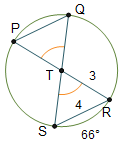
What is the measure of PQ?
noblelove42:
In circle T, ∠PTQ ≅ ∠RTS.
noblelove42:
cant upload picture
 mhchen:
|dw:1540915764025:dw| is it like this?
mhchen:
You can press the pencil-button on the top-right of my drawing to draw on it.
 mhchen:
Oh okay. So you see how there are 2 triangles in there? |dw:1540915914346:dw|
noblelove42:
yea
mhchen:
The 2 triangles are the same (or congruent). Because the angles from the middle are the same. And since it's a circle, all the sides of the triangle are the same. (The radius doesn't change).
noblelove42:
What is the measure of ? 24° 33° 48° 66°
mhchen:
What is the measure of what? your question didn't say what angle.
noblelove42:
pq
mhchen:
Oh that's the same as SR. Remember how the 2 triangles are the same? It's also 66 then.
noblelove42:
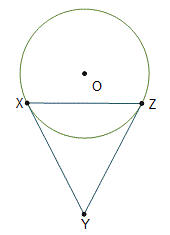
Which kind of triangle must triangle XYZ be? an equilateral triangle an isosceles triangle a scalene triangle a right triangle
 mhchen:
Hmm.. It looks like XY and YZ have the same lengths so it'll be an isosceles.
noblelove42:
A point is on a circle if the distance from the center of the circle to the point is equal to the area. circumference. radius. diameter.
mhchen:
|dw:1540916727074:dw| Do you know what that red line is called?
noblelove42:
radius
mhchen:
Yeah. That's what the question was describing.
noblelove42:
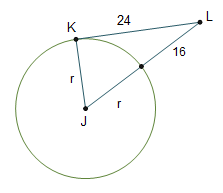
What is the length of the radius, r? 8 units 10 units 12 units 16 units
 noblelove42:
?
mhchen:
Sorry uh...I'm still thinking about it
noblelove42:
take your time
mhchen:
I'm going to make one assumption. "KL is tangent to circle J." Otherwise I don't think it's possible to solve this.
noblelove42:
yea it is tangent to J
mhchen:
|dw:1540917166085:dw| let me look at this a little more
mhchen:
GOT IT. So you know what the Pythagorean theorem is right?
noblelove42:
know of it
mhchen:
\[(Leg)^2 + (Leg)^2 = (Hypotenuse)^2\] If we use it here: \[(r)^2 + (24)^2 = (r+16)^2\]
mhchen:
So if we simplify that it becomes \[r^2 + 24^2 = r^2 + (2)(16)(r) + 16^2\] and that becomes \[24^2 =32r + 16^2\]
mhchen:
Are you able to solve for 'r' from here? or would you like me to help.
noblelove42:
yea
noblelove42:
its 10
mhchen:
Welp. There's your answer.
noblelove42:
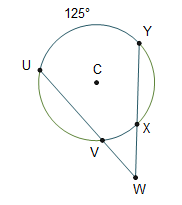
In the diagram of circle C, m∠VWX is 43°. What is m? 39° 41° 78° 82°
 noblelove42:
would i do the same for this
mhchen:
No since none of them are tangents. Tangents make a right-angle. And you can only use pythagorean theorem for right-angle triangles.
mhchen:
Okay wait, where is 'm' at?
noblelove42:
there is no m
mhchen:
|dw:1540917711896:dw| So uh what are we looking for?
mhchen:
\(\color{#0cbb34}{\text{Originally Posted by}}\) @noblelove42 In the diagram of circle C, m∠VWX is 43°. What is m? 39° 41° 78° 82° \(\color{#0cbb34}{\text{End of Quote}}\) This is what you asked
noblelove42:
What is mvx?
mhchen:
oh
mhchen:
|dw:1540917938014:dw|
mhchen:
Sorry I messed up xd, anyways there's the formula. |dw:1540917983781:dw|
mhchen:
Can you solve for VX in this equation: \[43 = \frac{125-VX}{2}\]
noblelove42:
82?
mhchen:
I got 39. 43 x 2 = 125 - VX 86 = 125 - VX VX = 125 - 86 VX = 39
noblelove42:
ok i get it
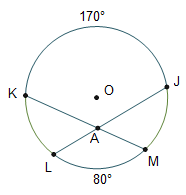 mhchen:
I actually don't know how to solve this without assuming A is right underneath O. xd. Are there answer choies?
noblelove42:
no answer choices
mhchen:
Yeah shoot. i can't help anymore sorry.
mhchen:
@ThisGirlPretty Are you able to help with this question?
noblelove42:
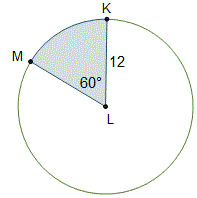
What is the area of the sector that is not shaded? 12 24 120 144
 mhchen:
My brain is burned out. You know the area of a circle right? In here it would be 12^2 * pi Which is 144pi. Then you know that a circle is 360 degrees right? And you're only trying to find (360-60) degrees of it. That's 300/360 or 5/6 of the circle. So you divide 144pi by 6 and multiply it by 5. 5*144pi/6 = 120pi.
mhchen:
I can't help anymore. I'm gonna suffer some mental trauma.
noblelove42:
help tomorrow ?
noblelove42:
thank you
mhchen:
If you get on maybe xd.
noblelove42:
what is that
noblelove42:
questions that need to be answered ?
noblelove42:
?
noblelove42:
The measure of central angle ABC is radians. What is the area of the shaded sector?
Join our real-time social learning platform and learn together with your friends!
 KBaby:
Verse 1 We left our names in the dust of the driveway Watched the old town shrink
KBaby:
Lyrics Generator Use AI to write the lyrics for a song. Suggested Genres: Pop Hip
KBaby:
Verse 1 We left our names in the dust of the driveway Watched the old town shrink
KBaby:
Lyrics Generator Use AI to write the lyrics for a song. Suggested Genres: Pop Hip
 aitexturegenerator:
How are you all handling AI-generated textures for 3D models and game assets without losing the hand-made feel? I've been doing a small stylized environment
aitexturegenerator:
How are you all handling AI-generated textures for 3D models and game assets without losing the hand-made feel? I've been doing a small stylized environment

 Demon25:
Woke up feeling like that girl and that dude well he still aint crap pluse the du
Demon25:
Woke up feeling like that girl and that dude well he still aint crap pluse the du
 playtsec:
how do I get rid of stress from teachers... I just feel like running out the classroom and leaving on my own.
playtsec:
how do I get rid of stress from teachers... I just feel like running out the classroom and leaving on my own.
 JohnnyLFowler0812:
What type of gamer would play something and then get off for a while. Why not sta
JohnnyLFowler0812:
Which is better? Metallica Rap Country R&B hiphop Medal Gospel Chill Which 3 opti
JohnnyLFowler0812:
What type of gamer would play something and then get off for a while. Why not sta
JohnnyLFowler0812:
Which is better? Metallica Rap Country R&B hiphop Medal Gospel Chill Which 3 opti