
 kaylak:
calc help @vocaloid
 Vocaloid:
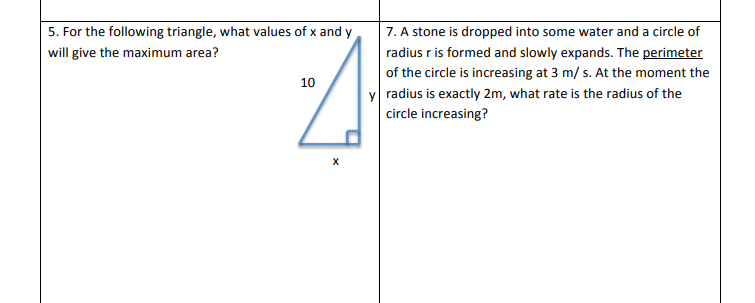
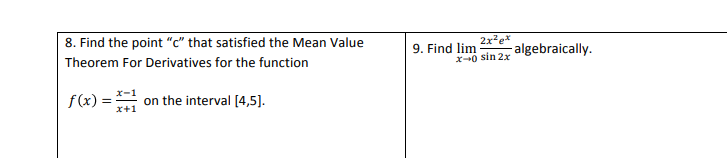
for 7 you just need to take the derivative of the perimeter equation wrt t and plug in dp/dt to solve for dr/dt for 8 solve for c where f'(c) = 0 you will need to take the derivative of the function
kaylak:
@Shadow I got the derivative but what do I do next?
Vocaloid:
You are given dp/dt and r Take the derivative, plug in dp/dt and r, solve for dr/dt
Vocaloid:
perimeter of a circle = 2pi*r dp/dt = 2pi * dr/dt
kaylak:
for dr/dt do I plug in radius/time?
kaylak:
could you help me get these solved before 2. I have a meeting today
kaylak:
8. I have the derivative 2/(x+1)^2
kaylak:
@v
kaylak:
@Vocaloid
kaylak:
@Ultrilliam
kaylak:
@Angle
 Angle:
which one are we still stuck on?
kaylak:
7 and 8
kaylak:
do you see them? or do I need to repost
Angle:
I see them what do you have so far? for 7, you have the equation for the perimeter of the circle which is P = 2*pi*r and vocaloid has pointed out that taking the derivative in terms of time gives dp/dt = 2pi * dr/dt
kaylak:
I have that part do I plug in or what do I do next
Angle:
[honestly it's been a while since I have done a related rates problem] I think you are given that the "rate of change for the perimeter in terms of time" (i.e. dp/dt) = 3 so you plug in dp/dt = 3 and get dr/dt
kaylak:
okay so .48 makes sense
kaylak:
8?
Angle:
we start off with finding f(4) = ? and f(5) = ?
kaylak:
I have the derivative 2/(x+1)^2
kaylak:
I would think so yes
Angle:
ok ok so for this problem we want to find the slope between f(4) and f(5) then find the point between 4 and 5 that has the same slope so first step is to find the slope between f(4) and f(5)
Angle:
once you find that slope, you set the derivative equal to that number and solve for x so 2/(x+1)^2 = slope and solve for x
kaylak:
do you thinl I should graph it to find F(4) and 5
Angle:
I think you can just plug in? like f(4) = (4-1)/(4+1) = 3/5 f(5) = (5-1)/(5+1) = 4/6 = 2/3 so slope = (y2 - y1) / (x2 - x1) = \(= \frac{(2/3) - (3/5)}{5-4}\) = ?
kaylak:
got it ty
kaylak:
4.48
Angle:
perfect :)
Join our real-time social learning platform and learn together with your friends!
 KBaby:
Verse 1 We left our names in the dust of the driveway Watched the old town shrink
KBaby:
Lyrics Generator Use AI to write the lyrics for a song. Suggested Genres: Pop Hip
KBaby:
Verse 1 We left our names in the dust of the driveway Watched the old town shrink
KBaby:
Lyrics Generator Use AI to write the lyrics for a song. Suggested Genres: Pop Hip
 aitexturegenerator:
How are you all handling AI-generated textures for 3D models and game assets without losing the hand-made feel? I've been doing a small stylized environment
aitexturegenerator:
How are you all handling AI-generated textures for 3D models and game assets without losing the hand-made feel? I've been doing a small stylized environment

 Demon25:
Woke up feeling like that girl and that dude well he still aint crap pluse the du
Demon25:
Woke up feeling like that girl and that dude well he still aint crap pluse the du
 playtsec:
how do I get rid of stress from teachers... I just feel like running out the classroom and leaving on my own.
playtsec:
how do I get rid of stress from teachers... I just feel like running out the classroom and leaving on my own.
 JohnnyLFowler0812:
What type of gamer would play something and then get off for a while. Why not sta
JohnnyLFowler0812:
Which is better? Metallica Rap Country R&B hiphop Medal Gospel Chill Which 3 opti
JohnnyLFowler0812:
What type of gamer would play something and then get off for a while. Why not sta
JohnnyLFowler0812:
Which is better? Metallica Rap Country R&B hiphop Medal Gospel Chill Which 3 opti